Showing posts with label Sofia Pension. Show all posts

Monday, 15 November 2010

Greece 2010, Thumbs-down for Ixian Grand Hotel but Thumbs-up for Booking.com


On the day we arrived at the Sofia Pension there was a message from Booking.com to get in touch. I did so immediately and was told that there was a problem with our next hotel, the Ixian Grand in Ixia, which we had chosen for our last two nights, because due to a mix up they were double booked and they couldn’t therefore fulfill our booking. We were disappointed about that because we had been looking forward to stopping in a four star luxury spa hotel but now it was cancelled and there was nothing we could do about it.

Actually I never believed it for one minute because we had booked the room nearly three months ago and I suspect that what really happened was that they had received a better offer or had had to find accommodation for one of the holiday package companies and although it was nice of them to offer me an alternative, once I had established that there would be no cancellation charge, I turned it down out of principle and immediately called the Caravel where we had stayed for the first two nights and arranged accommodation there for only €50 a night.

I was surprised however when I checked my emails in a bar a couple of days later that there was correspondence that suggested I had been charged by the Ixian Grand a €135 on night’s cancellation fee and there was an explanation that this was my fault because I had not accepted their alternative. Naturally I was fuming but could do nothing about it until I could visit the Ixian Grand in person a couple of days later.

So I resolved that this would be my very first job when we returned to Ixia in a couple of day’s time. On the last morning we had a final breakfast and said our farewells and then we walked to the bus stop. The sensible thing to do was to call a taxi but I argued that this would be a waste of money so we took the cheap option instead. Kim complained most of the way because it was uphill, the cobbled pavements made it difficult to drag her suitcase and it really was quite hot. By the time we reached the bus stop I was feeling quite guilty but the bus arrived quickly and soon we were booking back into the Caravel and being allocated room 101 again and while we waited for it to be ready we had a drink in the bar with the 15% discount for guests.

While Kim rested I went looking for the Ixian Grand fully prepared to trash the place if I had to! It wasn’t far away and to be fair it was very busy. At the reception I introduced myself and demanded an explanation and whilst they stuck to their double booking lies they did agree that I shouldn’t pay a cancellation fee and they assured me that they wouldn’t so there was no need for any rough stuff after all. (When I returned home, just to be doubly sure, I emailed them and once again, to be fair, they quickly confirmed that there would be no charge).

Before I left I had a little look around the place and to be honest I was rather glad our booking had been cancelled. The pool area was busy, the lobby bar was expensive and the restaurant was corporate and pretentious and I was pleased that we were at the Caravel instead.

So, thumbs-down to the Ixian Grand but a big thumbs-up for Booking.com. I was really impressed that after I hadn’t responded to an email notification that they took the trouble to track me down at the Sofia Pension and make sure that the matter was resolved. I think good customer service generally deserves a mention and my favourite hotel booking web site certainly didn’t let me down on this occasion!

Wednesday, 10 November 2010

Greece 2010, Rhodes Town and an Unexpected Dinner Invitation


We enjoyed three days staying in the city and made a couple of other visits as well, the harbour was bustling with activity and although we didn’t especially like the new town the old town was spectacular with a castle and city walls, old churches and an abundance of historical sites. We explored the back streets and the ruins, some of which were the result of British bombing in 1944 which made us feel guilty.

On the first morning we woke early and went to the Street of the Knights because this is one of the best preserved/restored medieval streets in Europe and we wanted to get there before the crowds. As soon as the cruise ships arrive and discharge their guests onto the quayside hundreds of people make straight for this place and it immediately loses its atmosphere and its charm. At eight o’clock in the morning however there was no one about except the odd delivery man and it was possible to soak up the medieval ambiance of the place.

All of this medieval history is here on Rhodes because in 1309 the Island was occupied by forces of the Knights Hospitaller and under the rule of the newly named ‘Knights of Rhodes’ the city was rebuilt into a model of the European medieval ideal. Many of the city’s famous monuments, including the Palace of the Grand Master, were built during this period. The citadel of Rhodes, built by the Hospitalliers, is one of the best preserved medieval towns in Europe, which in 1988 was designated as a UNESCO World Heritage Site.

Gradually however the strong walls which the Knights had built came under siege and withstood the attacks of the Sultan of Egypt in 1444, and of Mehmed II in 1480. Ultimately, however, Rhodes fell to the large army of Suleiman the Magnificent in 1522 and the surviving Knights were permitted to retire to the Kingdom of Sicily before later moving their base of operations to the strategically placed island of Malta. The Knights had ruled the island for two hundred years but Rhodes was thereafter a possession of the Ottoman Empire for nearly four centuries and during this time the city acquired a characteristic eastern and Turkish culture and style.


In the nineteenth century the decline of the Ottoman Empire resulted in the general neglect of the town and its buildings, which further deteriorated due to strong earthquakes and in 1912, Italy seized Rhodes from the Turks. Under the terms of the Treaty of Lausanne, the island, together with the Dodecanese, was officially assigned to Italy.

The Italians would later demolish the houses that were built on and around the city walls during the Ottoman era. They also turned the Jewish and Ottoman cemeteries into a green zone surrounding the Medieval Town and whilst they preserved what was left from the Knights’ period they destroyed all of the Ottoman buildings. During the Second-World-War, following the Italian Armistice of September 8th 1943, the British attempted to get the Italian garrison on Rhodes to change sides but this was anticipated by the German Army, which succeeded in occupying the island. In 1948, together with the other islands of the Dodecanese, Rhodes was united with Greece.

In the morning we visited the City museum which was fascinating but had rather too many old pots to keep my interest for very long and an hour was long enough for both of us so we walked around the harbour and under the city walls around the gardens in what was once the defensive dry moat. We had learnt to say no with some authority by now and dodging the persistent waiters we explored the much quieter Turkish quarter before finding a bar with a shady spot for a lunch time drink.

Later in the afternoon while I sat on the terrace with a book Kim went to a Turkish bath for an exfoliation and a massage but I declined to join her because if truth be known I am quite attached to my dead skin and by this time I was nine days into a self cleansing experiment and a good scrubbing would have ruined it.

In the early evening we sat chatting to some people, a New Yorker and a young woman from Lichtenstein who worked together in Luxembourg as investment bankers and a student from Bosnia who studied at the University there. They were young show-offs really and I couldn’t help wondering why they weren’t at work sorting out the banking crisis that people like them at created rather than sitting around on holiday in Rhodes sailing and scuba diving but chatting to them turned to our advantage when we received an unexpected dinner invitation.

The room owners Sofia and Phillip were cooking for them and as they prepared the tables they invited us to join them for a home prepared meal of dolmades and possibly the best beef stifado we have ever tasted. We had an excellent meal and swapped increasingly boastful travel stories and Sofia told us all about Greek cuisine. We have the recipe for the stifado but we are pessimistically certain that it will take some recreating to achieve that authentic taste.

Monday, 8 November 2010

Greece 2010, Lindos to Rhodes


There was no particular rush to leave Lindos and we planned to catch the eleven o’clock bus to the city and this gave us plenty of time to have breakfast on the terrace and then settle up. We didn’t anticipate the problem however with the credit card payment machine which eventually managed to charge me three times and required the owner to attend from somewhere in the village to straighten matters out, a process which used up most of the spare time that we had factored in.

It took an hour and ten minutes to get back to Rhodes using for most of the journey the same road that we had taken to drive to Lindos three days earlier but on this occasion thankfully bypassing Falaraki and Kalathea and arriving at just about lunch time. From the bus stop we walked through noisy Ippokratous Square and back to the little taverna where we had had lunch on the first day for a drink, a short rest and some map interpretation. It turned out that the Sofia Pension wasn’t that far away and after our drink we found it easily within ten minutes.

Our accommodation in Rhodes turned out to be first class, functional and unexciting from the outside but with a well furnished room and a delightful walled garden and sun terrace inside. It was situated inside the old town walls barely a hundred metres from the boisterous main shopping street of Socrates and busy Ippokratous Square but was surprisingly quiet set in a labyrinth of narrow alleys and shady lanes and squeezed in between the old Turkish quarter with its abandoned Mosques and erect minarets piercing the perfect blue sky on the one side and the run down old Jewish quarter on the other. The friendly owner showed us to a nice traditional room with good air conditioning and outside a nice shady terrace with tumbling vines, the aroma of mimosa and jasmine and randomly placed pots of vibrant geraniums.

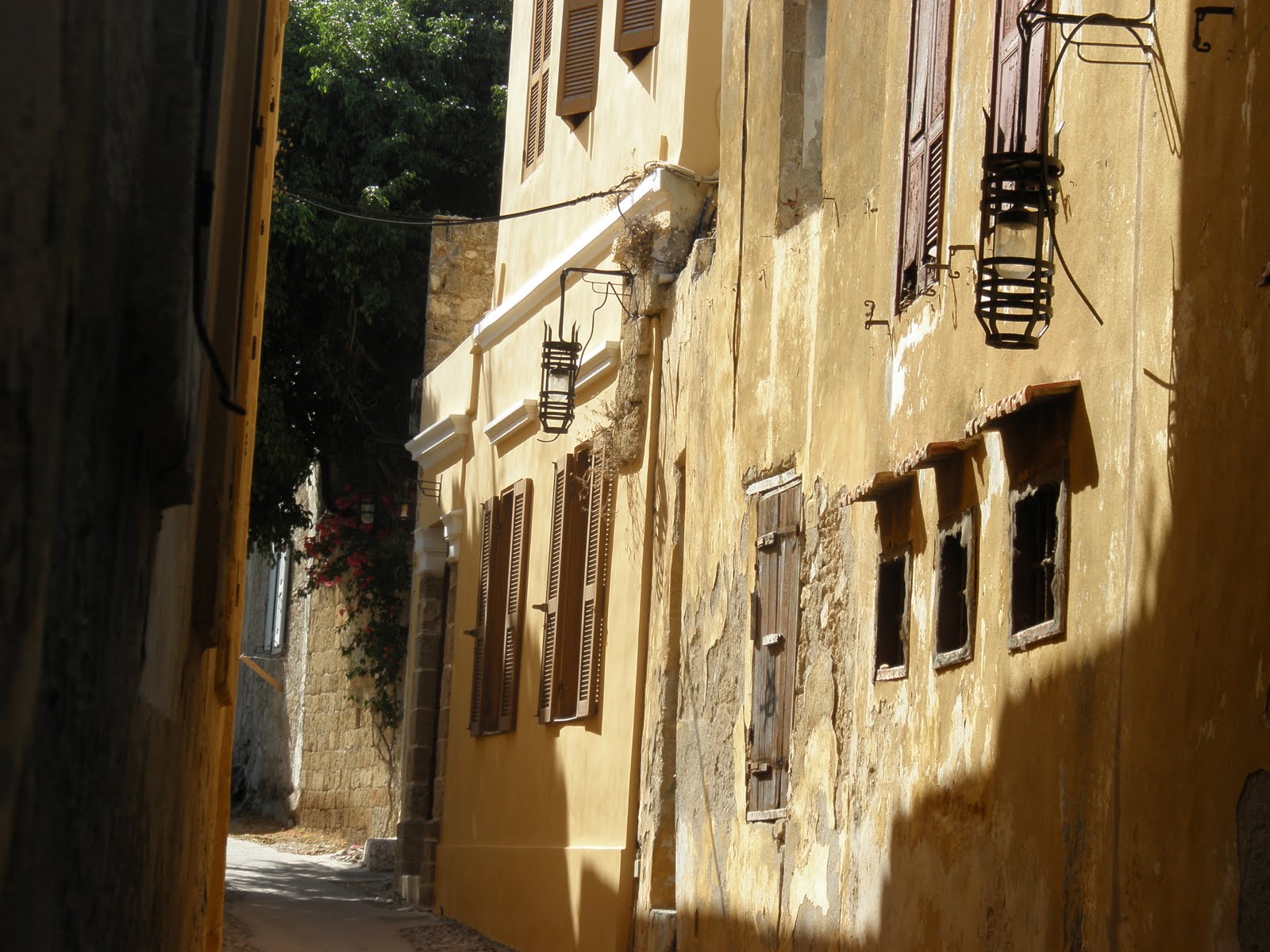
The island of Rhodes is probably one of the most fascinating of all Greek islands. It has been inhabited for six thousand years and due to its unique geographical position on the major Mediterranean Sea trade routes is at a crossroads between Europe, the Middle East, and Africa and this has given the city and the island many different identities, cultures, architectures, and languages over its long history. In the afternoon we went for a stroll through the back streets of the old town; cobbled, narrow, twisting and moody with long shadows thrown down by the tall stone buildings next to narrow looping lanes and intriguing alleyways. It was like being transported back six hundred years and it was almost possible to imagine the medieval knights swaggering, bullying and clanking through the streets. In this quieter part of the old town there were shops and tavernas but also artisans houses and small workshops next to people’s houses where whole families seemed to be living in a single room and if this wasn’t cramped enough then sometimes even shared with a motorbike or scooter as well.

Eventually we left the back streets and emerged on Socrates Street where shops were doing brisk trade selling to the rich people from the cruise ships. At a shop selling silks and fabrics Kim stopped to take a picture and was immediately chastised by the owner for not asking permission. He demanded €10, she laughed and he chased away down the street in a whirlwind of hand gestures and chattering chastisements.


Tired of the continuous uninvited attention of the traders and the waiters trying to generate business we made our way back into the warren of back streets and through the Turkish Quarter which not surprisingly all felt a bit eastern and oriental with shops selling carpets, hookahs and Turkish coffee. We walked through arches and buttresses, past turrets and balconies and occasionally a little oasis of green amongst the dusty streets and then interesting narrow roads and every one with a surprise around each crooked turn.

In the late afternoon we walked to the top of the town and climbed to the top of the restored clock tower next to Sulliman’s Mosque for some good views of the town and the harbour. There was an entrance charge of €5 but that turned out to be good value because the price included a drink in the roof top bar terrace where we sat and enjoyed the views.

The rest of the day was spent on the terrace and as evening approached we slipped again into the back streets behind the hotel and had an unhurried evening meal in a pleasant little restaurant close by. I must have had too much wine because on the way back to the room I showed unusual amounts of interest in some cheap glass necklaces and Kim took advantage of this momentary slip up on my part and spent some time choosing and then purchasing three when she didn’t really need any.