Showing posts with label Norway. Show all posts

Saturday, 26 March 2011

Norway, Haugesund Museum


On the way back it started to rain again so we quickened our pace and returned to the hotel and made for the tea machine and the television lounge. Twelve o’clock was checking out time so we completed the formalities and then wondered what to do. The city museum, that was closed yesterday, was open from midday today but I couldn’t persuade Kim to step out in the drizzle for a second time so I left her in the comfy chair next to the log fire and went back out by myself.

I wasn’t expecting a great deal I have to say but it was something to do for an hour or so and I walked back and went inside the rather grey and boxy utilitarian building. It wasn’t very busy and an attractive young museum attendant greeted me in Norwegian which meant nothing to me of course so I just said that I would like to visit the museum. ‘You speak English’ she asked, ‘I am English’ I replied and she gave me a quizzical look that asked what I was doing there so I felt obliged to offer an explanation about cheap flight opportunities and never been to Norway before etc. and she seemed genuinely pleased to see me and in perfect English explained about the museum and suggested that I might find it nice to return in the summer.

After paying the 3 kroner entrance fee I went to the first room that had old photographs of Haugesund and little models of the town showing its development over the last hundred years or so and I wondered just how long I could make this last because I wasn’t sure what to expect to find in a Norwegian provincial museum.

Famous Norwegians perhaps? The country is of course well known for its explorers, Leif Eiriksson, the Viking who was the first European to discover the New World in 1001 (not Christopher Columbus, five hundred years later), Roald Amundsen, the polar explorer who beat Captain Scot to the South Pole in December 1911 and Thor Heyerdahl who set out on many risky ocean voyages in traditional sailing craft just to prove that it could have been done. In the arts there is the painter Edvard Munch, the writer Henrik Ibsen and the musician Edvard Grieg.

Johan Vaaler invented the paper clip and secured his patent rights in Germany in 1899. He was granted an American patent in 1901 with the description: ‘It consists of forming same of a spring material, such as a piece of wire, that is bent to a rectangular, triangular, or otherwise shaped hoop, the end parts of which wire piece form members or tongues lying side by side in contrary directions.’

The cheese-slicer is also a Norwegian invention. In 1927 Thor Bjørklund had his lunch break in his carpenter-workshop at Lillehammer. He was pleased when he discovered four slices of bread with gouda-cheese but it was a hot day and the heat had caused his cheese to melt. He didn’t have an appetite for it all so he tried to divide the slices of cheese so that he didn´t have to eat it all. At first he tried the knife and that didn´t work and then (allegedly) he tried the saw. That didn´t work either so he found his plane that he had been using recently to slice some wood and it worked perfectly well. It was a bit difficult and clumsy to use however and he decided to make a smaller version. Neighbours and friends loved his cheese slicer, so he had to make one for them too and eventually he took out a patent on his invention.

There was no mention of any of these people but in the second room there was an impressive story of local farming through the ages, display cabinets with old tools, agricultural implements and old farm photographs. Because Norway with eighty-three thousand kilometres of coast (including fjords and islands) is a seafaring nation there were a couple of rooms about ships and shipping both old and new and the final room had recreations of the interior rooms of traditional Norwegian houses.

Interestingly there was nothing in the museum about the war because in Norway this remains a sensitive subject. The country was occupied by Nazi-Germany and, like elsewhere in Europe, some people suffered as a result of the occupation. Women who had relationships with German soldiers were persecuted after the war. Even the children who were born and had a German father (lebensborn), were subsequently discriminated against. Norwegians who co-operated with Nazi-Germany were called “quislings” which is equal to “traitor of the Norwegian nation”, named after Vidkun Quisling. Quisling served as Minister-President of the collaborationist Norwegian government, after being appointed by the German authorities. After the war he was tried for high treason and executed by firing squad. Today in Norway and other parts of the world, quisling is a synonym for traitor.

As it turned out I wasn’t disappointed by the museum at all and a spent an interesting hour looking around the exhibits. I walked back to the hotel where we watched television and counted down the clock until waffle time and shortly before three o’clock the batter arrived and we had a snack just ahead of the taxi arriving at quarter past.

It arrived dead on time and we set off for the airport. It seemed to take a long time to drive the sixteen kilometres but the driver was being very careful because speeding fines are very high in Norway and if caught exceeding the limit the penalty can also include a spell in prison. The journey took twenty minutes and cost £40 (as much almost as the cost of the eight hundred mile each way flights) and at Norwegian prices that probably wasn’t even a rip-off!

This was unfair but I wasn’t desperately sad about leaving Norway. Unfair because Haugesund is probably a much better place to visit in the summer when the days are longer and the place enjoys relatively good weather so I think we will have to return at a different time of the year. By a twist of fate as we sat waiting for the flight the clouds broke up and at the end of daylight hours a blue sky opened up to greet the plane and the next set of visitors enjoying a cheap flight bargain to a place they have never heard of.

Tuesday, 22 March 2011

Norway, Haugesund and the Vikings


Sure enough, in the morning, it was still raining and over the first cup of tea of the day there developed an awful realisation that this might turn into a ‘killing off time’ sort of day. We took our time getting ready for the day and then stretched breakfast out for as long as we could and discussed our rather limited choices. I could read but Kim hadn’t brought a book with her and didn’t fancy my spare one which was a rather heavy going ‘history of modern Spain’ so a library morning also seemed to be ruled out.

As we lamented the weather and talked through the options however the rain started to ease off and by half past ten, although it had not stopped completely it was at last possible to go outside.

It was another depressing morning, the city crippled under the weight of a leaden grey sky, as we set out in a northerly direction along the black granite coast towards Huagesund’s most famous visitor attraction, the Haroldshaugen Norges Riksmonument a couple of kilometres outside of the city. We joined a handful of local people in brightly coloured ‘North Face’ kagools and hiking boots who were wandering along the coast line cinder path stopping occasionally for no apparent reason to stop and stare out into the grey nothingness of the North Sea.

We found the monument and it struck me as a bit strange for an Anglo-Saxon to be visiting a monument that commemorates the Viking Age and a starting off point for longships full of heathen bullies on their way across the North Sea to rape and pillage a part of England where I now live.

The Vikings were Norse explorers, warriors, merchants, and pirates who raided, traded, explored and settled in wide areas of Europe and the North Atlantic from the late 8th to the mid 11th century. These Norsemen used their famous longships to travel as far east as Russia, and as far west as Newfoundland, and as far south as modern Spain in a period known as the Viking Age.

Whilst we tend to retain the school boy image of them it actually becomes increasingly evident that Viking society was quite complex and popular conceptions of them are often in conflict with the truth that emerges from archaeology and modern research. A romanticized picture of Vikings as noble savages began to take root in the eighteenth century, and this developed and became widely propagated for over a hundred years. The traditional view of the Vikings as violent brutes and intrepid adventurers are part true, part fable but no one can be absolutely sure of the accurate ratio and popular representations of these men in horned helmets remain for now highly clichéd.

Haraldshaugen was erected during the millennial celebration of Norway’s unification into one kingdom under the rule of King Harald I and was unveiled on July 18th 1872 by Crown Prince Oscar to commemorate the one thousand year anniversary of the Battle of Hafrsfjord. Truthfully I found it a bit disappointing I have to say, a seventeen metre high granite main obelisk surrounded by a memorial stones next to an deserted car park, a closed visitor centre and an empty vending machine but I’m sure I am being unfair because places such as these are not really meant to be visited in January.

We walked back along the same route and into the suburbs of the city which felt a bit like a deciduous tree coping with winter; existing, hibernating, waiting, watching for the first signs of spring. The people with pale complexions, weary streets, grass burned brown by frost and houses battered and besieged and firmly closed to the outside world, a city beaten to the edge of submission by winter and still only part way through.

Monday, 14 March 2011

Norway, Bjørge Lillelien, Football and other Sports


The rain showed no sign of easing off so we settled in to an afternoon of sport on the satellite television which was promising a full afternoon of English Premier League football. I sampled the first can of Frydenlund and was pleased to discover that it was very nice indeed and then sat down for the match. I suppose they have to show English, German and Spanish matches because Norway doesn’t have a much of a football team themselves and although they are big hitters in the economic and social world league indexes their football record in World and European cup competitions is nothing much to brag about. They compensate for this however by having possibly the most famous bit of football commentary ever.

The Norwegian broadcaster Bjørge Lillelien most famously reported on Norway’s unlikely 2-1 victory against England in a World Cup qualifier in Oslo on 9th September 1981. At the end of the match he was almost hysterical, no, he was completely hysterical and, alternating between English and Norwegian, he screamed into his microphone:

“We are best in the world! We have beaten England! England, birthplace of giants”,

And he followed this up by taunting a roll call of famous English people:

“Lord Nelson, Lord Beaverbrook, Sir Winston Churchill, Sir Anthony Eden, Clement Attlee, Henry Cooper, Lady Diana we have beaten them all, we have beaten them all! Maggie Thatcher, can you hear me? Maggie Thatcher your boys took a hell of a beating! Your boys took a hell of a beating!”


Away from football interestingly Norway has a national cricket team that are ranked a credible thirty-eighth in the World, out of one hundred and five and a rugby team that is not so successful being ranked eighty-sixth out of ninety-four.

I didn’t get to watch the football match however because as we sat in the lounge the sky brightened a couple of shades of grey and the rain stopped so not having travelled eight hundred miles to Haugesund to watch television we found our coats and returned to the streets. Taking the bridge across the water we walked to the island of Risøy where behind a couple of streets of timber clad houses there was a large ship building yard and dry dock and in the middle and dominating the skyline was a massive blue building which turned out to be the biggest indoor shipping repair facility in Norway.

The wind buffeted us about and rearranged our clothing as we crossed back over the bridge and slipped into the shelter of the shopping streets again. Old photographs of Haugesund show Haraldsgate as a row of attractive timber buildings but over the years some of these have disappeared and have been sadly replaced with later inappropriate concrete and glass additions, a bit like any modern English town scarred forever by 1960s town planners. A lot of the wooden buildings looked in need of some urgent attention after the winter offensive had attacked the external finishes and the timbers. At home I like to paint the woodwork on the house every ten years or so whether it needs it or not but here I expect it is an annual chore.

It was still light and dry so we went on a rather pointless walk to a pretty church and then returned to the warmth of the hotel via the waterfront. We opened the wine and I had a second Norwegian beer, taking care to enjoy every expensive drop and when the waffle machine was wheeled into action at three o’clock we were first in the queue at the trough of batter mix and prepared ourselves a tasty snack.

On the top floor of the hotel there was a fitness centre and relaxation room so in the late afternoon we planned to sweat off the calories from the waffles in the sauna. We had the place to ourselves which was nice but overall it was a disappointing experience because even at maximum heat the temperature was only marginally warmer than I generally like my front room to be on a winter’s day. It certainly wasn’t making us sweat or casting off calories so we stayed for a short while, played on the fitness equipment for an even shorter while and then went back to our room where we sat and listened to the rain steadily falling. We finished the Norwegian beer and I instinctively knew that I should have bought more.

Our second evening buffet at the hotel Amanda was sadly not as good as the first, we had planned to make ourselves a prawn cocktail but without prawns this just wasn’t possible and there was no hot meat selection tonight either so we had to make do with something very similar to breakfast but without the eggs and bacon. Tonight the dining room was busy with Norwegian guests most of whom looked as though they were attending a tribute band retro rock concert, especially the men with their pony tails and platted beards. We were the only English people in the hotel and the Norwegians treated us with a sort of arms length curiosity because they were probably wondering what on earth we were doing there.

It was pouring with rain now so this ruled out any evening walk option so instead we made ourselves comfortable in the lounge, claimed possession of the television remote controller which put us in charge of channel selection and choose an English speaking film. Some Norwegian guests turned up but didn’t stay and this time unlike the Scott of the Antarctic arriving second at the south pole after the Norwegian Roald Amudsen, this time the English were there first and we were staying put.

By the end of the movie it had stopped raining but we were warm and comfortable and after a few glasses of wine we were had no real enthusiasm for stepping outside again today so we called it a day and went to bed worrying about tomorrow’s weather.

Wednesday, 9 March 2011

Norway, Vinmolopolet and Marilyn Monroe


To be honest the shops weren’t that thrilling but we did stop at a co-op supermarket to see what sort of things Norwegians eat and how much they pay for them. We had some difficulty in understanding the prices and everything seemed horribly expensive but then we realised that a box of cornflakes couldn’t possibly be £25 so finally understood that prices were in øre which is a hundredth of a krone and effectively therefore the equivalent of a penny or a cent.

Continuing along Haraldsgate, even at midday it was still quite dark and although the Christmas lights were still twinkling this did little to lift the gloom and the overall impression on this mid January Saturday that this is a town teetering on the edge of dullness. An indoor shopping centre was a little more lively and on the third floor I found the state liquor store.

I had imagined that the Vinmonopolet store would be a seedy and secretive sort of place where people might be half ashamed to be caught shopping but it was not like that at all. It was probably the best laid out shop in Haugusand which was in keeping with the stated aspiration of the Government owned enterprise to be ‘the world’s premier wine store’. Out of curiosity I took a look around the shelves and for research purposes only compared the prices to those we would expect to pay at home and I imagine that at £50 for a bottle of gin or vodka and an average price of £15 for a bottle of wine that this place probably easily achieves the Government policy to set high price controls to limit the drinking of alcohol.

We didn’t spend much longer in the shopping centre and were soon back on the main street where we noticed that the people seemed to be outnumbered by the statues. Every few metres there was a bust or a figurine of some kind or another and I was left with the impression that the city council must spend a considerable amount of its budget on sculptures and street art. At the end of Haraldsgate we came to a paved public square and behind it the town hall itself which is an imposing neoclassical building painted a surprising and, in my opinion, inappropriate shocking pink!

There were a few spots of rain now so we headed back in the direction of the waterfront and the hotel just in case we might have to make a run for cover and down at the harbour side we came across a statue of a young and flirty Marilyn Monroe. The reason it seems that she should surprisingly turn up here is that her father, Martin Mortensen, came from the village of Skjold, just twenty kilometres away and lived in Haugesund before emigrating to America in about 1880. After abandoning his family after only six months of marriage, he was killed in a motorcycle crash without ever seeing his daughter – Norma Jean Mortensen.

The rain was getting heavier so as we had been walking for a couple of hours or so we went back to the hotel to shelter. Another really good thing about the Hotel Amanda was complimentary tea and coffee throughout the day so we were saving money all the time as we sat in the lounge to warm up and enjoyed a hot drink. I usually prefer a beer at about this time when I am on holiday and because I thought it was rude not to sample a genuine Norwegian brew I slipped back to the co-op and bought three cans at a massive £3 each and returned with my purchases just hoping that the Frydenlund pilsner and the original Hansa Fatøl would be worth every øre.

Monday, 7 March 2011

Norway, A Land of Plenty – Some Facts and Figures


Norway, or officially (on account of being one of the ten European Monarchies) the Kingdom of Norway, is a Nordic country occupying the western part of the Scandinavian Peninsula, as well as Jan Mayen and the Arctic archipelago of Svalbard. It has a total area of 386,269 square kilometres and is the fourth largest country in Europe after France, Spain and Sweden. With a population of only about 4.9 million however it is one of the most sparsely populated countries in Europe. The majority of the country shares a border to the east with Sweden, its northernmost region is bordered by Finland to the south and Russia to the east, and in the south Norway borders the Skagerrak Strait, facing Denmark.

In the morning by a minor miracle the rain had stopped and the pavements had been dried off by the piercing wind so when we woke and discovered this we were hopeful of a dry day. Just to satisfy ourselves we searched the Norwegian breakfast television channels for a forecast and after a few minutes surfing eventually found one. The weather man appeared in front of a map full of symbols and, I don’t know why she did this, but Kim turned up the sound so that we could hear what he was saying! I think she failed to take into account that whatever it was he was telling it in impenetrable Norwegian. I asked her why she did that and she said that she thought it might be helpful!

Breakfast turned out to be an excellent affair with a good cold buffet and a hot egg and bacon selection as well. There was a lot of chopped up fish, which, quite frankly, I wasn’t tempted by and some Norwegian brown cheese, which is apparently quite popular in Norway, so I tried some and regretted it almost immediately. I think brown cheese is what you call an acquired taste and quite clearly two days was not going to sufficient time to get anywhere close.

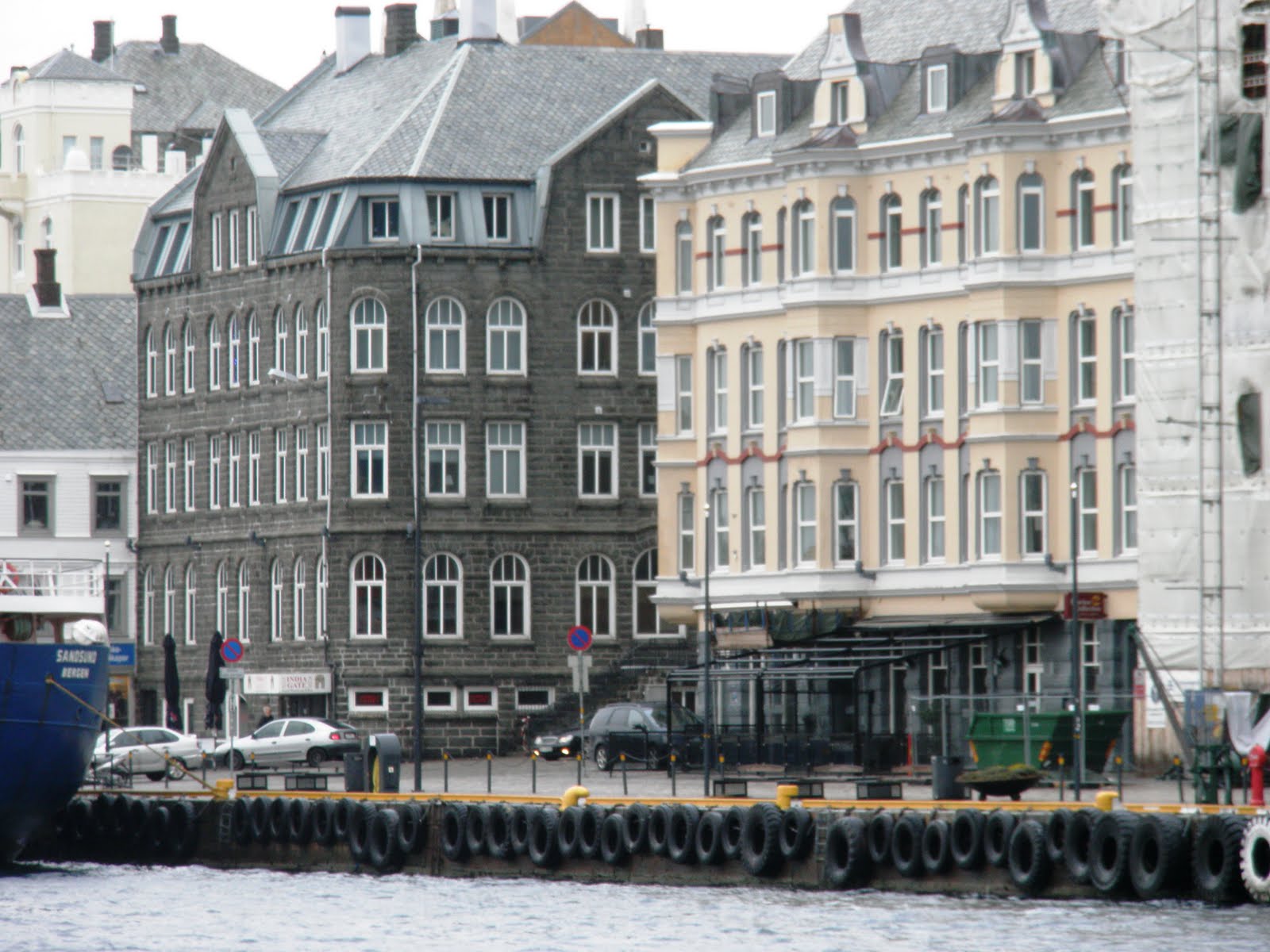
It was ten o’clock by the time we were ready to leave the hotel and we stepped out into a drab world of semi-darkness that was just overwhelmingly grey and sad. Under a blue sky the gaily coloured buildings would have looked cheerful I am sure but under a somber sky it was most depressing. We walked along the waterfront past boats bobbing gently on the calm waters and except for the occasional piercing squawk of a seagull it was eerily quiet for a Saturday morning. There was a bridge to walk over to an adjacent island and as we climbed to the top the sharp wind clawed at our faces and fingers and on the other side it was cold, austere and closed so we turned around and walked straight back.

Although the wind was sharp it wasn’t as cold as we might have been expecting because south east Norway despite its northerly latitude has a relatively mild climate because of the warming effects of the North Atlantic Drift. To put things in perspective St Petersburg in Russia is on the same line of latitude but you wouldn’t want to go out without your scarf and gloves there in mid January where average temperatures are much lower.

The best thing to do was to walk back towards the centre and soon we were on Haraldsgate, the main shopping area and the longest pedestrianised street in Norway but even though it was the weekend the streets were empty and the shops were seriously short of customers. They all had January sale signs offering juicy discounts but even with 50% reductions most of the goods were still very expensive in comparison with the United Kingdom.

The prices were not really a surprise and we could tell of course that we were in a special place because from 2001 to 2007 Norway was ranked highest of all countries in human development and, overtaken briefly for a short time by Iceland, then again in 2009 and 2010. The Index ranks countries by level of ‘human development’ and the statistic is composed from data on life expectancy, education and per-capita gross national income.

Also in 2010, as well as being top in the Human Development Index, the World Economic Forum deemed Norway the fourteenth most competitive country in the World and in a separate exercise the country was rated the fifth most peaceful country in the World in a survey by Global Peace Index. This is produced by the Institute for Economics and Peace and developed in consultation with an international panel of peace experts from institutes and think tanks with data collected and collated by the Economist Intelligence Unit (so with all those boffins working on it, it must be right!). New Zealand was top and not unsurprisingly Iraq bottom.

Norway is a parliamentary democracy and constitutional monarchy, King Harald V is the head of state and according to the Democracy Index Norway is also the World’s most democratic country. The index is compiled by the United States based Economist Intelligence Unit and measures the state of democracy in one hundred and sixty-seven countries and is based on sixty indicators grouped in five different categories: electoral process and pluralism, civil liberties, functioning of government, political participation and political culture. No surprises again down at the bottom but this time it was North Korea.

But let me now bring the Norwegian people back to earth and remind them that, despite these impressive successes and accolades, the country also holds the unfortunate distinction of having scored the most ‘nul points’ in Eurovision Song Contest history – four times in all, and that is what I call humiliating. They have also been placed last ten times, which is also a record, but one that no one else really wants!

Wednesday, 2 March 2011

Norway, Haugesund and the Hotel Amanda


We were flying north in Europe for only the second time after Iceland in 2007 and after we crossed the North Sea the plane approached the rugged and heavily indented Norwegian coastline and crossed a scattering of ghostly islands and through the darkness we could just about make out small hamlets and villages clinging determindly to the granite rocks. As the plane dropped lower and lower on its final approach we could see boats swaying in the water and waves crashing against the shore – we seemed to be dangerously close to the water but then we hit tarmac and with only a short runway the pilot hit the brakes in what seemed to be a bit of an emergency stop. It wasn’t of course and everything was under control and soon we were leaving the aircraft and heading for the small terminal building.

Ryanair weren’t making a big profit out of this flight because there were only forty passengers on the plane which was probably a good indication that Norway in mid January is not a popular tourist destination and once through duty-free and passport control thirty-seven got on the bus for the three hour journey to Stavanger which was an even bigger clue that Haugesund is not on many people’s itinerary as a tourist destination.

After a short wait the bus driver finally conceded that there were no more passengers and set off towards Haugesund along heavily salted roads with piles of cleared grit stained snow and ice piled up on either side. We could see the lights of the city and a ring of snow streaked mountains in the background and soon the bus passed out of the bleak countryside and into the streets of the city and after just a short wait at the main bus station the driver, who had a strange 1970s retro haircut, obligingly went off route to drive us to our hotel down on the waterfront.

The Hotel Amanda was warm and welcoming with a log fire burning in reception and as Haugersund is home to the annual Norwegian film festival the whole place had a movie theme with appropriate memorabilia and every room named after a famous film. We would have liked the Gladiator suite but we were allocated Shane, named after the famous 1953 Alan Ladd western, which although not as exciting as Ben Hur or Spartacus was better than the Rosemary’s Baby room on the opposite side of the corridor because I could have guaranteed nightmares if we had been sleeping there. I can’t imagine what sort of sick mind would have thought that was a good idea for a hotel room name?

In the hotel dining room there was a help yourself waffle maker so we tried that and a glass of the duty free wine and as we sat in the window it began to spit with rain and soon it was coming down really hard driven into shore by a strong wind off the North Sea. We attempted a short walk but it was that sort of driving rain that an umbrella cannot protect against and after only a few metres our coats and trousers were getting soaked so we were forced to abandon any thoughts of evening exploration and return to the hotel where we sat in the room drinking wine and listening to the rain pouring down outside. It was a good job that we had brought the wine with us because a small bottle in the mini bar was a ludicrous 85 krone, nearly £10.

And there were more price shocks to come when we investigated restaurant prices from a menu left in the room presumably for humorous entertainment. With green salads at 150 krone and a main meal an average of 300 it was obvious that dining out would be a pricey business so we were grateful therefore that the hotel rate included an evening buffet which although not very thrilling at least it wasn’t a wallet busting experience. As we dined the weather got worse as the rain turned to sleet and then to snow, back to sleet again and then full circle back to driving rain and when we finally went to bed we began to wonder how we might entertain ourselves for two days in Haugesund if it was going to continue like this.

Sunday, 20 February 2011

Norway, Europe’s Most Expensive Country


Although I have an ambition to visit all of the countries of Europe the quest has slowed down a little in the last eighteen months with limited opportunities to see new places due to several return visits to different regions of Spain, an annual holiday to the Greek islands of course and repeat visits to Poland, Germany and France. So by early 2011 and without a visit to a new European country since Estonia in December 2009, it was surely time to put this right.

One part of Europe that we have so far missed out is Scandinavia so with January Ryanair weekend flight bargains to Norway, Sweden and Denmark this was the perfect opportunity. There were a lot of destinations to pick from and after comparing all the options we finally choose Norway. We could have flown to the capital Oslo but it turned out that the airport is almost seventy kilometres from the city, which would have meant a lot of travelling in a short space of time, so we decided upon Haugesund instead, a city on the North Sea coast in between the two better known destinations of Bergen to the north and Stavanger to the south.

One of the reasons that we have tended to avoid Scandinavia is because of the notoriously high cost of living and the lofty prices relative to southern and eastern Europe but with flights at just £12 return (ok, plus the ludicrous £10 administration fee of course) we calculated that we could afford a couple of days of sky high northern European alcohol and restaurant prices without too much pocket pain.

The reason that Norway in particular is so expensive is that after World War Two, thanks to shipping, the merchant marine industry and a policy of domestic industrialisation the country experienced rapid economic growth. Then, from the early 1970s, there was further accelerated growth as a result of exploiting large oil and natural gas deposits that had been discovered in the North Sea. Today, as a result Norway ranks as the second wealthiest country in the world in monetary value, with the largest capital reserve per capita of any nation. It is the world’s fifth largest oil exporter, and the petroleum industry accounts for around a quarter of its gross domestic product. Norway has rich resources of oil, natural gas, hydroelectric power, forests, and minerals, and, after the People’s Republic of China is the second largest exporter of seafood in value. Following the financial crisis of 2007–2010, World bankers declared the Norwegian krone to be one of the most solid and reliable currencies in the world.

Because of this happy position Norway is one of the priciest countries to live in or visit and regularly features in the top five places where you can quickly run up an overdraft. For residents a high proportion of income is spent on housing and the monthly groceries for example for a typical family costs roughly £1,000. For Visitors dining out is an expensive luxury and a typical three star hotel in Oslo costs a whopping £150 a night, starting at the smallest hotel room and definitely without a balcony or a view. Alcohol, however, is the real killer (financially not medically) because the Government slaps on punitive taxes to stop people from drinking and the price of a bottle of spirits is four times that of the United Kingdom.

Norwegians can only by wine and liquor from special liquor outlets called Vinmonopolet (literally, wine monopoly) and there are normally only one or two of these in each city, depending on its size so some people living in the countryside have to travel great distances just to buy a bottle of wine or alternatively they just brew their own.
It’s not all bad news for Norwegians however because high prices go hand in hand with the country’s high standard of living. Hourly wages are extremely high to attract workers that would get the same pay in Norway’s oil or fishing industry and consequently products in the shops and supermarkets are expensive but to Norwegians, their pricey lifestyle is just something that they have come to terms with.

With budgets in mind the search for a hotel produced the highly recommended four star Clarion Collection Hotel Amanda situated right on the waterfront and at £110 a night all inclusive including evening buffet that seemed just about perfect so we had no hesitation in booking the room. On the day of departure and anticipating low winter temperatures we packed appropriately because Haugesund is just slightly further north than the Orkney Islands so we were expecting cold weather. And with alcohol prices in mind we left space for a three litre carton of red wine from the duty free shop at Stansted airport! It was a lunch time flight and with the one hour time difference we landed at Haugesund airport on the nearby island of Karmøy at half past four where due to the high northerly latitude of 59º it had already been dark for over an hour.