Showing posts with label France. Show all posts

Thursday, 26 January 2012

France, Return to Carcassonne


On the way down to breakfast the next morning, knowing how precious the French can be about their language, I attempted some simple communication with the receptionist about the arrangements for petit dejeuner. I am fairly certain that I selected the right words but graciously concede that I may not have had them in the correct order and this is an annoying thing about the French because they like you to try and speak their language, which is fair, but then ridicule you if you don’t get everything absolutely grammatically correct, which isn’t very encouraging. It’s a good job we don’t humiliate them when they mangle the English language with zis and zat and their inability to understand when and when not to use the letter H, but anyway, this woman looked at me as though I was from the very bottom of the evolutionary chain and asked with a large dollop of sarcasm if I would prefer it if she spoke English? Most Europeans are really pleased if you attempt a few words but the French really don’t like anything that they perceive as a corruption of their ‘beautiful language’ and I nodded meekly and said yes please.

It was overcast and much cooler this morning as we walked through the streets of Castres to the car park and we were glad to get in the car, turn the heater on and set off back to Carcassonne for our early afternoon flight as yesterday’s blistering afternoon temperature was fading away into a recent memory. I was fairly sure of the way to go but the Satnav lady decided that I would like to take the difficult scenic journey instead of the direct route and before we reached the main road at Mazamet she took me onto a minor road and into the Forêt de Montaud and soon we were climbing again along winding roads through a deciduous beech forest back into the Black Mountains.

I could have asked Kim to plot a more sensible alternative route using the paper map but the truth is that she isn’t too good with maps and this responsibility generally brings on a panic attack as he stares blankly at the multi coloured squiggles hopelessly looking for a clue and before she has even pinpointed our position it is generally too late because we will have missed the turning anyway. I shouldn’t really be critical because her inability with maps would be rather like me being asked to interpret a knitting pattern and she is very good at that.

I suppose this was going to save us a kilometre or two and it was quite picturesque but it was at the expense of our timetable and as we planned to drive into Carcassonne and to La Cité for a final coffee before going to the airport at a convenient junction I eventually overruled the Satnav and instead of driving deeper into the forest made for the direct route and the main highway.

We arrived in Carcassonne at ten o’clock which gave us an hour in the old fortress so we walked through the main gate and the narrow streets and made our way to the main square where it was too chilly to sit on the pavement so we were forced inside instead. While we sat with our final drink we reviewed our holiday and made a comparison between France and Spain to see if we could reach consensus on which we like best. We had enjoyed visiting this region of France but I have to say that we both agreed that we have a preference for Spain.


It isn’t fair to make that statement without some explanation so here are our reasons: First of all the centrepiece of every town and city in Spain, the Plaza Mayor, which is the first place we visit when we arrive somewhere new but there isn’t the equivalent in France; secondly, Tapas and the complimentary bowls of food in the bars and bodegas which the French don’t do and thirdly, staying with bars for a moment, the prices are much better in Spain because I can never understand the sky-high price of drinks in French bars and restaurants; fourthly I’m afraid it is back to the unpleasant subject of dog excrement because this really is a most disagreeable aspect of France.

Leaving the city we drove to the airport and returned the car and when I enquired everyone seemed to have forgotten about the refund that I was due on the rental overcharge and I had to remind the staff at the car hire office. I didn’t get the refund of course just a sort of vague promise that it would be sorted out and that was the best that I could hope for without making a scene or trashing the place.

Although the airport was tiny it had a high quality restaurant overlooking the runway and bearing in mind that the last place anyone would choose to go out to lunch in England would be Stansted or East Midlands Airports this seemed to be a popular place with local people who were arriving here by the tableful just for their lunch. As we sat by the window waiting for the plane to arrive the weather continued to deteriorate as grey sky muscled in from the west and brought some spots of rain and by the time we had passed through security and immigration control and were boarding the plane there was a downpour which gave everyone a thorough soaking as they queued to climb the aircraft steps.

Like the terminal building that struggled to accommodate all of the passengers the runway looked barely long enough to cope with a Boeing 737-800 and I noticed that the end of it curled up into an incline like you see on aircraft carriers presumably to give the plane a bit of last minute assistance in getting off the ground but the pilot got us up without incident and we quickly flew into the clouds and below us France was completely obscured from view.

Back home I contacted EconomyCarRentals.com and their customer services department told me that it would take at least twenty days to deal with the overcharging mix up but they would deal with it as soon as they could.


post script: It took nearly thirty days, several emails and a critical blog post to get it sorted but I did eventually receive my refund but I’ll think twice about using EconomyCarRentals.com ever again.


Saturday, 21 January 2012

France, Castres and Holiday Reflections


It was a lovely day now and the sun was shining as we left the hotel and first of all tranferred the car to an underground car park and then emerged from below ground into les Jardins do ‘’Evéché which were designed and laid out in the seventeenth century by the same landscape gardener who worked as part of the team on the gardens at the Palace of Versailles. The walk took us past the Hôtel de Ville and the Cathedral and down to the banks of the River Agout where we discovered the real gem of Castres.

Lining the river on the right bank were les Maisons sur l’Agout which is the old medieval riverside quarter where the old tanners’ and weavers’ half timbered houses with running balconies overhang the water and their colourful shutters and windows cast reflections on the gentle water of the river. It reminded me of Girona in Catalonia although this was much smaller in scale and rather more attractive. After we had taken more pictures than we really needed we walked over the river and along the front of these riverside houses where we could see that most of them were now restaurants and cafés with prices to match their enviable position. We did a second circuit of this old quarter and then walked into the heart of the city and the Place Jean Jaurès where there were cafés spilling out into the square adjacent to a statue of the famous French socialist politician at one end and an elaborate water fountain at the other.

We stopped for a drink here and as we sat in the hot sunshine we could see that this was a city in complete contrast to Béziers. It is the largest city in France without a motorway link which means that it is something of a relative backwater and where Béziers was in some parts grimy and uncared for Castres was smart, upmarket and busy. I also have to contradict myself here about the French and dog excrement because here the streets were immaculately clean and there was no doggy poop on the pavements at all.

After the short refreshment break we resumed our walking tour of the city and arrived at the Goya Museum at the Hôtel de Ville which has the largest collection of Spanish paintings in France except for the Louvre in Paris. Kim wasn’t keen on visiting a museum so she sat in the sunshine and I took a tour of the rooms which culminated in a special temporary exhibition of Goya’s prints titled ‘The Disasters of War’ which were sketched as a protest against the violence of the 1808 Dos de Mayo Uprising, the subsequent Peninsular War of 1808–14 and the setbacks to the liberal cause following the restoration of the Bourbon monarchy in 1814. I found this rather surprising because the prints essentially set out scenes of atrocities, starvation, degradation and humiliation carried out by the invading French army against the Spanish people.

Our next task was to select a restaurant for later so we walked through the main square again and through some more medieval streets with authentic buildings and examined the menus of the three recommendations made by the hotel. We quickly made our decision before going back to the square for a second drink before returning again to the riverside where we anticipated that the position of the sun would now be perfect for more reflection pictures – and we were right!

The Hotel Europe turned out to be an excellent choice, a quirky place with an eclectic mix of furnishings and rooms. Ours was on the fourth floor up a creaky wooden staircase and through the heart of an old medieval building. We spent some time in the room and then prepared to return to our chosen restaurant. I really wanted an authentic meal so despite my squeamishness about the way it is produced and knowing that my vegetarian daughter would never approve or understand, I started with Fois Gras and for main course selected a Cassoulet.

The last time I had a Cassoulet was in a French restaurant in Baden-Baden in Germany and the beans resulted in an explosive and unfortunate intestinal reaction but I thought I would take a chance and try this regional dish in the region where it originates from. It was rather nice but a bit expensive and I cannot really understand why a few beans, a duck leg and a Toulouse sausage should cost nearly €20!

We enjoyed our meal, it was the best of the holiday and when we had paid up and left we wandered along the river for the final time before returning to the hotel for our final night in France for this time.


Wednesday, 18 January 2012

France, French Icons – Madame Liberty and McDonalds


After breakfast at the Hotel des Poetes we walked into Béziers on a rather chilly morning to visit the market hall which had been closed the day before. It was a typical French town market hall next to the Hôtel de Ville in the centre of the city and this early hour it was not yet particularly busy. Our last market visit had been to the Varvakios Agorain Athens which had been a delightfully chaotic affair but this was much more orderly and the stalls were laid out to perfection much like the one in La Rochelle which we had visited a couple of years before. We couldn’t realistically buy anything of course and take it back in our hand luggage so we stayed just long enough to get our ‘market fix’ and then we returned to check out of the hotel.

I wasn’t looking forward particularly to my next challenge but I surprised myself and today I managed to make a much better job of getting the hire car out of the garage and was relieved to get out onto the street without ripping off a bumper or putting a crease down the side and we waved goodbye to the patron and set off on our sixty kilometre journey to Castres.

For the first twenty-five kilometres there was nothing very special about the journey as we motored across unremarkable landscape puntuated with a few untidy villages under a disappointing leaden grey sky but then the situation began to improve as we started to approach the Languedoc National Park and we drove through vineyards with leaves curling and turning to brown, their job completed for this year and then we started to climb and the road swooped through forests of deciduous trees which at this altitude were adorned with golden and russet leaves and we climbed still further to over a thousand metres and left the deciduous trees behind and entered the conifer forests of the higher elevations, the cloud gave way to brilliant sunshine and blue sky and it all became very picturesque.

At the top of the climb we went through the charming town of St Pons-de-Thomieres and as we sat in the mid morning traffic we drove past the Hôtel de Ville and in the courtyard there was a magnificent statue of Madame Liberty, the traditional female embodiment of the French Republic with her ample thrusting bosom unashamedly thrusting out and exposed to all. Madame Liberty represents the spirit of the French Revolution (various revolutions actually, 1789, 1830, 1848, 1968) and I have always thought how magnificent it would be if England could have a big breasted busty national symbol instead of the frumpy Britannia! It’s an interesting fact however that when the French built the Statue of Liberty for the USA they made sure that she was more discreetly attired! The French are proud of Madame Liberty who can be found in most French towns alongside the inevitable Place de la Revolution and the Place de la Republique an interesting contrast to the UK where I am yet to find a ‘Constitutional Monarchy Square’!


We didn’t stop in St Pons-de-Thomieres but carried on towards Mazamet where a by-pass took us around the centre and through the ubiquitous edge of town shopping malls which are a disagreeable feature of most French urbanisations as everywhere it is almost certain that the approach to any historic town or city must now pass through a collection of supermarkets and fast food restaurants. And this is another curious feature of France because every town we drove through had countdown signposts and specific directions to the nearest McDonalds restaurant as though the French need the constant reassurance that somewhere nearby is a set of Golden Arches.  The poor French. There they were, with their low-rent bistros serving brie-filled crepes, soupe a l’oignon and coq au vin when all the populace really wanted was rectangular food-like objects that taste vaguely of chicken, and a side of dipping sauce

Well, actually it turns out to be not so curious because even though they maintain that they despise the concept of the fast food chain an awful lot of French people do eat there. Across France there are nearly twelve hundred restaurants (restaurants?)and in Paris alone there are almost seventy, with even more dotted around the outer suburbs. That’s much the same as London, but with only a third of the population. McDonald’s, or “macdoh” as it is known, is France’s guilty secret. In 2007 the chain’s French revenues increased by eleven per cent to €3 billion. That’s more than it generates in Britain and in terms of profit, France is second only to the United States itself. It is now so firmly a part of French culture that the menu includes McBaguette and Croque McDo and in 2009 McDonald’s reached a deal with the French museum, the Louvre, to open a McDonald’s restaurant and McCafé on its premises by their underground entrance.

It didn’t take long to drive the last few kilometres into Castres and we found the Hotel de L’Europe without any difficulty at all and after we had checked in and deposited our bags we set out to walk around and discover the city.


Sunday, 15 January 2012

France, Béziers and The Origin of Faeces


It was quite a steep and demanding climb up from the river L’Orb to the Cathedral St. Nazaire which took us through the narrow streets of the old quarter which except for electricity, mobile phones and satellite dishes probably hasn’t changed a great deal since the days of the French Revolution. The Cathedral is one of the largest and most important in the region but sadly it was closed right now for lunch so we had to make do with the sweeping views from underneath its Gothic exterior across the meadows and woodland on the other side of the river bathed in light swirling mists all the way to the Montagne Noire (Black Mountains) in the Languedoc National Park away to the west.

Behind the Cathedral and in the streets running off the Place de la Revolution we found the restaurants that it would have been nice to come across the previous evening so we checked the menus and the prices for later and having found one that we both liked agreed that we return later. We left the old quarter and walked to the modern centre of Béziers with the shopping streets flanked on all sides by tall handsome buildings with iron balustrades and balconies rather in the Catalan style. We stopped for a while in an expansive square and had a drink in the hot sunshine and watched local people going about their business and then we walked on.

Béziers is a member of ‘The Most Ancient European Towns Network’ which is a group of the oldest cities in Europe in a sort of exclusive twin-town arrangement. It was founded in 1994 with the aim of addressing common issues within the towns, such as archaeological research, tourism and heritage. The members include Argos (Greece), Béziers (France), Cadiz (Spain), Colchester (United Kingdom), Cork (Ireland), Évora (Portugal), Maastricht (Netherlands), Roskilde (Denmark), Tongeren (Belgium) and Worms (Germany).

I wonder if, when they get together, they talk about dog mess because although Béziers is a nice city, like a lot of other places in France it really has a serious problem with canine excrement! I assure you that I am not exaggerating here but literally every few metres along the footpaths we came across little piles of dog poop. It is estimated that France has nearly nine million pet dogs and as a general rule the owners couldn’t give a frog’s leg where little Fido drops his load and they would no more think about clearing it up than they would consider drinking Californian red wine or standing in line at a bus queue.

Occasionally we saw evidence of doggie doo victims – an initial large skid mark at the source of the unfortunate event and then a pattern of diminishing patches where the victim has tried to remove the obnoxious filth from their shoe. Avoiding it is a chore but it’s easy to know when you have stood in it – it could be a slip and a slide and a sprained ankle, it might be a gasp from a passer-by as they clasp a hand over their face or, if neither of these, it is almost certainly going to be the malodrous smell that is released. This certainly explained why lots of families in Béziers seemed to keep their shoes outside on the balconies because next to stepping in nuclear waste tredding in dog waste is one of the most unpleasant accidents of all as the foot comes down and like a faeces fondant the hard crust breaks and the smelly interior oozes out and fills the tread in the soul of the shoe!

You have certainly got to have your wits about you in Béziers that’s for sure if you are not going to spoil the sightseeing walk with a smelly accident. For the most part the art of safe passage is a subconscious affair – the eyes briefly scan downwards taking in the next six or seven metres of pavement in front, and then you can walk forwards in moderate confidence before the process starts again. One thing that you definitely don’t want to do on an Autumn day like this one however is walk through or kick the fallen leaves because there is no way of telling what obnoxious filth lies beneath.

It was still quite early when we returned to the Hotel and Kim had had enough of walking even after a short break and a glass of wine declined my invitation to go back out into the city again. I thought that there may still be things to see so I left her resting and went first to the Park des Poetes which was glorious now, bathed in late afternoon sunshine perfectly accentuating the colours of Autumn. In a prominent position in the park was a monument to another of Béziers’ famous, Jean Moulin, one of the heroes of the French Resistance in the Second World War and then I left and walked along Allées Paul Riquet, turned right at the statue and walked for about a kilometre to the crimson bull ring which was closed now for the season and was undergoing a refurbishment. To be honest, Kim made a good decision here because Béziers is never going to get into my personal top ten of favourite cities and having seen the arena I returned directly to the hotel.

In the evening we walked back into the city and went to the restaurant that we had picked out earlier where we had a nice but unexceptional meal before walking back to the room for the final night in the city.


Friday, 13 January 2012

France, The Canal du Midi


We planned to stay in Beziers today, partly because it seemed good manners to spend some time there rather than dash off elsewhere and partly because I didn’t relish the prospect of reversing the Citroën out of the garage again. So, after another good breakfast we left the hotel and walked through the Park des Poetes which is a lovely oasis of green space with water features, wildlife and winding paths past statues and fountains. We strolled through and out of the park and then an untidy part of the town and underneath the railway line down towards the River L’Orb and the Canal du Midi which is one of the engineering marvels of France.

The idea of creating a waterway as a shortcut between the Atlantic Ocean and the Mediterranean Sea had captured the imagination of successive French Kings and governments since Roman times. The regional route overland was slow, uncomfortable and haunted by bandits; the three thousand kilometre passage by sea took at least a month and was also dangerous as ships negotiating the Spanish coast dodged storms and Barbary pirates to pass through the Strait of Gibraltar.

In 1516, King François I invited Leonardo da Vinci to France to carry out a survey of a possible route, but this project was even beyond the great man and was abandoned because of the apparent impossibility of finding a source of water to fill any canal. Finally in the second half of the seventeenth century Paul Riquet had the vision and the courage to finance and complete the project. When finished it boasted ninety-one locks, three hundred and twenty-eight bridges bridges, dams and tunnels, and forty viaducts. In its citation and admission to the list of World Heritage Sites, UNESCO said the canal had “provided the model for the flowering of technology that led directly to the Industrial Revolution and the modern technological age”.

We arrived at the Port Neuf, a basin providing overnight stopping facilities and then walked along the towpath and crossed the river over a later viaduct addition, the longest on the entire canal and built in the nineteenth century to avoid having to use an unpredictable and dangerous stretch of the river. We were intending to walk to the Fonserannes Locks which are the third most popular tourist destination in Languedoc-Roussillon, after the Pont du Gard in Nîmes and the city of Carcassonne. It was about a kilometre and a half and it took us forty minutes to arrive at the car park adjacent to the eight staircase lock which descends just over twenty metres in three hundred rather like a Giant’s staircase.


The locks are considered to be a huge engineering achievement because they had to be cut from solid rock, and descended a hillside with an inconsistent gradient. All of the locks had to contain the same volume of water, but could not have precisely the same shape but nontheless they were built successfully without need of subsequent major repair. Suprisingly perhaps, this amazing piece of engineering was subcontracted out to two illiterate brothers, the Medhailes, and was built by a workforce composed mainly of women.

It wasn’t too busy today with just a few visitors and a handful of barges waiting patiently for the next scheduled operation of the locks. It was quite interesting but I have to say that if this is the third most visited tourist attraction in Languedoc-Roussillon then the region must be short of visitor attractions and I’m not sure that I believe that claim. From the top lock there was a glorious view across the river valley towards Beziers but we turned our back on that and continued to walk along the tree lined canal where two-hundred year old Plane trees with decorative mottled bark lean across the water, their heavy foliage forming an impenetrable canopy of heavily dappled olive-green shade.

The trees have been a feature of the eastern half of the canal from Toulouse to Sète since they were first planted in the 1830s. Their triple purpose was to strengthen the banks, reduce water evaporation by the strong Midi sun and shade the canal boats, which originally transported delicate products like wine and fabrics. But in 2005 disaster struck and for the past six years a fungus has been attacking the trees, spreading along the waterway and defying all attempts to cure or control it. Tree specialists have concluded that it is almost certain all the planes will have to be chopped down, burned and replaced because the trees have been struck by an outbreak of a virulent, incurable microscopic fungus which spreads through the roots and is thought to have first reached France with American GIs in the Second-World-War whose sycamore ammunition boxes were infected. We counted ourselves lucky to have seen these magnificent trees at this time because in a couple of years or so they may well be gone.


After a while we walked back, stopping briefly along the way at a café beside the locks and then we returned to Beziers via a redundant basin called the Chemin du Quai du Port Notre Dame that was once a thriving commercial part of the city lined with warehouses and store rooms but is now a derelict, run down and sadly neglected part of the canal with stagnant water, rotting quaysides and overgrown towpaths that will never be used again.

Having followed this alternative route back from the Fonserannes Locks we were unsure of our location, we were heading towards the thirteenth century Cathedral of Saint Nazaire but we had to cross some busy roads and walk through some poor and run down streets before crossing L’Orb over the Pont Vieux which is the oldest bridge in the city across the river and making our way back to the city.


Wednesday, 11 January 2012

France, The Camargue


So we sat in the warm sunshine finished our drinks and then returned to the car, left Arles and made our way into the Camargue.

The Camargue is a special place not only in France but in all of Europe and it is another of those places that I have always wanted to see. It is a triangular area lying on the coast between the Languedoc-Roussillon and Provence and is a river delta where the River Rhône meets the sea – a marshy island bounded by two branches of the Rhône and the Mediterranean. With an area of nearly a thousand square kilometres the Camargue is western Europe’s largest river delta, with exceptional biological diversity and home to unique breeds of Camargue Horses and Camargue Bulls and to more than four hundred species of birds including Pink Flamingos. As well as all this wildlife it is always associated for me with Manitas de Plata and the Gypsy Kings.

We were only on the western edge of the park and inland and some way from the lagoons and the real heart of the Camargue but even here it was possible to appreciate the place for its unique qualities. The first thing we noticed was that for us there was a similarity with the south of Lincolnshire and the Wash Estuary, where we had once lived, flat featureless salt marshes, shallow lagoons and hectares of wetlands, drainage dykes lined with reeds, rice fields and wide open fields swarming with birds. We saw more flamingos stalking about, always a surprising cloud of pink in an overwhelming green landscape and then we saw the famous white wild horses, the Camarguais in the fields on either side of us and, just once or twice, the black bulls that are bred in feral conditions and reared for bullfighting in both France and Spain.


This was a drive across an empty and in places lonely route and I began to get concerned about the French driving rule of priorite à droite which can sometimes still persist in rural areas. This is the stupidest and most dangerous driving rule in all of Europe and is a French law that states that a vehicle coming from the right has the right of way even if they are joining a main highway from a farm track or a bridle path. It is so stupid that the French themselves have mostly abandoned it (except at the Arc de Triomphe in Paris) but in remote areas it is still a good idea to watch out for farmers in combine harvesters and pensioners in old 2CVs that continue to think that the rule is sensible and that it still applies.

It took about ninety minutes to cross the wetlands of the Camargue without incident and soon we were out and following the coast road back to Montpellier passing by La Grand-Motte, a purpose built seaside resort constructed in the 1960s and is a mass (or mess, depending on your point of view) of gleaming concrete and steel in startling contrast to the region that we had just left behind us. We skirted around it without stopping and then picked up the motorway which got us back quickly to Beziers just before six o’clock.

Our plan was to take a stroll around the city before it got dark to see if we could find a nice restaurant for later. We wanted to walk through the Park des Poetes but it closed at six and the park attendant was securing the gates so we walked instead in the opposite direction along the tree lined boulevard Allées Paul Riquet towards the city centre

Paul Riquet is the most famous son of Beziers, he was a wealthy salt tax collector in the reign of Louis VIV and in 1654 he drew up a plan for the Canal du Midi. At the peak of the construction, twelve thousand engineers and labourers people were employed in constructing the canal which was built in just fifteen years at a cost of more than fifteen million livres, a huge sum that Riquet financed personally, almost bankrupting himself and his family in the process. He died six months before the final stretch of the canal was completed in 1681. We thought we might go and see the canal tomorrow morning.

In this part of the city there weren’t a lot of restaurant options Kim wanted to explore further but I overruled her and this was a mistake because we were to discover tomorrow that there were more choices closer to the Cathedral quarter so we hoped that last night’s restaurant might open later and that we would return there. It started to cool quickly now as the streets, bounded with three and four storey buildings on each side, slipped first into shade and then into deep shadow. Beziers was completely different to Arles with an edginess that made us feel uncomfortable wandering through the narrow streets so we returned to the hotel, drank wine and watched French Television before we went out again later.

Unfortunately the simple restaurant that we had liked last night was closed this evening so this left us with only one other choice which Kim was unsure of. But it was warm enough to sit outside on the pavement even in shirt sleeves and to my relief we enjoyed a pleasant meal at a reasonable price and we made our plans for sightseeing in Beziers the next day.


Monday, 9 January 2012

France, Arles – Romans and Post-Impressionists


As it turned out, quite by chance we had parked in a very convenient spot indeed and it was only a couple of hundred metres to the very centre of the ancient Roman city. We walked up some steps through a public park and immediately before us we could see the Roman amphitheatre and as there was a nice café with a terrace next to it with a good view we stopped for a while and sat in the sun and had a drink.

We had chosen to visit Arles for two main reasons, its Roman heritage and the painter Vincent Van Gogh. The city has a long history, and was of considerable prominence as a principal Roman Province and the Roman and Romanesque Monuments of the city were listed as a UNESCO World Heritage Sites in 1981. The Dutch post-Impressionist painter Vincent van Gogh lived in Arles in from 1888 to 1889 and produced over three hundred paintings and drawings during his time there – that’s a lot of paintings in only a short time.

This was out fourth Roman Amphitheatre this year after Pula in Croatia in March, Mérida in Spain in April and the Coliseum itself in Rome in June and there is something majestic about them which just fascinates me. No one can be absolutely sure about which was the largest in terms of capacity and it is generally agreed that this was the Coliseum but we can be more certain about physical size and there was a plaque nearby that claimed that this was the twelfth largest in the Roman Empire. Interestingly using this criteria the plaque only listed the Coliseum as second largest but it’s like I have always said size isn’t the most important thing!


It didn’t matter at all that this might only be the twelfth largest because it is certainly one of the best looking and the works that have been taking place for over one hundred years or so have made an excellent job of the restoration. In that time the city has torn down houses that had been built inside the arena and demolished structures that had been built around and joined on to its perimeter and the gleaming white structure now stands in a natural bowl surrounded by tasteful up-market cafés and bars and tourist shops.
After we had walked around the outside and felt the imposing presence of the towering walls we paid our admission and went inside into the arena which is in use again today and stages concerts and bull fighting. Provençal-style bullfights are conducted in the amphitheatre in which the bull is not killed but rather a team of brave or foolish men who attempt to remove a rosette from the bull’s horn without getting injured. In addition to this every Easter and on the first weekend of September Arles also holds Spanish-style bull fights and has reckless bull running in the streets.


We stayed awhile in the amphitheatre but there was more to see in Arles so after we left we wandered through the streets and down to the banks of the River Rhône, the second longest river in France after the Loire, and walked along the embankment where river cruisers were beginning to welcome guests on board for a journey north to Lake Geneva in Switzerland. Because of the river, Arles remained economically important for many years after the Romans left as a major port but the arrival of the railway in the nineteenth century eventually killed off much of the river trade, leading to the town becoming something of a backwater.

This made it an attractive destination for the painter Vincent van Gogh, who arrived there in February 1888. He was fascinated by the Provençal landscapes and many of his most famous paintings were completed there including The Night Cafe, the Yellow Room, Starry Night Over the Rhone, and L’Arlésienne. I like Van Gogh paintings and the tourist shops were full of prints and reproductions but I am not an art critic and have to confess that alongside those I find brilliant I find some that quite frankly are not so good (shock, horror). The sort of things that my children used to bring home from school, I’d say well done and give them words of patronising encouragement and then after they had gone to bed I’d sellotape it up inside a kitchen cupboard!


As we walked through the narrow streets and into the Place de la Republique, the Hôtel de Ville and the Cathedral I liked to imagine that we were walking in the footsteps of Vincent but the truth of course is, that like Mozart and Salzburg or Shakespeare and Southwalk, it is unlikely that, a hundred years later he would recognise very much about the place at all bearing in mind all of the restorations to the Roman antiquities and especially the fact that Allied bombing raids in 1944 destroyed the house where he lived, much of the rest of the city and the principal bridge across the river that he would have been familiar with.

Our circuitous walk brought us back to the amphitheatre and the Roman theatre which has also been extensively restored and after in the last two thousand years being a fortress, a Visigoth housing development and later a landfill site is now restored to its original intended purpose. We walked around the grounds and through the ancient relics that littered the gardens and then before we said goodbye to Arles we had a second drink in the café near the arena where Kim persuaded me not to drive to Nîmes and another amphitheatre but to take the coast road back across the Camargue instead. And here was me mistakenly thinking she likes Roman amphitheatres as much as I do!


Saturday, 7 January 2012

France, Beziers to Setê to Arles


After a long day previously we slept late in a dark room blacked out by tight electric shutters and it was well past nine o’clock before we went downstairs and had an exceptionally good breakfast. We were planning to drive to Arles today further east and there were a number of different options for the route so we debated these over our food but failed to come to any firm conclusions except that we would first of all go to Setê, a fishing port and holiday resort on the Mediterranean coast.

Before we could go anywhere we had to retrieve the car from the hotel garage around the corner and this was something I was not looking forward to. The basement garage was rather crooked with a difficult entrance/exit and lots of brick walls inside separating the parking spots and I was going to have to reverse out! Ordinarily this wouldn’t be a problem but I seem to have considerable trouble in reversing a left hand drive car. At home in the UK my natural tendency is to look through the back window over my left shoulder but this is unhelpful in a left hand drive because it is almost impossible to see anything and looking over my right shoulder I find curiously difficult. Needless to say it took me several attempts to manoeuvre the car out of this tight space and it brought on such a sweat that I needed the air conditioning on full blast to cool down.

As we drove out of Beziers and followed the road to Agde the sun retreated behind marble white clouds that looked like crazy paving in the sky but as we reached the coast and the road followed a narrow spit with water on both sides and a string of beaches along the Mediterranean coast the cloud was pushed away and by the time we arrived in Setê there were clear blue skies once more.


I’m not sure what we were expecting of Setê but what we found wasn’t really it. I suppose we thought we might find a charming Breton fishing village or a Cantabrian seaside port but Setê was much bigger than we had anticipated and it was busy too as the city was filling up with tourists and locals who were making their way to the harbour and the seafront for their sea food Sunday lunch and the waiters at the cafés and bistros were preparing the tables in undisguised anticipation.

We parked the car in an underground car park underneath the Canal du Midi and left it there hoping that it wouldn’t choose today to spring a leak. The Canal, which starts at Bordeaux on the Atlantic Coast, terminates here at the Mediterranean and back at street level we walked along the basin full of colourful boats and surrounded by pretty pastel coloured buildings over the wall-to-wall shops and restaurants that seemed to be elbowing each other aside in the competition for business.

It isn’t fair to make a judgement based on la stay of ess than an hour but we didn’t particularly enjoy Setê and we left after a short while, navigated out of the city and continued our drive to Arles. For some reason the Satnav seemed determined to avoid the motorway and keep us on the coast road and we were glad that it did because a short way out of Setê we passed a series of marshes and lagoons where flocks of vivid pink flamingos were trawling the water searching for their lunch.

The road took us along the coast towards Montpellier and eventually to a motorway but soon as we were past the city the Satnav was again insistent that we leave and rejoin the slower departmental roads. I ignored it and eventually we discovered that we had got the thing set to avoid tolls and sure enough after just a couple of kilometres we came to a queue at a toll plaza. It was only €5 and it was worth it because instead of a slow drive through all the towns and villages along the coast we now headed towards and past the city of Nîmes (where there was an option to return to later) and in less than half an hour later we had crossed into the Camargue National Park and were approaching Arles.

It was lunchtime and like Setê, Arles was also busy with motorists and pedestrians pushing their way through the hectic streets and as we crawled through it looked horribly as though we might have a parking problem but eventually we saw a spot on a pavement next to a park and as local people seemed to be happy to park somewhere that really looked as if they shouldn’t we were happy to trust our luck and join them. The sky was cloudless now and the temperature was climbing as we asked for directions to the old town and set out to see the sights.


Monday, 2 January 2012

France, Carcassonne and La Cité


After I had familiarised myself with our temporary transport and we had loaded our bags in the back of the car we set off towards the city and concentrating now on driving on the correct side of the highway and following unfamiliar road signs I soon forgot about the car hire scam.

It took only a few minutes to arrive in the modern city of Carcassonne which seemed strangely quiet for a Saturday afternoon and after a few minutes of parking indecision found a spot with no charges just about five hundred metres from the main attraction and its medieval core, La Cité, a huge walled town that was added to the UNESCO World Heritage list in 1997.

For the record France has thirty-seven World Heritage Sites, which is third most in Europe after Italy and Spain.

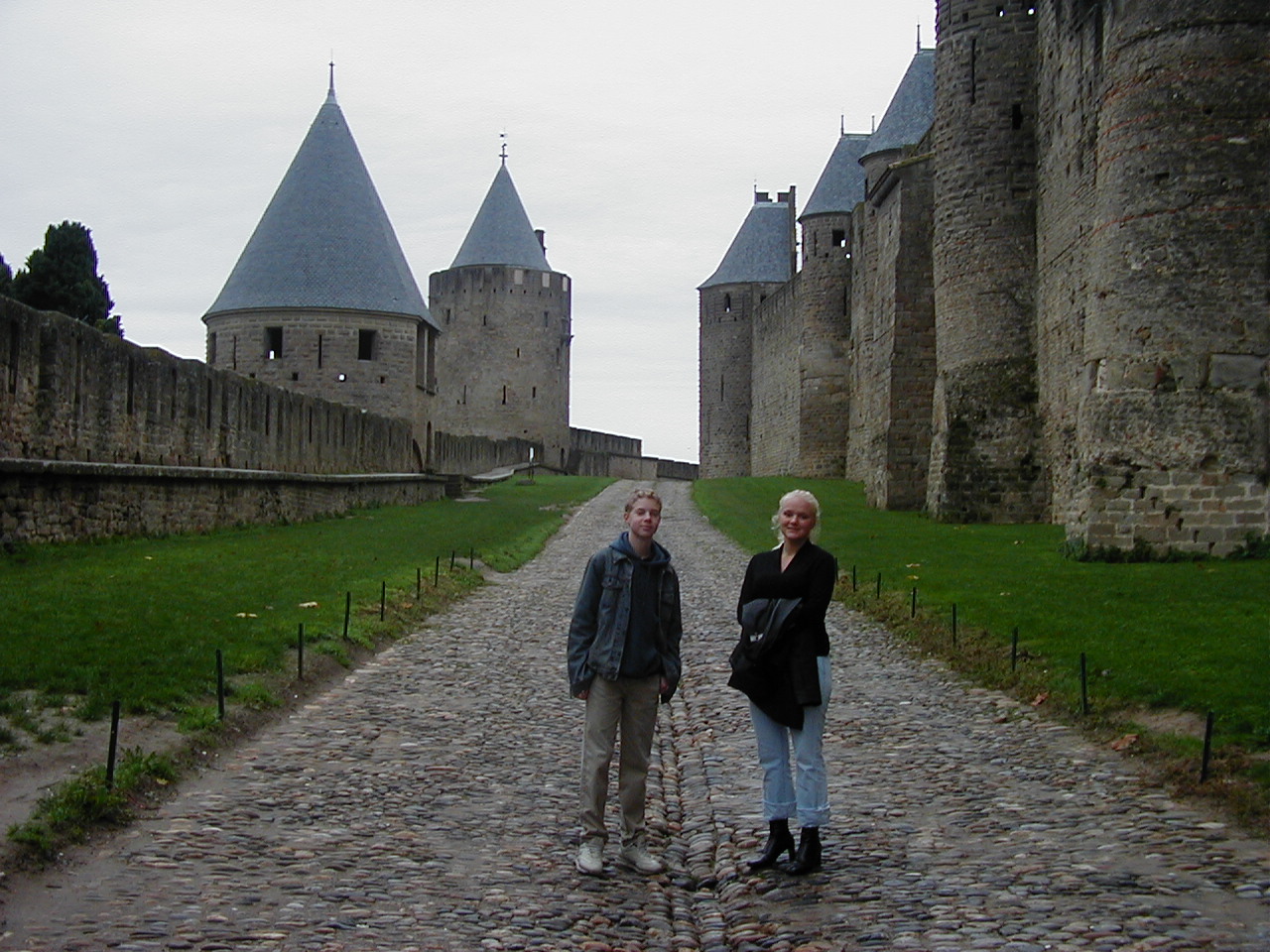
We were glad that we had parked in the city and not in the official visitor car parks not just because there was a parking charge there but because we now had to walk and across the Pont Vieux and the River Aude which was lined with trees that were just beginning their transformation into Autumn colours. This is the best pedestrian approach to La Cité because, set high up on a hill overlooking the river, Carcassonne’s ancient walled city is picture-book perfect and this fairytale collection of drawbridges, towers and atmospheric cobbled streets was reputedly the inspiration for Walt Disney’s ‘The Sleeping Beauty’. This may or may not be true but is also similar to the story of Cinderella’s castle in Segovia in Spain.

A stone statue of Dame Carcas stood at the drawbridge entrance to the city and again, whether she is fact or fiction, this is the legend of Carcassonne. When the Holy Roman Emperor Charlemagne stood before the gates of the city with his rampaging troops, the castle army existed of only one person, Madame Carcas. (Difficult to believe I agree, but I will carry on anyway). Somehow she managed to give the illusion that many men were still on the walls (rather like the movie ‘Home Alone’).


Charlemagne’s plan was to starve out the occupants of the castle and Dame Carcas, rumbling this, threw a pig over the wall, its belly filled with sweet corn to give the impression that it was well fed. Charlemagne was duped and falling for the deception that the castle was both well provisioned and bristling with angry soldiers packed up and left. On witnessing the retreat Madame Carcas triumphantly blew her horn and thus – Carcas sonne. Now this is almost certainly not true and is very similar to the story of the painted oxen during the Hohensalzburg Fortress in Salzburg in Austria but one thing that is true about Carcassonne is that it was used to portray Nottingham Castle in the Kevin Costner film ‘Robin Hood – Prince of Thieves’ and for anyone that has seen the real Nottingham Castle this requires no explanation why.

Carcassonne stood as a fortified city from as far back as Roman times until Napoleon removed it from the list of official national fortifications and it fell into such disrepair that in 1849 the French government decreed that it should be demolished. This prompted an immediate campaign to preserve it as a historical monument and in 1853 restoration work began under the direction of the architect Viollet-le-Duc who repaired the walls and the roofing on the towers and the ramparts. The restoration was strongly criticized during his lifetime for lack of authenticity because recently returning from work in the north of France, he made the error of using slates and restoring the roofs as pointed cones, where local practice was traditionally of tile roofing and low slopes but it is exactly this feature of his restoration that has made Carcassonne such a magical place.

After walking around the outside of the walls we entered the city by a minor entrance and were transported into an alternative world of narrow streets and cobbled alleyways. we were immediately below the flying buttresses and the grotesque gargoyles of the St Nazaire Cathedral, which is a nineteenth century replacement for the original building but still manages to give a realistic medieval impression. We walked around the corkscrew streets and explored the battlements but at €16 each declined to take the Chateaux tour. There are rather too many shops in Carcassonne for my liking but we looked in one or two and puffed our cheeks out in disbelief at the prices and then we compared menu cards in the bars before selecting one that was consistent with our budget where we stopped for a drink.


Wednesday, 28 December 2011

France, Customer Service Improvement and a Car Hire Scam


Earlier in the year we had flown from Stansted Airport to Pula in Croatia and the grotesque behaviour and the appalling lack of manners shown by the airport security staff prompted me to write to the airport to make a formal complaint when we got back home. I often threaten to make complaints and then calm down and forget all about it but not this time. Because of the complete contempt for the customer and the apparent determination to be as rude and ignorant as possible to passengers being processed through the security lines I imagine that quite a lot of other people might have complained as well and I would like to think that all of those complaints collectively did some good because on this occasion there was a completely different experience.

The man that checked the boarding pass actually smiled and wished us a pleasant flight, the woman at the scanning machine purred instead of snarled as she asked for our liquids and furthermore didn’t demand the transfer to a £1 Stansted plastic bag and the man who does the frisking when I set the alarm off actually apologised for the inconvenience of having to carry out the body search. I hope it wasn’t just an extraordinary fluke and that the airport is paying more attention to improving customer service skills and if they are then I for one will say (and I really didn’t think that I ever would) ‘well done Stansted Airport’ it was so much nicer being treated like a human being!

This was my second Ryanair flight to Carcassonne in the south of France as I had been there previously in November 2003 on genuine 1p fares and on that flight I got to sit in a row of seats in front of a television celebrity. My daughter Sally noticed him first and told me that the person behind was the man in the Vauxhall Zafira adverts, I turned and looked and agreed that it certainly looked like him but I argued that it couldn’t possibly be but then I heard him speak to his wife in that perpetually silly comedy voice of his and there was no mistaking that it was indeed Griff Rhys Jones.

Carcassonne is not a big place so we saw Griff several times the next day when we were sightseeing at the castle and the day after that when we sheltering from the rain in an unusually expensive restaurant for me and we had now bumped into each other so many times that he was beginning to recognise me. It was a cosy place with not a lot of room between the tables and he was sitting right next to me. As we had already been on nodding to each other terms for forty-eight hours it seemed rude not to speak so I said hello and we lamented the weather and then, not sure what to say next to a television celebrity, I stupidly asked him what he was doing on a 1p Ryanair flight. He thought about it and then simply said ‘Well, why not?’ and I think that was just about the perfect response.

We were staying in Carcassonne for two nights but we didn’t see him in the evenings because we were in a cut-price Ibis hotel on an edge of town shopping centre and I guess he was staying in a swanky hotel in La Cité because I could think of a lot of reasons why he wouldn’t have wanted to stay at the Ibis regardless of the price. We did see him again on the way back though because he flew back to the UK on the same flight as us.

I didn’t spot anybody famous on this occasion and after the short ninety minute flight we landed at the tiny municipal airport and after clearing customs found the car hire offices. I had booked a car with EconomyCarRentals.com and I was satisfied with the price I was paying but as so often with car rental companies there was going to be a problem. The girl at the National car rental office went through our paperwork and then charged me €65 more than the quoted price. I pointed this out and she explained that this was the correct price and that EconomyCarRentals.com were quoting incorrect rates and that as it was their fault that I could rest assured that they (EconomyCarRentals.com) would refund the difference and that they (National) would arrange for this to be done.

I have been ripped off by car hire companies before so I was not very confident about this but there was nothing that I could do except turn down the car which would have left us with an even bigger problem so I reluctantly agreed to a car hire scam that I hadn’t been the victim of before, took possession of the keys and complained about this all the way to the silver Citroen Picasso that was waiting for us in the car park baking in the warm midday sun.


Carcassonne has changed in eight years – for some reason they have removed the grass and replaced it with limestone chippings – a mistake in my opinion!


Sunday, 2 January 2011

The Grand Tour of Europe


People have always travelled to other parts of the world to see great buildings and works of art, to learn new languages, to experience new cultures and to enjoy different food and drink. As long ago as the time of the Roman Empire, there were popular coastal resorts such as Sorrento and Capri for the rich. In 1936 the League of Nations defined a foreign tourist as someone travelling abroad for at least twenty-four hours and its successor, the United Nations amended this definition in 1945 by including a maximum stay of six months. In early 2010 the European Commissioner for industry and entrepreneurship, Antonio Tajani, unveiled a plan declaring tourism a human right and introduced it with the statement that “travelling for tourism today is a right. The way we spend our holidays is a formidable indicator of our quality of life.”

Young English elites of the seventeenth and eighteenth centuries (Rahs really) often spent two to four years travelling around Europe in an effort to broaden their horizons and learn about language, architecture, geography and culture in an experience known as the Grand Tour.


In fact the word tourist has its origins in what used to be more correctly called the Grand Tour of Europe, which was a term first used by Richard Lassels in his 1670 book ‘Voyage or a Complete Journey through Italy and after that it came into general usage to describe the travels in Europe of wealthy young men and women in the years of the Enlightenment where it was quite normal to take a gap year (or four) in the quest for a broader education. Lassels was a Roman Catholic priest and a tutor to several of the English nobility and travelled through Italy five times. In his book, he claims that any truly serious student of architecture, antiquity, and the arts must travel through France and Italy, and suggested that all “young lords” make the Grand Tour in order to understand the political, social, and economic realities of the world.

The primary purpose of the Grand Tour lay in the exposure both to the cultural legacy of classical antiquity and the Renaissance, and to the aristocratic and fashionably polite society of the European continent. In addition, before museum collections went on tour themselves, it provided the only opportunity to view specific works of art, and possibly the only chance to hear certain music and it was commonly undertaken in the company of a Cicerone, a knowledgeable guide or tutor. The Grand Tour had more than superficial cultural importance as the historian E.P. Thompson observed, “ruling-class control in the 18th century was located primarily in a cultural hegemony, and only secondarily in an expression of economic or physical (military) power.”


While the general objective of the Grand Tour was essentially educational (and this probably what mum and dad thought that they were forking out for) they were also notorious for more frivolous pursuits such as getting hammered, partying heavily and sleeping with as many continental lovelies as possible and so began a tradition that thousands of holiday Brits continue to this day in the party hotspots of Europe.

When young men on the Grand Tour weren’t misbehaving like people on a stag weekend to Amsterdam they were mostly interested in visiting those cities that were considered the major centres of culture at the time, primarily Paris, Rome, Venice, Florence and Naples were popular destinations. The Grand Tourist would travel from city to city and usually spend some time in smaller towns and up to several months in the three main cities on the itinerary. Paris was considered the grandest and most cultured city and was usually first en route and tourists would rent apartments for several weeks at a time and would make occasional visits to the countryside and adjacent towns.

From Paris, they travelled south either across the Alps or by a ship on the Mediterranean Sea to Italy and then they would pass on to Rome or Venice. To begin with Rome was initially the southernmost point they would travel to but when excavations began at Herculaneum and Pompeii in 1738 the two sites also became additional major destinations on the Grand Tour.


Other locations sometimes included as part of some Grand Tour included Spain and Portugal, Germany, Eastern Europe, the Balkans, and the Baltic States. However, these other spots lacked the cultural and historical appeal of Paris and Italy and the substandard roads made travel much more difficult so they were not always the most popular. Some of them didn’t have vineyards either so I suppose that might have reduced their appeal somewhat.

The British it seems have always been rather keen on travelling abroad and we have left our mark all over Europe (and not just through football violence either) in Nice one of the first and most established holiday resorts on the French Riviera, the long esplanade along the seafront is known to this day as the Promenade des Anglais and in many other historic resorts in continental Europe, old well-established palace hotels have names like the Hotel Bristol, the Hotel Carlton or the Hotel Majestic, reflecting the predominance of English customers.


In fact there are nearly 300 hotels around the world called Bristol. They take their name from Frederick Augustus Hervey (1730-1803), the 4th Earl of Bristol and Bishop of Derry, who spent most of his life travelling around Europe enjoying the best hospitality money could buy.

This sort of thing really appeals to me; both the finding out about things and having a really good knees up at the same time and I have become determined to travel as much in Europe as I possibly can. The problem with that is that I have full time job and I certainly cannot afford to take a four year sabbatical break so I have developed an alternative Grand Tour method and that is to take absolutely full advantage of the low cost airlines.

There are forty-six countries in Europe and I have only so far been to twenty-five so I am just over half way towards my objective of visiting them all.

Ryanair was Europe’s original low fares airline and is my favourite which is lucky for me because the airline has over eleven hundred low fare routes to one hundred and sixty-one destinations in Europe and North Africa. In the last three years I have flown thirty times at a very reasonable average cost of £40 return all inclusive. Not all of these flights were with Ryanair of course and I have been forced to use others but I generally find that these work out more expensive. A return flight to Athens with Easyjet for example costs £120 and my biggest bargain so far was with Ryanair to Santander in Cantabria, Spain at just £10.02 return. To put things into some sort of perspective it costs over £80 to go to London on the train from Peterborough with National Express and for that you are not even guaranteed a seat. That is about .90p a mile and on that basis it would cost approximately £1,800 to go to Santander and back by train!

In 2008 the most visited country in Europe was France, followed by Spain, Italy, United Kingdom and Germany. Spain made the most money out or tourist revenues and on average the Germans spent most while away from home. The most visited city was London (although as usual France disputes the official figures) and the most visited place was Trafalgar Square, followed by the Eiffel Tower and then the Vatican. The United Nations World Tourism Organisation, which has its headquarters in Madrid, produces the World Tourism Rankings and is a United Nations agency dealing with questions relating to tourism. For the record I visited Trafalgar Square in 2008, the Eiffel Tower in 2005 and the Vatican in 2003.


Tuesday, 26 October 2010

France 2010, Hardelot Plage (again) and Etaples


The cottage was just a few kilometres from the holiday resort town of Le Touquet Paris Plage but we hadn’t visited yet so we agreed that as this was our last day that we really ought to go and see the place and after breakfast we loaded the cars and set off.

We made good progress at first but as we got closer to the coast the roads began to get busy, progress slowed down and then eventually ground to a complete halt. I calculated that we were still about six kilometres from the town and the coast and the traffic was at an almost complete standstill. It seemed that everyone else in Northern France had also decided to visit Le Touquet today.

I have visited Le Touquet a couple of times and stayed there while on golfing holidays and I think it is a very nice place but not so special that I would want to queue for an hour or so to get in and then struggle to find a parking space if I ever made it. Not sure because unlike the surrounding towns of Nord Pas de Calais, the words ‘quaint’ and ‘medieval’ have no place there. The resort is too young for cobbles and ramparts and the same goes for museums and Cathedrals. I also seem to remember a lot of dog shit! The main event is Le Touquet itself, a case of leisure over culture and I was certain that we could all live with the disappointment of not actually going there so at a convenient junction we left the line of crawling traffic and decided instead to revisit Hardelot because we were certain that there were some parts of the town that we had missed earlier in the week.

The locals call Hardelot ‘little Le Touquet’ but there were no such traffic problems getting in and we drove effortlessly to the centre and parked in a car park where we were the only two cars. The sun was shining but it was a bit too breezy for the beach so we headed instead for the tiny town centre and its couple of streets of shops and restaurants. Actually there wasn’t a great deal to see and this didn’t take very long and very soon afterwards we were on the promenade and enjoying the bracing sea air.

Hardelot is a well-to-do sort of town and many Parisians own property here and use it for summer and weekend breaks. Apart from the grand villas however I personally don’t find the place that attractive and behind the sea front is a ribbon of featureless high rise flats most of them with their shutters firmly closed for most of the year. Like Le Touquet, Hardelot was occupied by the Nazis in the Second-World-War and they did huge amounts of damage before retreating ahead of the Allied invasion forces. Much of it had to be rebuilt and this explains the prominence of these rather unattractive buildings.

We walked back through the town and found a sunny spot to stop for a refreshment break and ordered some beer and sipped it slowly on account of the prices and then speculating that the roads might be less busy now we decided to have a second attempt at getting into Le Touquet.

The route to Le Touquet took us towards the old fishing town of Étaples on the river Canche and just outside the town we stopped to visit the largest Commonwealth War Graves site in France where nearly twelve thousand soldiers are buried.


Because of its strategic position Étaples was the scene of much Allied activity during World War One due to its safety from attack by enemy land forces and the existence of railway connections with both the northern and southern battlefields. The town was home to sixteen hospitals and a convalescent depot, in addition to a number of reinforcement camps for Commonwealth soldiers and general barracks for the French Army. By all accounts this was a truly dreadful place and most soldiers buried in the cemetery died after treatment in the hospitals. It is said that after two weeks, many of the wounded would rather return to the front with unhealed wounds rather than remain at Étaples.


It was also a particularly notorious base camp for those on their way to the front. Under atrocious conditions, both raw recruits and battle-weary veterans were subjected to intensive training in gas warfare, bayonet drill, and long sessions of marching at the double across the dunes. There was resentment against the officers who enjoyed the better conditions of Le Touquet and from which the men were forbidden to visit and this led to a famous mutiny in September 1917 which was brutally repressed.

Apart from the solemn rows of white headstones there was no reminder of this unpleasantness today as we entered the cemetery through the impressive memorial designed by Sir Edwin Lutyens and walked through the carefully tended graves. I had never visited a war graves site before and it was poignant to read the inscriptions on the graves and sad to see how young so many of them were who never returned to England. Molly ran and skipped through the rows of graves and I was struck by the fact that she could only do this because of the ultimate sacrifices made by all these men.

After the visit to the cemetery we continued on our journey towards Le Touquet but at Étaples the traffic ground to a halt again and not wishing to spend our last afternoon in a traffic jam we resigned ourselves to not seeing Le Touquet this year and turned the cars around and returned to the cottage at Longvilliers.

It was lovely sitting in the garden in the late afternoon, the sun was shining and there was no wind, Molly played in her pool, the wasps kept falling in the improved trap, we drank some beer and wine and Richard prepared for what he promised would be the best log fire of the week. Later, when it had cooled down, Molly and I went for a walk into the village and had a last look at the livestock in Camille’s garden and I knew she understood that this would be the last time because we were going home tomorrow.

Molly went to sleep earlier than usual and Richard didn’t let us down with the fire. He supervised a final excellent barbeque meal where we used up all of the remaining food including the last of the pasta dishes that Rachel and Sally had prepared four nights ago! After the food Richard placed his specially selected log on the fire and it entertained us for a couple of hours or so as it burnt away in the brick barbeque and slowly turned to embers and ash. We had enjoyed our barbeque meals but they were all over now and we left the garden and went to bed knowing that the first job in the morning was to pack.

The next day the weather was miserable again so with no reason to hang around we finished our packing, tidied the cottage and after the return of the deposit we set off for Calais with plenty of time allowed for a second visit to Carrefour at the Cité de Europe to stock up on cheap beer and wine.

We left France in a rain storm and arrived backing England to be greeted by another one and on account of the bad weather we felt sorry for all the people queuing to take our place on the ferry for the return crossing.

We had had another good week in France and we all look forward to returning again perhaps next year.

Monday, 25 October 2010

France 2010, Berck Plage (again) and French Obesity


I can only put it down to the peace and quiet of the place but everyone seemed to be taking things easier by the end of the week and even Molly was sleeping longer and she didn’t wake me up this morning until almost eight o’clock. This was still earlier than all of the others however and it was well past nine before we sat down for breakfast and some time past ten when we had finished clearing up.

This didn’t matter because we were in no particular rush today and planned an easy itinerary with a return visit to the beach at Berck.

We spent most of the morning in the garden, Molly and I played ball, Richard checked the wasp trap and chose his logs for tonight’s fire, Sally read her book, Rachel had a nap and we did some washing, some items for the second time this week, and it was almost midday when we finally set off for the short journey to the coast.

We drove past Montreuil and along the clear roads towards Berck but close to the town the traffic became heavy and we spent some time in a crawling traffic jam making only slow progress. Eventually we broke through the bottleneck and arrived in Berck. We tried to get closer to the town this time but this proved difficult and after I had driven down a road on the wrong side and frightened a poor French motorist half to death we decided it was safer to simply return to the same beach next to the crumbling convalescence hospital.

The hotel is there because Berck, a former fishing village, took on a therapeutic role in the treatment of tuberculosis during the Second Empire. The Maritime hospital was inaugurated in 1869 by Empress Eugenie and other hospitals and benevolent institutes were soon created to cater for the sick and those in need of rest and recuperation.

We were a bit earlier today so the tide wasn’t as far out and there wasn’t so much beach to choose from so we selected a spot in the soft sand just above the high tide mark and it turned out to be a good job that we did because although we didn’t know it the tide was coming in. Molly enjoyed the sand and the lagoons again and was even a bit more adventurous about going further into the sea. Actually the sea was surprisingly warm and Richard and I both stripped down to our bathing costumes (garish yellow Hawaiian style for Richard and Speedos for me) and we went swimming in the sea and this was the first time that I had been fully submerged in the waters of the English Channel since at least 1975.

As the sea came steadily towards us and covered the beach, more and more people started to arrive and the sand was starting to get a bit crowded. One surprising thing was the amount of fat people on the beach because France has always prided itself on being slim and healthy with a belief that there is something in the French lifestyle that protects them against obesity, heart disease and diabetes. This is called the ‘French Paradox’ and is now being exposed as a myth because they are straying from the very dietary habits that made them the envy of the world: eating small portions, eating lots of vegetables, drinking in moderation, and limited snacking. It seems that the French are exercising less, eating more fast food, and are employed in more service jobs where time is spent sitting at a desk rather than driving a tractor or working an assembly line. Overall six and a half million French, that’s 14.5% of the population, are now classified as obese and it is worse in the north (around 20%) because of the rich heavy food of the region.

To illustrate this shift we can look at the example of McDonalds. Even though the French will maintain that they despise the fast food chain and the concept an awful lot of people do eat there. Across France there are nearly nine hundred restaurants and in Paris there are almost seventy restaurants under golden arches, with even more dotted around the outer suburbs. That’s much the same as London, but with only a third of the people. McDonald’s, or “macdoh” as it is known, is France’s dirty secret. In 2007 the chain’s French revenues increased by 11 per cent to €3 billion. That’s more than it generates in Britain and in terms of profit, France is second only to the United States itself.

There were some really heavy specimens on the beach at Berck today (they may not all of been French of course) and even worse there were more and more dogs arriving and running about the sand. I have explained many times that I am not a lover of dogs so I started to feel uncomfortable about this and I was almost pleased when the clouds started to move in and blotted out the sun and everyone agreed that this was a good time to leave.

On the way back we stopped briefly in Montreuil for some final supplies and extra beers but in the late afternoon a lot of the town was closed and the bars weren’t open and the place lacked atmosphere so we abandoned the plans for a drink and went back to the cottage instead.

Molly and I went for a long walk towards the next village in search of a field of cows but they were a long way a way so we had to count tractors instead and then sit and watch a combine harvester working in a field of corn and reducing the flowing clouds of golden stems to a carpet of brown stubble. On the way back we had to pass Camille’s house and when he spotted us he came out to greet us and Molly asked to see his rabbit and he was only too happy to oblige.

This evening, like all of them, passed surprisingly quickly as we played in the garden and waited for Molly to tire herself out and Richard prepared the barbeque. We were enjoying the al fresco dining and once again after we had finished we sat around the fire but Richard kept the poker well out of my reach.