Showing posts with label Fazana. Show all posts

Friday, 23 December 2011

Istria 2011, Markets and Fortresses


It was our final morning but today we managed to sleep through the church bells until about eight o’clock and breakfast time and after a leisurely first meal of the day we packed and booked out of the hotel.

We had an early afternoon flight so that gave us the opportunity to drive back to Pula and finish off the sightseeing that we hadn’t yet managed and a final lunch at Orfej restaurant.

After we arrived we parked in the same car park and went out into the town to visit the market that was close by. There was an outside area with rows of colourful pitches with stalls straining under the weight of fruit and vegetables all presented for purchase in an untidy but satisfying way but the best part of the market was the covered building constructed of iron and glass which housed the butchers and the delicatessens and best of all the fishmongers.

Now I always thought that fish was in short or declining supply but you wouldn’t have thought so here. European Union fishing regulations as well as the General Fisheries Commission for the Mediterranean (a division of the Food and Agricultural Organisation of the United Nations consisting of twenty-four counties that either border the Mediterranean Sea or just happen to fish there) do not seem to have had a serious impact on the availability of marine produce in Pula.

The agreed fishing quotas must be very generous indeed because this fish market looked as though someone had sucked up the entire seabed and delivered it right here at this spot. On closer examination of the produce however it soon becomes clear why we have to put up with stock shortages whilst the Croatians, and most of the rest of Europe as well, have such an abundance of choice, we are just far too fussy and our preference for fish is restricted to two or three species that we have fished into a crisis of extinction whilst the Europeans will eat a much greater variety of sea food. We like to buy our fish in little blue polystyrene trays and definitely without heads or tails and ready for the frying pan but here the slabs were brimming with fish so fresh some of it was still alive and flapping about and winking at us as we inspected it.

Excuse me a recollection here but this illustrates my point perfectly; once on holiday with my mother and presented with a menu that included a cod dish she actually asked the waiter if it was served with its head still attached! These things can be two metres long for goodness sake!

There were crabs still frothing at the mouth and octopus with tentacles still writhing and with an eye open daring anyone to buy it and take it home and tackle preparation for cooking. The colours were spectacular too, sparkling silver, gleaming green and radiant reds and trays and trays of vivid orange scampi and other intriguing and colourful crustaceans. One of my personal favourites was some unpleasant looking spiny specimens, which are used as a principal ingredient in a Croatian fish stew called Brodet.

In a separate part of the indoor market the butchers presented their abundant produce in display cabinets and negotiated with customers on cuts and joints for purchase, there were cheese and dairy stalls and fresh pasta and other local delicacies. What I liked was the smell of the whole place. In England supermarkets have no smell at all because everything is over-packaged and presented in plastic trays and vacuum packed containers, which makes shopping a wholly unsatisfactory and sanitised affair.


After the market we made our way to the highest part of the city to the Venetian fortress. We had the place practically to ourselves and we wandered around the battlements and enjoyed the views of the old town and the port that sat below this elevated position. We recognised the stone of course because this had come directly from the amphitheatre that we had visited a couple of days ago. The Museum was interesting but largely unremarkable but there were maritime displays that were close enough to touch and I enjoyed picking up the old ships tools that seemed far too heavy and crude to be of much use in the modern high-tech world.

There was one very interesting room full of exhibits from old ships that you were not allowed to touch and there was adequate signage to make this clear. On a previous visit to Pula, true to form, Kim ignored these precise visitor instructions and just had to reach out and investigate a jar of ships surgeon’s dried semen (I kid you not!). This set an alarm sounding and the immediate appearance of a member of the castle staff to investigate just what we had been up to. I thought that this was very amusing and well worth a photographic memory so I arranged an appropriate pose and was ready to capture the moment when Kim decided to give the moment a touch of authenticity by breaking the alarm beam for a second time. What the…..? Out scuttled the attendant again and this time around I could sense that she didn’t find it so amusing, she was clearly losing her patience so the only sensible thing to do was to leave before Kim broke any more ‘do not touch’ museum rules.

There were no accidents this time and when we had seen all that there was to see we made our way down to the main square for a final drink in the sunshine and then a short walk to the Orfej where we were not disappointed by the final meal that we had been promising ourselves and after an excellent lunch we made our way back to the car and then a short drive to the airport for our return flight.

It had been an excellent four days and we had enjoyed Croatia and Istria. We especially liked Pula and Rovinj, the Konoba Ferral and the Café Orfej, the boat ride with dolphins but most of all we had been delighted to be staying at the hotel Villeta Phasiana and the lovely fishing village of Fažana.


Thursday, 22 December 2011

Istria 2011, Romans and Fascists


It was only mid afternoon and as we had just about exhausted all that there was to do in Fažana without going over the same ground we decided to return to Pula for the afternoon.

Having visited the primary tourist attraction of the city on the first day we walked back to the town centre to see what else we could discover. The town had a slightly uncared for feel with many buildings having a lack of attention to detail in the finishings with drab concrete facades, exposed pipe work and cables that had not been quite tidied up and the first impression was that, compared to Rovinj, this place was a bit shabby and definitely still quite short of money. Looking up we could see bits of masonry looking precariously dislodged and practically disconnected from the buildings and I was sure that there was always an imminent danger of being hit on the head so did my best to make sure that we walked wherever possible in the middle of the street. There were quite a few shops but not many shoppers and the streets were curiously quiet.

We found the Temple of Romae and Augustus in the main town square and the Arch of Sergii, which are some of the town’s best preserved Roman structures and we also came across Agrapinina’s house, which sadly is not. I don’t think Agrapinina was anyone especially important and the remains of her house has been discovered in what is the back yard and garage area of a block of modern apartments. Such a shame really because these looked quite interesting but they were full of litter and there was even some graffiti on the walls. I suppose this is why people like Lord Elgin decide to bring ancient artefacts back to Britain if they are found unloved and uncared for in their original settings.


Instead we walked for a while along what has to be said was a disappointing sea front not least because it was completely devoid of bars for a refreshment stopover. I suppose this is to be expected of course because Pula is not a tourist marina but a fully working shipyard with a lot of activity breaking down old ocean going tankers that were so large there huge bulk overshadowed the adjoining town. In the days of the Austro-Hungarian Empire this was a principal naval base that I am sure would have been familiar to Captain Von Trapp before he was pensioned off and sent off to Salzburg.

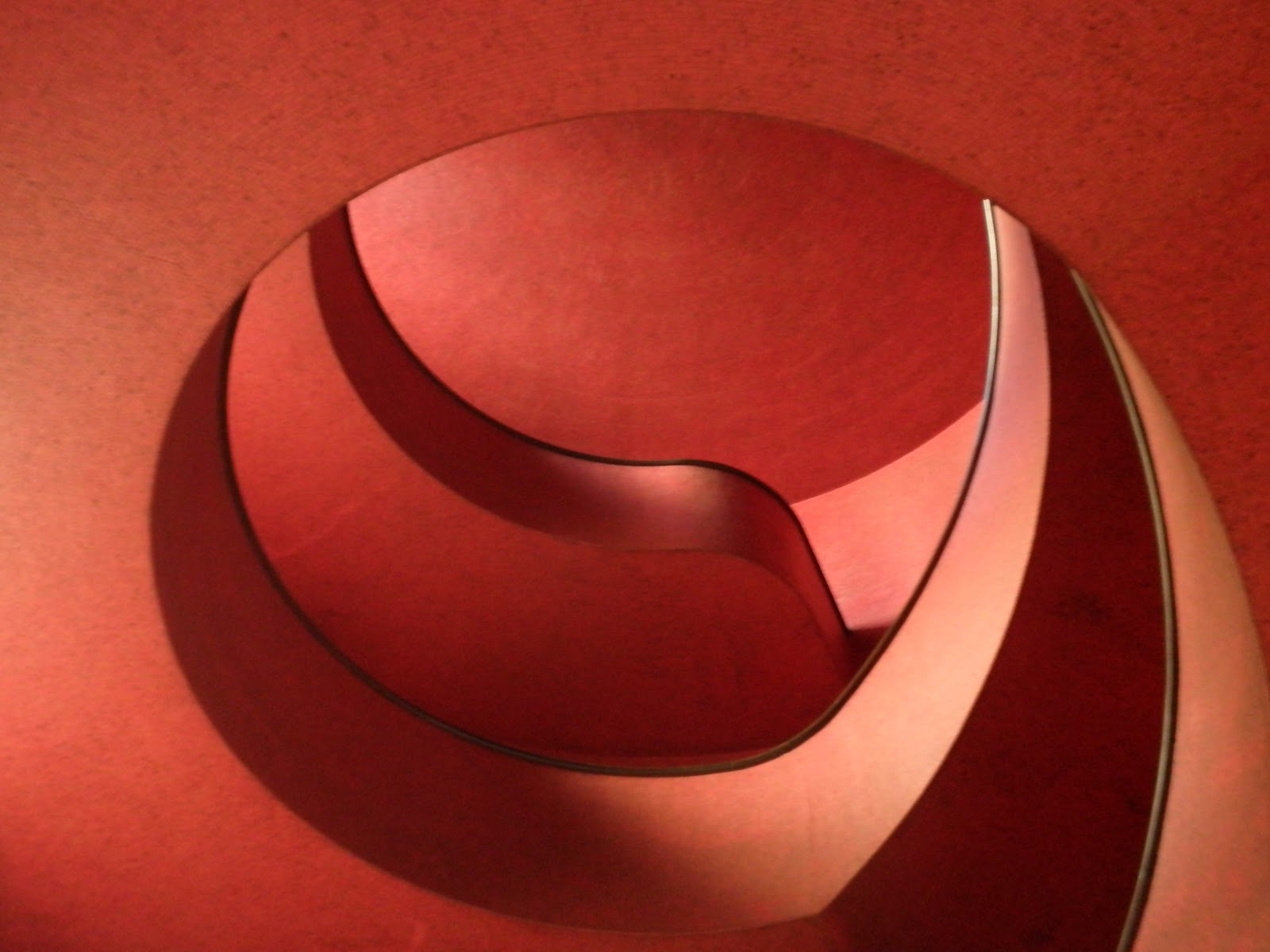
In a more modern part of the city we chanced across a pleasant little square with a water fountain and lined with nineteenth century buildings that had once been the bourgeois commercial centre at the height of the Austrian Empire. In this square was the City Post Office which was a much later twentieth century addition built in 1933 and although unremarkable from the outside had hidden inside a magnificent Gaudi like spiral staircase which rose majestically from the ground floor to the top of the building in an extravagant scarlet sweep that oozed style and grandeur.


The building was designed by Angiolo Mazzoni del Grande who was the chief architect for the Ministry of Communications and for the State Railways under the Mussolini regime in Italy. He was one of the most outstanding Italian architects of the modern period and was responsible for the design of many public buildings and railway stations across Italy that were characteristic of the Fascist building boom. It was an unusual discovery and it would be much better housed in a more important building but this was a hidden gem of Pula and I am glad that we found it.

As the afternoon slipped away we found ourselves back in the main square where we stopped for a drink on the way back to the car and then we left Pula, on this occasion finding the correct route out of town without taking the unnecessary detour and in fifteen minutes we were back at the Konoba Ferral. Ferral, we learned means one of those lights that fishing boats have to attract the fish and in terms of attracting things it certainly worked with us.

Later, after Kim had taken some final magic camera sunset pictures we assembled there again and while we sat there in shirt sleeves a German couple, wrapped up for winter, correctly identified us as English and mad. Actually it wasn’t that cold at all but we did take the precaution of eating inside again. Once more the food was excellent and we enjoyed a sociable meal with a helpful and attentive waiter who guided us expertly through the menu.

It was our last night in Fažana so before we returned to the hotel we took a final night time walk around the harbour and the square. We had enjoyed this place and it would be disappointing to leave in the morning.


Wednesday, 21 December 2011

Istria 2011, A Boat Ride With Dolphins


The next morning the church bells woke me again at six o’clock and after a good night’s sleep I found it impossible to snooze away another hour or so, so knowing that Micky is an early riser and would probably be wandering about the village I decided to dress and go and see if I could find him. There was no sign of him in the streets or the coffee bars and it turned out that just like me the day before he was on early morning shopping mission to buy a new travel kettle to replace the one that Sue and Christine had somehow managed to blow up!

Although it was early there was quite a lot of activity preparing for the day as shops opened, cafés began to set out their tables and chairs and a few people were shuffling towards the bars for a first cup of coffee. In the back streets there were display boards which explained the history and the heritage of the little village which has a fragile economy based on the sea and fishing. Unable to find Micky I walked around the water and out along the harbour wall and all the while the sun was getting higher and warmer and it looked like another good day in prospect.

It was the day of the boat trip but that wasn’t until midday so after breakfast we set off on another walk out of the village but this time in a northerly direction. Not far out of the village we passed through shady pine woods that fringed the stony beach and then came across a camp site that was being prepared for summer visitors and beyond that was an abandoned holiday camp complex where the chalets were in a state of terminal disrepair and with a feel of the 1970s about it I think the kindest thing would be to demolish it entirely.

There was time for a drink now before the boat trip so we sat at our favourite bar and debated whether we had appropriate clothes for a sea going adventure and even though it was warm and the sun was shining we went in turn to the hotel to get some extra layers just in case.

We met Alex as arranged at twelve o’clock and he explained that there would be a short delay as the Capitan (this is how he described the owner of the boat) had been dissatisfied with the quality of last night’s fish catch in Fažana and had had to go to the fish market in Pula to get satisfactory supplies for lunch. We fully understood that because we had seen the catch coming ashore late last night and believe me it was not very impressive!

While we waited Alex explained that he didn’t think he could honour the five for four deal after all but we ignored him and Micky was especially determined that either he would or he would be going over the side later. It turned out to be quite a long wait because having gone to Pula to buy the fish the Capitan then had to cook it and prepare the salad to go with it and then we he finally arrived he had to go to the petrol station to get some fuel but finally after an hour delay we were finally on the boat and heading out to sea.


The boat trip was to be a circumnavigation of the island of Brujini and a scattering of smaller islands in a mini archipelago and as we got closer Alex passed round the home made wine served from a coke bottle and started to begin a narrative of the sights. Brujini was the holiday home of the Yugoslavian President Marshall Tito and today is used by the President of Croatia. On account of this there was a lot of security and a few soldiers but they seemed quite relaxed so I don’t think he was there today.

Alex pointed out the golf course, the President’s mansion, the zoo where a couple of elephants live (apparently) and the hunting grounds all well stocked with game. To be honest after half an hour or so it all became a bit tedious because, quite frankly, one island looked very much like another and the wind was getting stronger and it was beginning to get chilly.

Suddenly however the tedium was broken when Christine spotted something in the water that turned out to be a dolphin and encouraged by the sighting the Capitan went off course and tried to pursue it. It turned out to be two dolphins and although they kept a safe distance from the boat they accompanied us for a while and entertained us by regularly breaking the surface of the water. It isn’t everyday you see dolphins like this, my last time was in Cephalonia in Greece in 2000, and Alex explained that we were lucky because this happened only infrequently on the Capitan’s boat trip.

The sea was a bit rougher now so Alex explained that we wouldn’t be able to stop and eat as planned but the Capitan would take us back closer to Fažana where the sea would be calmer and I for one was glad to be heading back to the mainland. Eventually we stopped and enjoyed a simple meal of fish and chicken with a nice salad and a couple more glasses of the dubious red wine. We finished, fed the scraps to the seagulls and then headed back to the harbour. Alex tried to charge the full rate but Micky was having none of it and after a word with the Capitan the original deal was honoured. It had been a good trip but I was glad to be back on dry land.


Tuesday, 20 December 2011

Istria 2011, Rovinj


It was time for a coffee and a beer and there were plenty of busy harbour side bars to choose from so as we looked for empty spaces Micky reminded me of his theory that if we (the men) made a selection then this would be automatically overruled by Kim who has a curious habit of always walking to the next one perhaps in some sort of belief that it will always be better, or perhaps she just thinks we can’t make a good choice? Micky stopped by an empty table at a perfectly acceptable café and sure enough Kim rejected it and led us instead to the one next door. It was almost identical and the coffee and the beer would be exactly the same so there really was no explanation. Micky smirked!

It was really hot in the midday sun and we sat and watched the harbour activity, the tour groups being led around the town and the children playing in the square. Rovinj was certainly very different to Pula with a chic Italianate ambiance that oozed style and disposable income. Whereas in Pula the tourist part of the city rubs shoulders with the noise and sweat of its industry Rovinj felt exclusively like a pleasure zone for holiday makers, yachtsmen and tourists with no hint of a scruffy industrial area. People in smart clothes parading along the promenade stopping every so often to stop for a sociable drink or to gaze into a shop window with overpriced souvenirs or to buy a couple of scoops of Italian ice cream from the parlours all along the front.

After our refreshment break we walked through the main square and melted into the side streets with the twisting cobbled streets flanked by pastel coloured buildings rising steeply from the pavements with washing lines strung between them and brightly painted shutters on the windows. The route to the top took us a maze of streets until we emerged at the top and in the cathedral square. All but Micky went in for a look around and then we took an alternative path and descended down to the square. On the way we passed a shop selling shell costume jewellery and as Kim examined the necklaces the shop keeper rather sharply said that if we were just looking then we should do it with our eyes not our fingers. We didn’t think this was a very friendly sales technique and if we might have been tempted to purchase something then we certainly wouldn’t be after that.

It was lunch time so we stopped at a water side restaurant advertising a reasonably priced menu of the day so we choose a table ordered some drinks and made our selections. Surprisingly Christine choose fish and I say surprisingly because although she is not so anti-sea food as Sue this was most unusual. And then unsurprisingly she didn’t like it and gave most of it away to Micky in exchange for his meat selection. Over lunch we agreed to take the boat excursion so we phoned Alex and told him that we liked his five for four deal and that we would meet him tomorrow at twelve o’clock.

After lunch we passed from one side of the old town to the other and walked through a market selling local produce and vegetables and then, except for some excitable seagulls, to the quieter side of town, which was less picturesque and home to a large stone monument to Croatian heroes built in the monolithic style much loved by the previous communist regime of Yugoslavia and which looked rather foolishly out of place but very, very permanent.

On the way back to the car the girls stopped for some ice cream and we retraced our steps to the car park. There was no wheel clamp and so we left the delightful town of Rovinj and ignoring the coast road took the direct route back to Fažana.

After a drink at the Konoba Ferral we let the rest of the day just quietly slip away. First we walked south out of the village along a stony beach that arched away in a crescent shape from the village and it was so warm and the sea looked so nice that I went for a paddle in the water but everyone else declined to join me and I have to say that it was a bit cool. Later we enjoyed another spectacular sunset and then being creatures of habit dined once again at the Konoba Ferral and we all enjoyed an excellent second meal where Kim and I shared a special fish plate and Micky, Sue and Christine had beef steak and we all declared our meals to be perfect.


Monday, 19 December 2011

Istria 2011, Palm Sunday and Intermittent Coastal Roads


But that was only until six o’clock the next morning when the peace and quiet amnesty was over and the bells began to ring again and through a half slumber I counted the strikes and satisfied that it was still only early dozed on and off between the quarter hours until it was time to get up.

The day started with a crisis because during the over-zealous search routine at Stansted airport Kim had lost her hair brush and didn’t feel able to tackle the day with only the use of the hotel complimentary comb and I was dispatched to try and buy a replacement. At eight o’clock on a Sunday morning I wasn’t terribly optimistic but to my surprise there was a small shop open in one of the side streets and although it wasn’t a state of the art styling brush they had something that would suffice for a couple of days so I purchased it and returned.

It was a glorious start to the day with the sun flooding into the village square, making the water sparkle like thousands of tiny diamonds and the brightly painted boats shine in the reflected light. There was a good breakfast at the hotel and without many guests it was all for us. Despite the reliable early good weather Croatia has a compressed holiday high season from late June to mid September so the hotel was virtually empty except for us.

Being a week before Easter it was Palm Sunday, the day the Catholic Church, celebrates Christ’s entry into Jerusalem and on account of this there was a lot of activity in the square outside the church as more and more people began to assemble. Some had traditional palm leaves but it seemed that almost any sort of vegetation was acceptable and there were a lot of palm substitutes being carried. Soon it seemed the entire village was assembled outside the church and at half past nine they formed into a procession and set off to parade through the streets. It took them about fifteen minutes and then they began to file back into the square and into the church. There were so many people that only those at the front of the parade could make it inside so those at the back had to stand in the pleasant sunshine and listen to the service through loudspeakers attached to the front of the church.

Our plan today was to drive north along the coast to Rovinj and possibly Poreč but we would see how the day went before committing to both. The map seemed to suggest two alternative routes. One was a main road, possibly even a motorway, and so, with my paranoid nervousness about toll roads, we selected what appeared to be a perfectly good coastal route that would take us through a succession of villages along the way.

In theory it was a good idea but some of the roads that the map suggested were actually not really roads at all and in between villages the tarmac often ran out only to be replaced by a deeply rutted track that was completely unsuitable for our little car. Added to this was the inadequacy of the road signs that would regularly disappear leaving us to guess the direction of travel. The result of this was that we were forced to stop a couple of times and turn around and try again and after an hour or so we travelled inland from the intermittent coast road and came to the main road which wasn’t a toll after all and would have been the far better option in the first place.

As time was getting on we abandoned the idea of driving to Poreč and drove straight to Rovinj where we arrived late in the morning. The town was very busy so it took a while to find a parking spot and then some more time to understand the car park fees. It was free on Sunday but I needed to reassure myself completely about this because I didn’t want to get back to a wheel clamp.

The car park was next to the marina just south of the old town and as we walked past the boat repair yards and nautical shops there was a good view of old Rovinj. Like a lot of other Croatian Adriatic places such as Primosten and Trogir the original town was built on an island with a natural moat for protection so the town jutted out into the sea with layer upon layer of buildings crammed around the outside and rising up to a cathedral on the top. The moat has long been filled in and the town has spread onto what was the mainland and we walked around a busy harbour full of pleasure boats and towards the busy main squares.


Sunday, 18 December 2011

Istria 2011, Fažana


Pula is the largest city in Istria so I suppose it was inevitable that we would get lost leaving the place. In theory it should have been easy to pick up the coast road and drive the short distance to Fažana but after fifteen minutes or so it was obvious that we were going in the wrong direction, away from the coast and driving into the hills of the peninsula.

Istria derives its name from the its first known settlers , the ancient Illyrian tribe of the Histri, who arrived there in the early bronze age who were the first to use the geographical advantages of the peninsula to establish trade routes and develop commerce. Istria’s privileged position was however to become its burden as one by one other, more powerful and aggressive neighbours moved in to take control and take advantage of the trading and strategic military advantages that it offered. First the Romans, then Byzantium and after that Slavic tribes from the east and over the following centuries Istria was governed by the Franks, the Venetian Empire, the Hapsburgs, Austria and in the early twentieth century by Fascist Italy. It was later absorbed into Yugoslavia and following its break up divided by modern day Slovenia and Croatia.

Once we had realised our (my) mistake we corrected it quite easily and as we were in an elevated position we could see a road that led to the coast and although there were no signposts to help we trusted to luck and set off west. We were right and soon we were in Fažana and after parking the car next to the sea we went to find our hotel, the Villeta Phasiana which turned out to be ideally located in a small square right next to the harbour.

After the girls had enjoyed their first speciality ice cream we moved the car to the designated car park and walked the short distance to the hotel where we booked into some simple but stylishly furnished rooms with a good view over the square, the harbour and the sea.

We stayed long enough to unpack and untidy the perfectly presented rooms and then we assembled back outside to explore the village and enjoy the late afternoon sunshine. The hotel was in a perfect position right at the centre of the pretty little village and we took a stroll along the seafront to examine the restaurants for later on. We hadn’t got very far when a tall man with a dog spotted us as tourists and launched into a sales pitch for a boat ride around the islands for the next day or the day after. He told us his name was Alex and a trip with lunch was two hundred Kuna (about £15 each), Micky offered him a deal which he declined so we said we would think about it and he left us his mobile phone number.

We didn’t walk to far and quickly returned to a harbour side bar/restaurant called the Konoba Feral where we sat out of the wind that was getting stronger and had a couple of drinks and thoughts began to turn to evening meal. Back at the hotel the helpful receptionist recommended the Feral for food and as it wasn’t far to walk we agreed that we would take her advice.

In the sky the late sun and some occasional clouds were beginning to assemble into an impressive sunset ensemble and with Kim’s magic camera (if you remember, it can capture a sunset even if there isn’t one) it seemed certain that we would be able to get some good pictures. Micky and I met first and after taking the pictures we took an outside seat at the tavern and over a beer we approved the menu by making sure that there were not too many slippery things from the ocean on it and there were some suitably plain alternatives for Sue and Christine and having satisfied ourselves that it was alright we sat and waited for the others to join us.

It was an excellent choice and the food was perfect. Micky had steak, the girls had spaghetti and Kim and I had a scampi buzura which is Adriatic prawns in a pasta sauce which was a bit messy to eat but tasted divine. We had chosen well and it was an excellent meal and after good food and wine we ended a long day with the short walk back to the Villeta Phasiana. Opposite the hotel was the village church which regularly chimed the hours from the campanile bell tower and we worried about that, especially after we discovered complimentary ear plugs in the bed side cabinet but we needn’t have concerned ourselves because at eleven o’clock they stopped and a pleasant peace and quiet descended on the village.


Friday, 16 December 2011

Istria 2011, The Roman Amphitheatre at Pula


The airport is only about eight kilometres outside of the city so once we had completed the hire car formalities and had squeezed ourselves and our luggage into the silver Hyundai Getz (not the Skoda Fabia that we had ordered) we set off towards Pula where we arrived just a few minutes later and found a convenient car park directly below the Roman amphitheatre and close to the busy docks.

The first century amphitheatre is the most important and most impressive building in Pula because it is the sixth largest in the world and one of the best preserved examples of its kind. The Coliseum in Rome was the biggest Roman amphitheatre and could seat a massive fifty-thousand spectators (Some estimates suggest eighty thousand but generally about fifty thousand is the agreed capacity of the stadium), the second largest was Capua, also in Italy but now sadly in ruin, which had only a slightly smaller capacity, and the third was in El Djem in Tunisia with a capacity of thirty-five thousand. The amphitheatre in Pula was designed for about twenty-five thousand and there were similar sized stadiums in Verona in Italy and at Nimes and Arles in Southern France so this was more of a Championship rather than a Premiership Ground.

We walked around the external walls and I was immediately struck by the grandeur and magnificence of the building. I have been to Rome and seen the Coliseum and in my opinion nothing can compare with that but this building made that assessment a close run thing. It towered mightily above us, the white stone walls reaching up into the clear blue sky and looking proud and strong.

As it was about lunchtime we decided to postpone the visit to the inside until the afternoon and we walked towards the city centre to look for somewhere to eat. We had stayed in Pula before so we knew where we were going, or at least we thought we did but confused by the busy streets we took a few wrong turns looking for a bar that we had enjoyed before. Down at the waterside the city isn’t particularly interesting or picturesque and we walked along a harbour that was fronted with bleak marine associated offices and was sadly without bars and cafés, but things improved as we walked back from the dockside and into main town street behind and eventually came to the main square with plenty of bars to choose from so we sat on the sunny side of the square and ordered drinks.

This has been Pula’s main square for a long time because in one corner, close to where we were sitting was the two thousand year old Roman Temple of Augustus which was in surprisingly good shape for all its years. It was hot now and the sun was trapped in the square and the heat intesified as it bounced off the white walls and pavements made of dazzling Istrian stone.


Istrian stone was quarried in the hills behind the coast and was much valued by the Romans and later the Venetians who, in the middle ages, controlled the quarries and transported thousands of tonnes to Venice to build the state buildings there. It is a limestone that is so dense that it resembles the finest marble and it was perfect for building columns and monuments because it could be quarried in exceptionally thick strata.

After the short break we left the square and quickly found the Café Orfej still advertising very reasonably priced meals. That appealed to us all so we went inside and made an attempt at translating the menu and finding that we didn’t have much trouble with pizzas we had a fine lunch and a couple of beers.

After lunch we walked back through the sunshine to the amphitheatre, this time to pay our entrance fee of forty Kuna and to go inside the impressive structure. There are over two hundred surviving Roman amphitheatres across what was the Roman Empire and this is one of the best to see because this is the only one that has its entire external structure rising to three levels still intact. There is still a lot missing however as parts of it had been dismantled over the years to provide ready prepared paving for roads and a convenient supply of building materials for later construction projects such as the town’s Venetian fortress built nearby. Thankfully most of the vandalism was restricted to the internal seating and terracing and the external walls with their towering arches are still left in place to see today.

The amphitheatre was built on sloping ground so that the part facing the sea has three levels and the other side facing the land has two. The great plinths which form the base are visible, along with two orders of arches divided by pilasters and an attic of rectangular windows. When it was in use large beams supported awnings which protected the spectators from the sun or the rain. Four towers around the perimeter had cisterns containing perfumed water that could be sprinkled on the crowd because the smell of animals, blood and fear must have been rather distressing even for a blood-thirsty mob. Under the fifteen entrances was a ditch served by elevators for beasts, people and stage sets to be moved easily about.

The amphitheatre was part of the primary gladiator circuit and remained in use until the fifth century and in that time it is impossible to imagine how many men and animals died in this place. Underneath the arena there is a small museum housed in the underground corridors where exotic animals and gladiators waited their turn to be raised to the stadium for their part in the bloody show and one can only try to imagine what a brutal and thoroughly unpleasant place this might once have been.

It was late afternoon now so having completed our tour of the amphitheatre and the underground museum we agreed that it was time to leave and drive to our hotel which was in the nearby fishing village of Fažana.