Showing posts with label Black Forest. Show all posts

Sunday, 27 June 2010

Black Forest, Baden-Baden


There was no let up in the heavy snow all the way into Baden-Baden and we were glad to get there because it didn’t seem possible that the road would stay open for very much longer unless a snow plough came along to attend to it. Even in the city the roads were treacherous and we had to make a couple of circuits of the centre before finding a parking spot at the top of a slippery hill. It was lunchtime so as it was still snowing heavily we headed for a traditional restaurant that we knew and had our final meal of the holiday and as we watched the snow through the window we started to wonder if this might affect the airport and whether it might be sensible to start making arrangements for an overnight stay in Baden-Baden.

Baden-Baden is a spa town not unlike Harrogate in Yorkshire but with a distinctly Mediterranean flair. Anyone who has visited Harrogate will know that this is probably the only town in England north of the M25 where the residents consider themselves posher than those in Surrey and I got the impression that it might be the same here in Baden-Baden. There was a smell of money about the place and the people, the buildings, the parks and the shops were all well turned out. I had made the assumption that it must be worth visiting because, as in the Frank Sinatra song, like New York they named it twice.

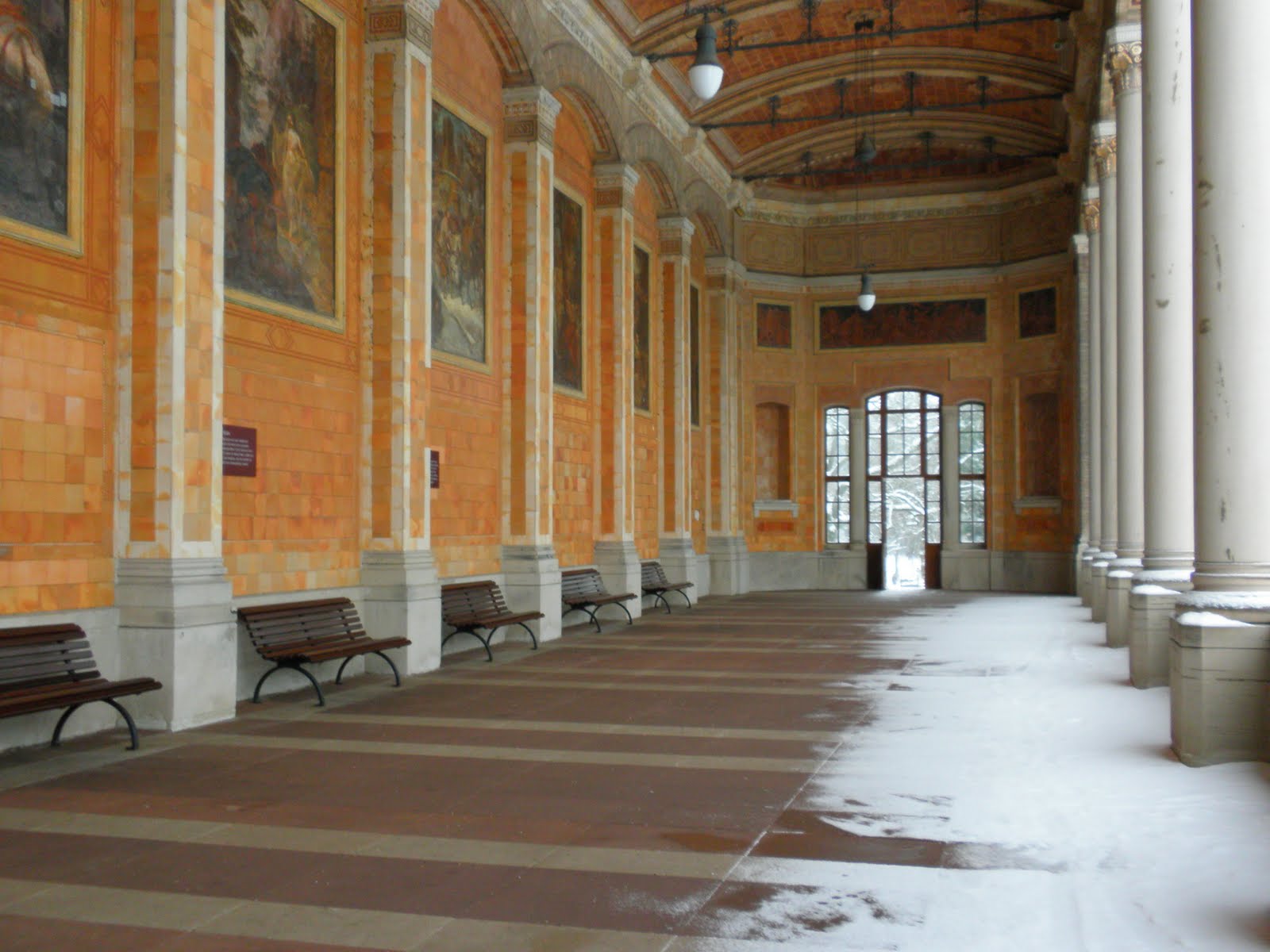
After lunch we moved the car from the short-stay car park and then investigated the city centre on foot. We walked through the snow that was continuing to fall, first to the Kurhaus, which is the city’s most famous landmark and is one of the most beautiful buildings in town. Originally it was a Promenade House and was the place to see and be seen and even today is the hub of the social scene and contains beautiful spa gardens filled with expensive shops, bars and reading rooms. Next, the oldest casino in Germany that has been a favourite amongst people from all over Europe for two hundred years or so. The Russian writer Dostoevsky wrote ‘The Gambler’ in Baden-Baden while compulsively frittering away his cash at this famous Casino and finally we walked by the Friedrichsbad or Old Baths that was built between 1869 and 1877 under the order of Grand Duke Friedrich von Baden. They follow the Roman-Irish method, which takes around two hours to complete the whole program, which includes a shower, two saunas, 55°c and 70°c, a brush massage, soaping, thermal steam baths and three freshwater baths.

The springs of Baden-Baden were known to the Romans, and the foundation of the town is attributed to the Emperor Hadrian but the town’s heyday was in the latter nineteenth century when it became a firm favourite with the aristocracy of Europe and featured prominently on their annual itinerary of places to visit and in the centre of the town and outside the Kurhaus spa, is an impressive bust of Kaiser Wilhelm I who especially liked this place. At that time it was called simply Baden as it always had been since the middle ages and it was only in 1931 that the town was officially given its double name which literally means Baden in the State of Baden, I suppose that would be a bit like Warwick-Warwick or Derby-Derby if the same principle was adopted in the United Kingdom. In both World Wars, the town was fortunate to escape damage or destruction which must have been a huge stroke of luck considering what happened to most of the Rhine towns and cities and after World-War-Two it became the headquarters of the French forces in occupied Germany who rather found the place to their liking.

After taking a short walk through the city park we agreed that this wasn’t really a good day for being out of doors and sightseeing and that we would be better off in a bar so we found a cozy place on the edge of town with a good view of the park and spent the last hour of our visit to Baden-Baden with a beer and a glass of wine. And it still kept snowing.

When it was time to leave we walked along the main street of expensive shops with their extravagant window displays and very high prices because Baden-Baden was a place of complete contrast to any of the other towns and cities that we had visited this week. After returning to the car we drove out of the city, stopped for fuel and were shocked by the price of a litre of petrol and then found our way back to the Airpark without any trouble although we kept an eye out for hotels and guesthouses in case we had to come back later. When we arrived we returned the car and its winter tyres to the car hire car park and I was quite sorry to leave it because I had grown attached to it on our winter driving adventures.

The airport was small and we felt sorry for the hundred passengers or so who were putting up with a four hour delayed flight to Rome and we hoped this wouldn’t happen to us. We were confident of getting off on time when the plane arrived and we were all settled down on board but immediately disappointed when the captain announced that he had brought out two engineers to mend the broken plane that was going to Rome and we had got to wait until they were finished so that we could take them back again. This meant an hours delay sitting on the plane but just as fellow passengers were starting to get fidgety and grumpy the men finished their repair job, climbed on board and within minutes we were on the runway, in the sky and on our way back to Stansted.

Friday, 25 June 2010

Black Forest, Schiltach and a Blizzard


At breakfast on the final morning the sun was shining and there was a blue sky so we weighed up the options and decided to drive through the northern half of the Black Forest and spend the afternoon in Baden-Baden before catching the late flight home. Unfortunately by the time we had packed our bags and checked out of the Rammersweir Hoff the sunshine had disappeared and had been replaced by the familiar grey sky. (There was no additional charge for the repair of the cuckoo clock by the way).

For the final time we took the road out of the city, through Gengenbach, Haslach and Hausach and then drove east along the Kinzig valley crossing the longest river in the Black Forest several times on our journey towards Schiltach where we arrived soon after. We parked the car in a car park next to the river near the tanner’s quarter, which is the oldest part of the town. Here the timber framed buildings were built at the side of the Kinzig in the eighteenth century and were used by the tanners in the production of especially high quality leather goods, which the town was famous for.

Two thousand years ago the Romans passed through Schiltach and constructed a road that we followed now from the river to the Städle or Old Town where every building was half timbered with colourful facades and brightly painted wooden windows that imparted a fairy tale ambiance. There was simply nothing here to spoil the picture book mood and character and in the pretty triangular market place at the heart of the town the Fasnacht festival bunting hung high above the cobbled street and old town well, the merchant’s houses and the town hall with its striking Teutonic wall paintings. After walking around the town and before we left for the next stage of the journey we found a little place at the side of the river Schiltach and stopped for refreshment in the immaculate café that was serving fresh cakes and treats.

We left Shiltach and took the road towards the city of Freudenstadt on the eastern side of the forest and after a few kilometres the road began to climb and at the same time the sky darkened and it started to snow and the weather was in complete contrast to the beginning of the day. It became grey and bleak and the snow became heavy enough for us to abandon a plan to take a scenic back road to by-pass the city and we continued on the main road instead. When we approached the outskirts of Freudenstadt we became confused by the road signs that didn’t seem to cater for the route we had chosen and we went wrong a couple of times and nearly crashed the car looking for the road to Baden-Baden.

Freudenstadt had had a lot of snow and this current fall was adding to the deep piles at the sides of the roads. It was a blizzard really and although some residents were valiantly trying to clear paths they were fighting a losing battle and would have been better off waiting for half an hour or so or until it stopped. The road kept climbing out of the city until we reached the village of Kneibis where we had planned to stop for lunch but the blizzard was so bad that we couldn’t find the restaurant that we had visited two years ago and it wouldn’t have been sensible anyway because one again the road surface was disappearing fast. So we carried on.

Soon we were in the grip of a complete whiteout and this was probably the most snow that I have ever seen in my life. Houses, fields, trees, everything was obliterated including the road and fairly soon it was impossible to distinguish the tarmac from the verges. The temperature dropped to minus six and the windscreen wipers froze again and became completely useless. The map showed that the road ran a serrated course and the jagged route meant a succession of sharp twists and turns as we climbed towards the highest point at about one thousand one hundred metres which is just about the same elevation as Mount Snowdon in Wales. At its highest point the Black Forest Mountains reach one thousand five hundred metres which is just a bit higher than Ben Nevis. And at this height it was just about possible to appreciate the vast scale of the forest that covers an area of about twelve thousand square kilometres which is roughly the equivalent of Yorkshire which is the largest county in the United Kingdom.

This was the worst journey of the few days in Germany and we were counting down the kilometers to Baden-Baden and wishing them away. We looked for a way of getting off this dangerous scenic route on the high ridge and dropping down into the Rhine Valley below and the autobahn but there were only minor roads in even worse condition than this one, which by now could be used as an Olympic bob-sleigh run, so it wasn’t worth taking the risk. With about twenty kilometers to go the road started to drop and this brought with it the added danger of skidding under braking and I had to be ultra cautious on the pedals. At one point a car in front did a theatrical 360° spin which required more braking than I was comfortable with but the winter tyres did their job and although there was a bit of sliding the car came to a controlled and graceful stand-still.


Monday, 5 April 2010

Black Forest, Badische Schwarzwaldbahn


I woke early in the morning and now that the effects of the wine had almost completely worn away immediately recalled the incident with the cuckoo clock and I worried that I might have broken it and would be presented with a hefty repair bill when we checked out. Wide awake I checked the weather and instead of the blue sky that we had predicted there had been a significant fall of snow and it was still coming down thick and fast.

Over breakfast we agreed that this was probably not a good day to be driving around the Black Forest on snow bound roads even with winter tyres so we decided to take a train journey instead. The car took some clearing and de-icing and then we left the residential streets of Rammersweier and headed towards the city centre and the train station. This being Sunday there wasn’t a lot of traffic about and the snow that had fallen remained mostly undisturbed and lay like a thick carpet across the road and the pavements. We negotiated our way safely to the station, found a car park and because it was still snowing left the car hoping that it wouldn’t get completely snowed in while we were away.

We had missed the train by just a couple of minutes so this provided an opportunity for an early morning beer in a bar opposite the station while we waited before going back to purchase our €30 day return ticket for a journey into the forest on the Badische Schwarzwaldbahn. The Black Forest Railway (as we know it) was built between 1863 and 1873 and today is a twin-track, electrified railway line running in a north-west to south-east direction and links Offenburg on the Rhine Valley Railway with Singen on the Upper Rhine Railway. It passes directly across the Black Forest, through spectacular scenery on a route that is one hundred and fifty kilometres long, ascends six hundred and fifty metres from lowest to highest elevation, and passes through thirty-nine tunnels and over two viaducts. It is the only true mountain railway in Germany to be built with two tracks, and is the most important railway line in the Black Forest.

Being Germany the scarlet DBAG Class 146 locomotive and modern double-decker passenger cars arrived and left completely on schedule and we selected good seats on the top deck with excellent views on both sides. The first part of the journey was quite flat as we passed through Gengenbach on our way to Hausach as the train lines followed the route of the Kinzig valley through sleeping vineyards and lifeless orchards and then as the valley narrowed the train began to climb effortlessly towards the most dramatic and scenic part of the route through the Gutach valley to Hornberg and then to Triberg and on to Sankt Georgan.

In this middle section the train has to ascend six-hundred metres through a series of helical tunnels and this part of the line was the most complicated to construct and was completed last. The route passes through thirty-seven tunnels in this section alone and across one large viaduct at Hornberg. On its way from north to south, the line passes under the main European watershed (a geographical feature that divides the drainage basins of the major rivers of Germany north and south) twice, once via the Sommerau tunnel between Triberg and Sankt Georgen, which is one thousand seven hundred meters long, and then via the Hatting tunnel, between Engen and Immendingen, which is nine hundred meters long.

This was a brilliant journey through magnificent scenery, thick snow and blizzards and as I was not driving today I was able to enjoy the fabulous views. After Sankt Georgan the line began to descend again until it reached our first destination of Villingen-Schwenningen where we left the train after a journey of an hour and ten minutes. It had stopped snowing now but not before it had deposited several centimetres on top of the town and everywhere looked pristine and clean under a dazzling white mantle.

Perhaps Villingen is always quiet on a Sunday or perhaps the snow had kept people in doors because the place was curiously tranquil today and everywhere was closed and it was obvious that this was not the place to drive out to for Sunday lunch on a snowy day. The town was much like Freiburg only smaller with a main street with too many shops but pretty enough with pastel coloured facades and colourful window displays but as there wasn’t a great deal to do we only stayed for forty minutes and then took the next available train back to Triberg.

From the eastern edge of the forest we went back through the cork screw loops into the high mountains covered in pine trees all bearing a heavy burden of snow and standing in rows like an army regiment waiting for orders to march. Before we reached Triberg there was another blizzard and the train passed through the succession of long dark tunnels with each black void ending with the explosive contrast of the brilliant white cresta run channels of trackside snow as we passed out of them. It was simply wonderful and we enjoyed it.


Wednesday, 31 March 2010

Black Forest, A spot of bother with a Cuckoo Clock


Despite the detour Kim navigated us back to the main road and suddenly there was a complete change in the weather, the clouds parted and let the sun through and there was a late afternoon blue sky. We were glad of this because this meant that we could return to Gengenbach to try and get the pictures that we wanted. We had to be quick though because it was getting late and the sky was beginning to darken as the sun dipped away somewhere over France so we did a whistle-stop march and then finished the afternoon in a smart Italian bar for a cup of tea and a slice of cake.

After stopping for wine supplies at a discount supermarket we arrived back at the hotel where the car park was coned off for no obvious reason. Thirty minutes later we discovered why when a coach party from the Netherlands arrived and swarms of guests on a Black Forest tour bus took over most of the hotel. This meant that the restaurant was especially busy tonight and we had to share a table with a German couple from Friedrichshafen in a side room just off the main dining area. Because they were so busy the service was slow which meant that we drank more wine than usual and after the German couple had left us to ourselves I started to poke around the bric-a-brac and the ornaments and then foolishly started to fiddle with an impressive large cuckoo clock hanging on the wall behind the table.

Immediately I wished I hadn’t touched those cone things that drive the mechanism because it unexpectedly whirred into life and out popped the cuckoo which turned out to be a rather loud cuckoo. And then as the chain headed non stop towards the floor it popped out several more times, each time announcing itself with its little song that just seemed to get louder and louder. The doors were banging, the chains were rattling and I wondered if I might have to throttle it. This impromptu and unscheduled entertainment seemed to amuse the people on the bus tour who were giggling and laughing and I just wanted the thing to get back in its box and shut up. There was no such luck and the clock went through twenty-four movements in under two minutes and believe me that is an awful lot of cuckoos. Then just as I was giving up all hope the thing thankfully finally exhausted itself and it stopped and with me red faced with embarrassment we slipped out of the restaurant and went back to our room before I could get up to any more mischief.

Monday, 22 March 2010

Black Forest, Freiburg and a Blizzard


Freiburg, or to give it its full title, Freiburg im Breisgau is one of the famous old German university towns, was incorporated in the early twelfth century and developed into a major commercial, intellectual, and ecclesiastical centre of the upper Rhine region. Statistically it is the sunniest and warmest city in all of Germany but that certainly wasn’t the case today. As we parked the car and walked towards the city centre there was a steel grey sky, a spiteful wind and stinging sleet, the pavements were wet and the colour was bleached out of the buildings and streets and after just a couple of minutes we knew that it was unlikely that we would be seeing the best of Freiburg today.

We walked to the centre of the city to the cobbled Münsterplatz or Cathedral Square where there was a small unhappy looking market where people were rushing past the stalls because it was too cold to stop (except for the fast food van that was doing brisk business and had a queue of people lining up for fasnacht doughnuts) and we did our best to find the cheerful bits of Freiburg’s largest square. The square is the site of Freiburg’s Münster, a gothic minster cathedral constructed of red sandstone, built between 1200 and 1530 and which is memorable for its towering needle like spire. We went inside and it was cheerful and warm with large stained glass windows and friezes on the walls that commemorated the various traditional trades of the city.

It didn’t take long to do a full internal circuit of the Münster and fairly soon we were back on the perishing streets complete with the city’s unusual system of gutters, called Bächle, that run throughout the centre. These Bächle that were once used to provide water to fight fires and feed livestock are constantly flowing with water diverted from the River Dreisam. During the summer, the running water provides natural cooling of the air and offers a pleasant gurgling sound but we didn’t need cooling down today. There is a saying that if you fall or step accidentally into a Bächle, you will marry a Freiburger but I imagine there is a much greater chance of just breaking a leg.

The weather was horrible now, it was getting colder and beginning to snow heavily so we had to concede that Freiburg wasn’t the place to be this afternoon and we returned to the car getting lost and losing our way in the tangle of little streets around the Münsterplatz. We were glad to get back to the car and begin our journey back to Offenburg. On the way out of the car park the ticket machine flashed the message ‘gute fahrt’, I thought ‘thanks very much and after that glass of gassy German Pils I just might.’

To return there was the same choice, autobahn or scenic route and just like this morning we took the second option but about ten kilometres out of Freiburg it started to snow and within minutes we were in the middle of a full blizzard and the driving snow was beginning to obliterate the road in front of us. For a while we followed in the tracks of vehicles in front but one by one they began to turn off and soon we were left with no one to follow and no tracks to help. Yesterday on icy roads had been interesting but this was just plain scary. We slipped and skidded, the windscreen wipers froze into solid chunks of ice and stopped working and we debated the alternative of turning around but decided that this wouldn’t be helpful because the conditions were just as bad in the other direction. So we carried on. Back through Gundelfingen, Denzlingen and Waldkirch and then the climb to Elzach where the temperature dropped to minus six and the snow on the road just kept getting thicker and thicker. There wasn’t a lot of traffic about which was a bit of a concern, just the occasional car coming towards us in the opposite direction and I was glad when we reached the top and started the slippery descent towards Haslach.

Conditions started to improve but just north of Haslach the road was closed, probably due to an accident, and we were diverted off and had to plot an alternative route back. Kim did a brilliant job of this but I overruled her at one point, went wrong and ended up on a very minor road that was completely wiped out and soon discovered that driving is especially difficult when you have to watch the road and concentrate on keeping your arse cheeks squeezed together at the same time.

Sunday, 14 March 2010

Black Forest, Cable Car Ride


Overnight the rain turned to snow and there was a little dusting on the roofs of the houses next to the hotel and on the road outside but the sky was still grey and overcast so we decided to take a drive to the city of Freiburg about fifty kilometres to the south and after breakfast we de-iced the car and set off. We could have taken the direct route on the autobahn but we decided instead to take a scenic route through the forest.

First we passed through the village of Ortenberg which was an ordinary sort of place except for a large castle standing in a dominant position on a hill with a good view overlooking this part of the Rhine Valley. It looked in good condition and we found out later that it is now a youth hostel.

Soon we arrived in Gengenbach which is a small town and a popular tourist destination on the western edge of the Black Forest. Gengenbach is well known for its traditional Fasnacht where the residents of the town closely follow tradition with the wearing of costumes and carved wooden masks and clapping with a Ratsche which is a wooden rattle like those we used to take to football matches before they became a health and safety hazard. We parked the car and tried to make sense of the parking fee information, bought more time than we really needed (forty-eight hours) and then walked into the Altsadt which was gaily decorated with bunting and flags for the festival. In the main square Gengenbach has a traditional town hall which is claimed to be the World’s biggest advent calendar because the twenty-four windows of the eighteenth century town hall represent the twenty-four windows of the calendar.

Just behind the main street there was a warren of tiny crooked streets surrounded on all sides by the most picturesque half timbered buildings and it was almost possible to imagine that we had wandered into a secret fairy tale village of uneven cobbled streets, colourful houses and cottages and might at any moment bump into Little Red Riding Hood or Hansel and Gretel. This part of the town presents such a traditional image that it was here that some of the scenes from ‘Charlie and the Chocolate Factory’ were filmed to represent Dusseldorf. We wandered through and out the other side and then returned to the car promising to return later if there should be any blue sky.

After leaving Gengenbach we followed the same road as the day before as far as Haslach but then took a different route towards Elzach and Freiburg. The road started to climb quickly and it began to snow just as we passed a road sign that seemed to suggest that it might be advisable to have snow chains ready for the tyres. As the snow became heavier we could understand why but it wasn’t getting too deep and the winter tyres seemed to be coping well enough again but just to be sure we kept to the main road and didn’t head off any ambitious scenic detours today.

And we really didn’t need to because this was a very attractive route anyway and we passed through the towns of Waldkirch, Denzlingen and Gundelfingen and eventually approached the outskirts of Freiburg where there was a series of road works and detours. We drove straight through the city with a plan to come back later and continued south towards the one of the highest parts of the Black Forest, the Schauinsland, and once outside the city we started to climb once more.

Schauinsland literally translates as ‘look into the country’ and we now set off on a twelve kilometre climb to the top through a series of sharp twists and turns through hair pin bends and narrow gorges and as we climbed the temperature dropped to minus six, it started to snow and the road turned into a treacherous river of slush. At one thousand, two hundred and ninety-five metres we reached the top and living in Lincolnshire that is about one thousand, three hundred metres higher than we are normally used to. The top of the mountain was a place of winter pastimes and people were skiing down the slopes, children were sledging and families were walking together through the thick snow. There were good views but the weather was getting worse and the snow even heavier and we were apprehensive about the drive back down so we didn’t stay too long.

We negotiated the snow and drove down the difficult road to the village of Horben and then decided to go back up again but by a different form of transport because from here it was possible to reach the summit on the Schauinslandbahn, which at just over three and half kilometres is the longest cable car ride in Germany. The return ticket cost €11.50 but it was well worth it because as we climbed through an avenue of snow covered conifers there were great views to the north-west all along the Rhine valley and into neighbouring France.

At the top once more it was snowing again and we emerged into a scene of pristine white snow, several centimetres deep, a crisp atmosphere that clawed at our fingers and toes and pure mountain air that filled our lungs and cleared our heads. We walked for a while through trees weighed down heavily with snow, deep frozen and covered in frost and ice, along steep slippery paths where we had to watch our step as we walked all around the summit and then back to the cable car. We had a short stop in the café but this was best forgotten because the service was lousy, the coffee was barely luke warm and the prices were a rip off.

On the return cable car journey it was cold and draughty in the cabin but for compensation there were more magnificent views over the mountains and across to the city of Freiburg which was where we were going next.

Saturday, 6 March 2010

Black Forest, Cuckoo Clocks


Triberg looked stunning under a covering of fresh snow and we started out to walk the main road which was difficult in the snow and ice because the town is very hilly and the main tourist road runs up a steep straight incline toward the waterfall at the top. The snow on the path to the waterfall was completely undisturbed and we were the first to use it this morning as we made our way towards the lower and middle falls. The snow was thick and came over the tops of our boots and it made a satisfying crunch with every footstep towards the top until we reached the noisy waterfall where the Gutach River plunges over a series of cascades two kilometers long and about five hundred meters high. The falls were spectacular this morning roaring over the rocks in between snow covered banks and icicles where the water had submitted to the freezing conditions and was temporarily fixed in time.

Many of the paths were closed for safety reasons but this didn’t stop Kim from squeezing in between the barriers, ignoring the closed signs and finding her way back to the bottom along a high ridge. As we were in Germany I did what the Germans do and respectfully obeyed the instructions. We met up again at the bottom of the falls and at the top of the main street that was full on both sides of tourist shops selling Black Forest souvenirs and traditional crafts including cuckoo clocks, because Triberg is the cuckoo clock capital of the forest.

Although the idea of placing a cuckoo bird in a clock did not originate in the Black Forest the cuckoo clock as we know it today comes from this region located in southwest Germany whose tradition of clock making started in the late seventeenth century. The people of the Black Forest who created the cuckoo clock industry developed it and still come up with new designs and technical improvements which have made the cuckoo clock a valued work of art all over the world. The clock is a symbol of the Black Forest and is probably the favourite souvenir of visitors to Germany, Austria and Switzerland and the centre of production is right here in the middle of the forest in the area of Schonach and Titisee-Neustadt.

We spent some time in the ‘house of a thousand clocks’ amongst the richly decorated time pieces displaying carved leaves, birds, deer heads and all the other forest animals and sometimes methods of shooting them as well. And with cuckoo clocks chiming and cuckooing all around us we even considered a purchase but the high prices and the pressure on the meager Ryanair baggage allowance stopped us from making the very basic tourist mistake of buying something for the sake of it and then wondering what on earth for when we got it home.

The time on the parking ticket was running out but before we left we found a hotel bar where we had soup and a beer and warmed our clothes on the radiator and then when we were finished we put our coats back on and went outside where it had stopped snowing so instead of going straight back we left the town of Triberg and set off for our next objective, the town of Schiltach.

The main road was clear again now and because we obviously hadn’t learned any lessons this morning about driving conditions at Sankt Georgan we turned off and choose a minor road through the forest towards our destination. Sankt Georgan was under several centimetres of snow and as the road began to climb the surface disappeared under a white blanket and we began to wonder if we had made an entirely sensible decision. The worst point of these journeys was always the mid way point where the turn-back option disappeared and there was no alternative but to carry on. The road took us through the town of Schramberg where everyone was busy clearing snow and then finally on to Schiltach where we found a car park without any trouble and we took a walk around the small town centre and along the river Kinzig.

After we had walked around the attractive streets of half-timbered buildings we had a drink in a little pub on the main road, warmed ourselves up again and then took the main road back towards Offenburg. It was still snowing but it was a nasty wet snow now and as we dropped out of the mountains it became grey and bleak and not very pleasant at all. We stopped at the Aldi supermarket in Haslach because we needed wine and being constrained to screw caps were restricted to a very limited selection and I for one will be really pleased when corkscrews can be taken on board planes again.

In the evening, based on complimentary guest reviews, we took the easy option and ate at the hotel in a busy dining room surrounded by ornaments, Black Forest bric-a-brac including cuckoo clocks, sporting trophies and decorations for the festival of Fasnacht which is a carnival in Alemannic folklore that takes place in the few days before Lent in Southern Germany, Switzerland and Alsace. The Alemanni were German tribes who lived in this part of Europe nearly two thousand years ago and this area remains characterised by a form of German with a distinct dialogue called Alemannic. The celebration literally means ‘Fasting Eve’ as it originally referred to the day before the fasting season of Lent. The schools are all closed for this festival and all over the Black Forest there are six days of parties and making merry. During this period a sort of doughnut is popular and these are called fasnachts that are a traditional fatty treat that are produced as a way to empty the pantry of lard, sugar, fat and butter, which are forbidden during Lent. This is a catholic tradition but in protestant England we call this Shrove Tuesday and serve pancakes instead of doughnuts, it is much the same thing.

They were certainly clearing out the pantry tonight and the restaurant was full of people enjoying hearty meals and plenty of beer and wine. We joined in and really had too much to eat, so much that we certainly couldn’t clear our plates which we apologised for. It was still damp and miserable when we went to bed so we held off making any plans until we could assess the situation in the morning but it didn’t look as though we would be needing the winter tyres.

Saturday, 27 February 2010

Black Forest, Over the Mountains to Schiltach


We had selected the Rammersweier Hoff hotel (http://www.rammersweier-hof.de/) because it was inexpensive and because of its location about half way between the main cities of Baden-Baden and Freiburg and on the western edge of the forest in the Rhine Valley. Also because last year when we had to cancel at the last minute they were really good about it and didn’t charge a cancellation fee even though they were entitled to. It also had excellent guest reviews and these were entirely correct. It was a homely place and very traditional with Teutonic décor and a collection of Black Forest ornaments. In the morning we had breakfast in the brightly coloured restaurant and there was a good selection of hot and cold food so we filled ourselves up on the basis that this would last us through until evening meal.

We hadn’t made any firm plans because we were waiting to see what the weather would bring and this morning it was dull and overcast so we decided to drive into the forest and visit some traditional towns and villages. We drove out of Offenburg through a string of places all squeezed into the narrow strip of flat land of the Rhine Valley on the German side of the river. We were right on the edge of the forest and to our left thickly wooded hills with a sprinkling of snow rose up dramatically towards the mountains beyond.

As we drove through Gengenbach, Haslach and Hausach there was a bit of snow in the wind but not a great deal of it and we began to wonder again about being ripped off for the winter tyres. It was a bit grey and dull and driving conditions presented no real challenges at all. We were heading for the tourist town of Triberg but really wanted some excitement so in need of snow and scenery we turned off the main road and into the mountains and started to go up.

The car climbed steeply and negotiated a succession of hair pin bends first through deciduous trees surrounded by the remains of last year’s autumn leaf fall and then into dense conifer forest and as it did so we quite quickly found ourselves above the snow line. Suddenly the Black Forest was completely transformed into the White Forest. There had been a substantial fall of snow a day or so before and the conifer trees were heavily laden with crisp white snow fixed in place by a stiff frost and it was as though we had been transported into a Christmas card world of snow and ice, frozen lakes and winter sports.

After a short distance we found the snow we had been chasing. Rather too much snow as it happened because from out of nowhere there came a blizzard that wiped out the road and left only the snow marker poles at the sides of the road to guide us. The little car kept climbing, through twisting bends and sharp turns, climbing to a thousand metres where the fresh snow was building up all the time on the road and it was about now that I had to concede that I was glad of the winter tyres because the conditions here would have tested the driving skills of the World Rally Champion Sébastien Loeb. The car was sliding and skidding and we passed some vehicles that had given up and ground to a halt and Kim’s contribution was by now restricted to the very unhelpful ‘I’m frightened, I’m very frightened, I’m very, very frightened’.

Finally we reached the top of the climb and we started to descend and conditions began to ease except that going downhill was still rather precarious and I was reluctant to use the brakes in case we skidded on the wet snow. Eventually we reached the town of Schonach where the heavy snowfall seemed to have surprised a lot of people and there was a lot of traffic disruption on the main street. About half way through there was a lorry that even with snow chains had run out of traction and was slipping and sliding and causing mayhem. Unwittingly I added to this because as I passed I brought another smaller lorry to a stop and then he couldn’t get going again. The driver wasn’t too pleased and flashed me some hand signals that can’t be found in the official German Highway Code.

Only a few Kilometres from Schonach we reached our first destination, the Black Forest tourist town of Triberg and in a region that has more than its fair share of tourist attractions, there is none that compares to this small town in the middle of the Schwarzwald because it has just about everything, the tallest waterfall in Germany, souvenir shops with the largest collection of Black Forest-related souvenirs and wood products for sale, and the world’s biggest cuckoo clock. Nearly every restaurant and café offers ‘authentic‘ Black Forest Cake, and tour groups arrive here by the busload.

Luckily for us it wasn’t too busy today and a lot of the car parks were under too much snow to be useable but the snow ploughs had kept the road open, there was lots of path clearing activity and a short stay car park in the main square was just about open so we literally slid in found a vacant spot and parked the car.

Sunday, 21 February 2010

Black Forest, Winter Tyres?


Two years ago we visited Germany and stayed in the city of Baden-Baden in the north of the Black Forest and enjoyed it so much that we booked to return a year later. We didn’t make it however because on the day of the flight there was a little bit of snow across the United Kingdom which closed down all of the airports and cancelled all of the flights. Not to be outdone by inefficient English bad weather emergency response planning however we booked again to visit in January 2009 and this time with mild weather at Stansted the flight got away as planned.

It took only fifty-five minutes to fly the short distance and land at Kahlrsrue-Baden Airpark at nine-thirty in the evening and after quickly clearing immigration and customs we were soon at the Sixt Car Hire desk to pick up our hire car. There was a pleasant young man on duty called Herr Schmidberger and he examined my hire details and then sighed and furrowed his brow and adopted a concerned demeanour, “You have a booking for a vehicle without the winter tyres” he said, “are you sure you want a car without the winter tyres?” I had no idea what he was talking about and must have given him my best blank expression because with that he rolled his eyes so far back into their sockets that if had laser vision he would have fried his brains. The winter tyres were an extra €55 and I was beginning to detect a well rehearsed scam so we took a while to consult with each other on the proposal of paying the extra and this started to test his patience.

I enquired why I might consider going to the unnecessary additional expense and although this was his opportunity to inform me that since May 2006 German motorists have been required by law to use the most appropriate tyres for the weather conditions and that driving on snow covered roads is permitted only if a car is equipped with winter tyres, instead he became even more theatrical and speaking in that clipped precise sort of way that Germans do when speaking English said “Look at the snow, you can see the snow, in just two minutes you can see the snow!” Obviously I could see the snow but I still failed to understand why he was so insistent (unless it was a scam). He could have told me that in Germany motorists are obliged to make sure they have correct tyres to suit the winter weather conditions and if a vehicle becomes stuck because the tyres are unsuitable drivers are liable to an on the spot fine, and further more if the vehicle causes an obstruction or aggravation to other traffic, the fine may be doubled. Instead he gave a look that suggested that I was the craziest customer that he had ever dealt with and that driving without winter tyres in snow was madder than wrestling with alligators, swimming in shark infested waters or sky-diving without a parachute.

I asked about the weather forecast and whether he thought it might be snowing in the Black Forest (which at over a thousand metres was an absolute certainty and a really dumb question) and then his eyes started to swivel from side to side like the symbols on a fruit machine and he was clearly losing his patience with me now. He might have explained that winter tyres use a tread rubber compound and block pattern specifically designed to retain flexibility in low temperatures and give good braking and traction performance on snow and ice covered roads but instead he just keep shrieking “Look at the snow, you can see the snow, in just two minutes you can see the snow!” By now we were beginning to understand that he thought snow tyres were a very good idea so finally agreed to the additional charge and he immediately calmed down and set about allocating us an appropriate vehicle for the conditions.

After that he went through the booking and paying procedures, explained where we would find the car in the car park and then clearly lacking any sort of confidence in my snow driving abilities and not expecting to see the car again in one piece bade us farewell with the words “please be sure to drive carefully in the snow, it is very dangerous…”

We quickly found the bright blue Nissan Micra hidden under a blanket of snow, cleaned it down, examined the tyres which, at this time not understanding about the special rubber compound looked quite normal to me and fairly soon after setting off I was certain we had been scammed. And we had been of course because at €13.45 a day I calculate that if they are on the car for a third of the year that is an extra €1,600 or €400 a tyre and I cannot believe that they can be that much more expensive than a regular tyre. And of course they are not because I have checked and they can be bought for as little as €40 each.

Preoccupied by this thought and how Herr Schmidberger had taken me for a mug I predictably took the wrong turn out of the Airpark and instead of reaching the motorway as intended we found ourselves on the back roads driving through small villages and searching for clues from the occasional unhelpful road signs. Although Kim has improved recently as a navigator she was off duty tonight so we just had to keep going and trusting in our natural sense of direction. It was still snowing but not as heavily now and I began to curse myself for having been rushed into the winter tyres decision. Eventually, after a bit of a detour, we reached the motorway and then the right exit and then after only one more mistaken wrong turning which we quickly corrected found the Rammersweir Hoff hotel without any difficulty at all. This is unusual for us and quite remarkable because the place was tucked away in a side street in the middle of a residential area and on a different occasion I could easily have spent hours searching for it.