Showing posts with label Benidorm. Show all posts

Wednesday, 5 January 2011

Spain, The Search Continues


Since early 2009, as part of our own Grand Tour of Europe, we have been drawn time and again to the Iberian Peninsula in search of the real Spain and in November 2010 we returned once more, flying to Madrid and planning a short three night stay in the city of Ávila about one hundred kilometres north west of the capital city.

Spain was not, generally, part of the traditional European Grand Tour and until the twentieth century only caught the attention of the braver or more rugged of travellers and writers. For many it was too primitive, too mountainous and just too dangerous, prone to violent upheavals, inhospitable weather and without acceptable restaurants or decent amenities. ‘To travel in Spain you need three francs a day and a gun’ said one Frenchman who accompanied Alexander Dumas on a mid nineteenth century trip to the peninsular. For the sons and daughters of the English Aristocracy Spain did not have the sophisticated allure of France, the Renaissance treasures of Italy or even the ancient charm of Greece and very few people ever considered crossing the Pyrenees into a land perceived to be full of fanatical Jesuit priests and lurid tales of bandits and cut-throats.


What a pity because, as I have now discovered over the past two years, they were passing up on the opportunities of marvelling at Baroque Seville, the Hanging Houses of Cuenca, the walled fortresses of Ávila and Ciudad Rodrigo, the historic cities of Toledo and Salamanca, the numerous Royal Palaces that surround Madrid and the rich heritage of Roman and Moorish Spain with the largest remaining Roman aqueduct at Segovia and what was once the second largest Mosque in the World at Cordoba.

Right up until the 1950s Spain was considered to be a place for the courageous because it was different and mysterious with a hostile geography, haughty aristocratic grandees and destitute peasants, Romany gypsies and blood thirsty customs. Travellers and visitors were often inclined not to regard it as part of Europe at all and it was often considered, on account of its Moorish heritage, dark skinned people and unfamiliar customs, as part of Africa or of the east. The Spanish themselves understood this perception of their peninsular and in the 1960s “Spain is different“ used to be the slogan of Spain’s international tourism campaign.


Sadly, even today, for many, Spain means only a fortnight’s karaoke holiday spread out on the golden sands of the Costas with a bottle of sun cream and a jug of sangria without any real attempt to understand the geography, the history or the culture of the country. But for those with imagination and an appetite for an experience of real Spain then the airports of Valladolid, Seville, Santander and Madrid are the places to begin a quest to find the Spain of the shrines, the Spain of the Knights-errant, the Spain of the Mosques, castles and mighty cathedrals as well as the Spain of the real castanet clicking flamenco dancers, Spanish guitars and matadors and bull fights as opposed to the ersatz versions of the holiday resorts.

The Easyjet plane flew over the Spanish coast at Santander and we could see the snow capped Picos de Europa Mountains soaring majestically through the low cloud which then immediately closed in and smothered northern Spain and Castilla y Leon completely. The land was completely obscured from view breaking only over the peaks of the Sierra Guadarrama and briefly revealing mountain towns and villages, rivers and shimmering blue reservoirs. A few minutes later around mid morning we landed in a misty Madrid where the temperature was struggling to reach double figures and after the formalities of border control went straight to the Sixt car rental desk.


Since my complaint about Sixt and winter tyre charges in Germany earlier this year I have been in regular correspondence with the Company Customer Services Manager for the UK and this led to the issue of a Sixt platinum account which gives me certain privileges such as discounted prices, speedy pick up service and on this occasion an upgrade from a Volkswagen to a BMW and we were delighted when we took possession of a shiny white 1 series, left the airport and pointed it in the direction of the mountains and the sunshine.

Friday, 6 August 2010

Benidorm 1977 – Food Poisoning and Guadalest


The weather was good to us for most of our stay and mostly it was sunny and dry, which meant plenty of time for lying on the beach or sitting around the swimming pool that was directly outside the front of the hotel. During the second week however there was a bit of a change and we experienced some very heavy showers. One afternoon it rained so hard that the Avenida de Almeria, the road to the beach, was completely flooded and rather than a street instead resembled a river in full flow. We couldn’t go out that afternoon so we sat in the bar with another older couple and shared a bottle of bacardi that I had won the previous day on a trip to the mountain village of Guadalest.

I mentioned before that the food wasn’t too clever and one day Linda went down with an awful case of food poisoning and was confined to the room. This was inconvenient because the next day we were due to go on a full day sightseeing trip and because we had paid for the tickets I was determined not to miss it and selfishly made Linda get up and go even though she really wasn’t anything like well enough. At the first scheduled stop the first thing she needed was the WC facilities but they were those old fashioned stand up and grab a handrail ones that aren’t very nice to use at the best of times. Anyway, I won’t go into the details here but the consequence of the visit was that I had to take off my underpants and give them to Linda and this left me ‘going commando’.

At the next scheduled stop was lunch followed by some silly games. Linda unsuprisingly didn’t eat lunch and she wasn’t in the mood for silly games either. One of the games was to put half a dozen girls or so in the middle of the floor and get them to obtain things from the audience and in each round the last one to do so was eliminated. A bit like musical chairs but this involved getting hold of other people’s personal possessions like watches and belts before it moved on to clothes. One girl found me cooperative and kept coming back and soon I was down to just my jeans. Inevitably the game organiser called for a pair of trousers and she came my way. The whole game was designed to get some poor bloke down to his underpants and giggle at him but I hadn’t got any on. I declined but she was persistent and she kept insisting and eventually I gave in, whipped off my trousers while trying to preserve my rapidly vanishing dignity, she ran to the centre of the room, won the game and that is where the bottle of bacardi came from! Linda wasn’t impressed but the other people on the trip found it all very amusing.


After the shock of getting a participant down to his birthday suit the trip continued on to Guadalest by way of a twisting road that climbed ever upwards, passing through the village of Polop and finally reaching a spectacular position at the top of the mountain with breathtaking views and the village sitting perched on the very top of the mountain. This was an old Moorish fortress that was virtually impregnable and the old village and the castle is only accessible through a tunnel carved through the rock and when we reached the other end we had been transported to a secret village of whitewashed houses and narrow streets where the houses crept up towards the top in a most fascinating way and old ladies dressed in black sat in their doorways selling hand made lace.

The narrow path continued towards the top past more small shops and through a cobbled square with friendly little restaurants, as well as a busy school and a very tiny jail. On one side of the square there were stone seats behind a wall beyond which was a stunning view over the mountains and in the Guadalest valley below the ‘Embalse de Guadalest’, a dam and a reservoir, which was built between 1953 and 1971 to supply water to a number of towns and villages in the area, including Benidorm. Unfortunately there was no water in it because it hadn’t been designed to cope with so many visitors and because of all of the people in Benidorm it had quickly been drained dry. This explained why there was always a large tanker ship in Benidorm Bay, it wasn’t full of oil as I had supposed but water and it was continually being replaced because this was the way that the City got its water supply. The guide told us that the reservoir was unlikely ever to fill again but he was wrong because I understand that it is now full and Benidorm no longer has need of the tankers.

Linda was feeling better by this time and I was glad of that because I had felt guilty all day. After we left Guadalest we returned directly to Benidorm in time for evening meal but I am fairly sure that Linda didn’t join me in the dining room that night.

In fact we had had enough of the unimaginative Don Juan catering and the drastic consequences for the digestive system of dining there and in the second week we went out into the town for a couple of evenings to meet Tanya and Steve who we had met on Peacock Island. Tanya and Steve were a friendly couple who lived in Blackpool, she had big 1970’s hair and wore extravagant amounts of make-up and he was tall and thin with a brittle Lancashire accent that became difficult to understand when he became excited. We enjoyed their company and we remained friends for a couple of years and then after a while we just drifted our own ways and we never saw them again. A shame really but life is like that.

After two weeks we were more than ready to go home. A friend had asked Linda to bring a bag back for her that she had left there earlier in the year and although we were nervous about drugs or something illicit we did it anyway. We declared it at the customs desk but we needn’t have worried because it was all perfectly genuine. We had enjoyed Benidorm but two weeks was really too long and I never had the any desire or reason to go back. But then in 2008 on a golfing holiday nearby and inspired by the TV series we visited Benidorm and I was surprised to discover a place that I did not recognise and a pleasant day there forced me to revise my opinion of the place.

Tuesday, 3 August 2010

Benidorm 1977- Beaches, the Old Town and Peacock Island


During the day there wasn’t a great deal to do except to visit the beaches and spend endless pointless hours sunbathing. Benidorm is famous for its two main beaches which stretch for four kilometres all along the bay. The city enjoys a unique geographical position on the east coast of Spain because it actually faces due south and has two stunningly beautiful beaches on the Mediterranean Sea that stretch out either side of the old town, on the east the Levante, the sunrise, and to the west the Poniente, the sunset, and it enjoys glorious sunshine all day long.

Even though the Blue Flag award wasn’t initiated until 1987 the beaches really were excellent with soft golden sand and a gentle shelf leading down into the warm sea. Since its introduction Benidorm had prided itself on the award and the quality of its beaches but then in 2009 there was a calamity and although the Poniente and Mal Pas were confirmed the Levante was removed from the list. The news of the loss of the blue flag status, previously considered to have some of the best sand in the world, was a bombshell for Benidorm. The town council, which is in charge of the beaches complained that the decision was unfair because the analysis took place after there had been a lot of rain which had caused turbulence in the water but the blue flag organisation couldn’t be persuaded. The authorities are determined to rectify this and the beach is almost certain to be reinstated to blue flag status in 2010.


I hope the Levante gets its flag back because It is an interesting fact that Spain has more blue flag beaches than any other participating country with four hundred and ninety nine in five thousand kilometres of coastline, the United Kingdom by comparison, has only one hundred and forty-four in nearly eighteen thousand kilometres. Greece has the second most blue flags at four hundred and thirty and France is third with two hundred and thirty-eight.

Behind the beaches were the wide Promenades, the palm fringed backdrop to the golden sand with flowing patterned tiles that provided a route for the inevitable tourist train (I really hate those tourist trains) and a thoroughfare from one end of the beach to the other with all of the sidestreets leading to hotels and tucked away bars. Benidorm has a unigue urban pattern because in 1954, the Mayor, Pedro Zaragoza Orts created the Plan General de Ordenación, or city building plan to you and me, that ensured that every building would have an area of leisure land, guaranteeing a future free of the excesses of cramped construction seen in other areas of Spain and it is the only city in the country that still adheres to this rigid rule. This vision for the future sparked the building boom that followed and the flying start that Benidorm achieved in the package tour boom of the 1960’s and 70s.

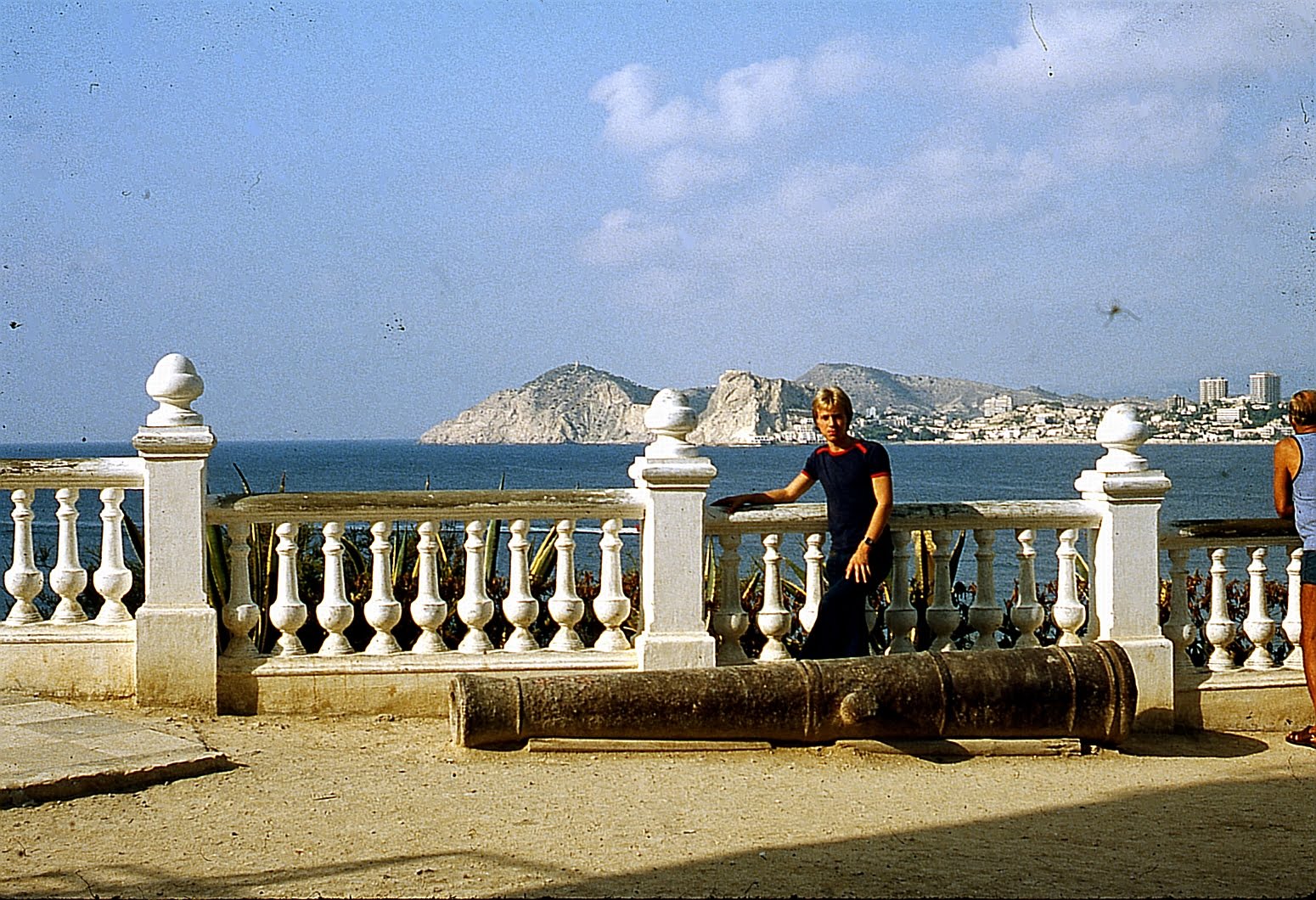
Inbetween the two magnificent beaches was the old town and this really was the best part of Benidorm. Here in the twisting narrow streets hemmed in by claustrophobic whitewhased buildings it was possible to imagine what the town must have been like in the past as small fishing village as we walked around the old town, the San Jaime church with its distinctive blue tiled hat roofs, the old town promontory with the Balcon Del Mediterraneo, and pretty Mal Pas beach below situated in between the Levante and the Poniente. Benidorm castle was thought to have been built on this rock around 1325. The castle survived until 1812, but now there are no signs of the ruins. Inland from the promontory Benidorm’s old town narrow streets were a joy to wander around, vibrant and continuously busy they were dotted with bars, restaurants and tourist shops that never seemed to close.


There was only so much time that we could spend on the beach and walking around the old town, there was the Wednesday market that we visited (twice) but to be honest there wasn’t a great deal more to do so filling fourteen days was a bit of a challenge. About three kilometres out in the bay was the little island of Isla Benidorm, a triangular shaped wedge of inhospitable rock with a regular bright red ferry boat called the Bahia de Benidorm running across for just a few pesetas each. There was so little to do that we made the trip twice and really once would have been quite enough. It was advertised as ‘Peacock Island’ but all we found there were a few scraggy chickens trying to get by in a very hostile landscape without any vegetation or water. Fortunately there was a bar on the island with really good views back towards the mainland so at least there was somewhere to sit and have a drink while we waited for the ferry to return. On one of the trips we met Tanya and Steve from Blackpool and we shared a table, struck up conversation and agreed to meet up one evening for a meal. Today Isla Benidorm is being developed as a wild bird sanctuary so maybe there are a few more species there than those few pathetic chickens?


Sunday, 1 August 2010

Benidorm 1977 - First Impressions and the Hotel Don Juan


In 1976 I travelled to Europe for the first time to Sorrento in Italy with my dad who obligingly stepped in at the last moment following girlfriend trouble. Very soon after that we patched things up and in October the following year I went to Spain with my fiancée, Linda. We could have gone practically anywhere we liked, so long as it was within our restricted budget of course, but we choose to go to Benidorm on the Costa Blanca for two whole weeks and we selected the Don Juan hotel on the Avenida del Mediterráneo, just behind the Levante beach because Linda had been there some time before with her parents and had liked it.

Benidorm is one of the most popular tourist locations in Europe, today six million people go there each year on holiday but in 1977 it was even more popular and that year attracted the most holidaymakers ever and over twelve million people poured into the city. That peak in numbers has never been matched since and it is unlikely that it ever will be. In the early 1960s my grandparents visited Benidorm several times in the Freddie Laker days of package holidays and came home with exotic stories and suitcases full of unusual souvenirs, flamenco dancing girls, matador dolls and velour covered bulls that decorated their living room and collected dust for the next twenty years or so.

The name Costa Blanca was allegedly conceived as a promotional name by British European Airways when it first launched its air service between London and Valencia in 1957 at the start of the package holiday boom. At that time the cost of the fare was £38.80p which may not sound a lot now but to put that into some sort of perspective in 1960 my dad took a job at a salary of £815 a year so that fare would have been about two and a half weeks wages! The average UK weekly wage today is £450 so on that basis a flight to Spain at British European Airline prices would now be £1,100. Thank goodness then for Ryanair because I flew to Seville last year for just £30 return which represents just about three hours work today in comparison with what of been about a hundred hours in 1960.

We flew from Luton Airport in Bedfordshire (made famous by Lorraine Chase in the 1970s Campari television adverts) on Monarch Airlines which was in the days before low cost airlines when flying still felt exclusive and glamorous. The pilots were all ex RAF and called Toby or Edward and the air hostesses were tall and elegant, wore smart uniforms and looked like catwalk models. The seats were comfortable with generous leg space and there was a free meal thrown in. There was a drinks trolley at below United Kingdom prices (today a cup of tea on Ryanair costs £3) and a genuine duty free service for spirits, tobacco and perfume.

As an experience flying has mostly deteriorated in quality since 1976 except in one important area where there has been massive improvement. In 1976 passengers that smoked were still allowed to light up a cigarette on board which meant that because of the way aeroplanes recirculate air in the cabin everyone else had to as well. To be fair they did all have to sit at the back of the aircraft, a bit like Dante’s Inferno, and puff away together but after a couple of hours there was a horrible acrid odour of stale tobacco and the entire cabin smelt like an unemptied ash tray. Actually it wasn’t just cigarettes but pipes and cigars as well and this was so bad that even the cigarette smokers complained about this. Pipes and cigars were banned in 1979 but a ban on cigarettes had to wait for another ten years. As there has been no smoking now on planes for twenty years I am always curious why arm rests still have ash trays in them because the only purpose they serve now is a place for ignorant people to stick their discarded chewing gum.


The flight lasted a little over two hours and then we landed at Alicante airport about sixty kilometres south of Benidorm and as this was in a time before Spain’s modern motorway network had been constructed the coach took the old coast road north through a string of small towns and villages. Just past Villajoyosa on the coast and the one thousand four hundred metre high Puig Campana Mountain to the west we snatched our first glimpses of Benidorm out of the right hand side windows of the coach and we could see a ribbon of golden sand at the fringe of the magnificent bay and behind it a strip of concrete skyscrapers towering into the blue sky above.

Once in Benidorm we went through the tedious process of dropping people off at their hotels and as the Don Juan was at the far end of the eastern Levante beach we had to wait quite a while to arrive there. Thirty years or so later the Don Juan isn’t there anymore and I might be mistaken here but it might now be the refurbished Don Pancho. It certainly looks similar and it is just about the right location. If I am correct it is only two hundred metres from the Hotel Los Pilicarnos on the Calle Girona, which is famous for being the setting of the Television comedy series, Benidorm.

The Don Juan was a typical 1970s Spanish seaside resort hotel with a cavernous reception and public area, a dining room that was little more than a school canteen and an entertainment room for evening activity. The hotel was an eighteen storey concrete and chrome building and we had a room on the front about half way to the top with a good view out to sea. In the 1970s rooms could only be described as functional because these were the days before mini-bars, Televisions, internet wifi access and complimentary cosmetics in the bathroom but it was nice enough and it was going to be our home for two weeks.

Later that day we had our first evening meal at the Don Juan and it has to be said that this was by no stretch of the imagination a gourmet experience. The menu was limited and consisted mostly of the sort of food that British holidaymakers, unfamiliar with Spanish cuisine, would have insisted upon in 1977, beef burgers or chicken, chips and overcooked vegetables, and for sweet it was a restricted choice between crème caramel or ice cream and it was the same for the whole of the fortnight. One thing was certain – it was unlikely that we would be introduced to traditional Spanish food on this holiday. To be fair however anything ethnic may have come as shock because like most English people I wasn’t ready for tortilla and gazpacho and although I am now rather partial to tapas and paella I had certainly never been introduced to these Iberian gastronomic delights in 1977.

If the twelve million visitors to Benidorm came in equal numbers each week, which of course they didn’t, then there would have been nearly a quarter of a million visitors to entertain every night and after dinner we walked to the old town, which even in October was bursting at the seams with visitors wandering around the bars getting lashed and in the shops buying things they didn’t really need. In 1977 most of Spain was still shaking off the restrictions of the Franco regime, in June there had been the first elections to the National Parliament since 1936, but Benidorm was way ahead of the rest of the country.

It was loud, brash and noisy and so was the hotel when we returned later on. There was entertainment on the ground floor and even though we were at least six floors up the noise from the discotheque could be heard all the way up to our room. The booming of the bass kept us awake and so did the loud German couple sitting on the balcony of the room next door who were having a conversation with someone in Hamburg! Sleeping has never really been a problem for me and I eventually managed to drop off but sometime in the early hours of the morning I woke up and found Linda on the balcony tired and sobbing and desperately in need of sleep. I think that it was at this point that I wondered just how we were going to survive fourteen nights in Benidorm!

Wednesday, 30 June 2010

Benidorm, The War of the Bikini


If Pedro Zaragoza Orts is remembered for the Beni-York skyscraper he is even more famous for the so called ‘War of the Bikini’. In the later years of the 1950s the icon of holiday liberty was the saucy two piece swimsuit but in staunchly religious Spain, still held in the firm two-handed grip of church and state, this scanty garment was seen as a threat to the very basis of Catholic society. According to the official version a French engineer called Louis Réard and the fashion designer Jacques Heim invented the swimsuit that was a little more than a provocative brassiere front with a tiny g-string back. It was allegedly named after Bikini Atoll, the site of nuclear weapon tests on the reasoning that the burst of excitement it would cause on the beach or at the lido would be like a nuclear explosion. Plenty of fallout and very hot!

And it certainly had this effect in Spain and although occasionally allowable on the sandy beaches, it had to be covered up in all other areas; on the promenades and in the plazas and in the shops and the bars and cafés for fear of causing any offence. In one famous incident, a British tourist, sitting in a bar opposite a beach wearing only a bikini, was told by a Guardia Civil officer that she wasn’t allowed to wear it there. After an argument she hit him, and her strike for social justice cost her a hefty fine of forty thousand pesetas. Zaragoza needed tourists and tourists wanted the bikini and with more northern European tourists arriving each year in search of an all over suntan the Mayor knew that the banning of the two piece swimsuit simply couldn’t be sustained or allowed to threaten his ambitious plans.

Zaragoza took a gamble and signed a municipal order which permitted the wearing of the bikini in public areas and in this single act he effectively jump started the Spanish tourist industry. Zaragoza said: “People had to feel free to be able to wear what they wanted, within reason, if it helped them to enjoy themselves as they would come back and tell their friends about the place.” In deeply religious Catholic Spain not everyone was so understanding or welcoming of the bikini however and in retaliation the Archbishop of Valencia began the excommunication process against him.

Excommunication was a serious matter in 1959 and his political supporters began to abandon him so one day he got up early and drove for nine hours on a little Vespa scooter to Madrid to lobby Franco himself. The Generalissimo was suitably impressed with his determination and gave him his support, Zaragoza returned to Benidorm and the Church backed down and the approval of the bikini became a defining moment in the history of modern Spain ultimately changing the course of Spanish tourism and causing a social revolution in an austere country groaning under the yoke of the National Catholic regime. Zaragoza went on to become Franco’s Director of Tourism and a Parliamentary Deputy.

Not many people would have described Franco as a liberalising social reformer and perhaps he just liked to look at ladies breasts but not long after this lots of women on holiday in Benidorm dispensed with the bikini bra altogether and brazenly sunbathed topless and Benidorm postcards had pictures of naked ladies on them to prove it.


One thing I am certain of is that this wouldn’t have made a great deal of difference to my Nan because I am not sure that she ever possessed a swimming costume, never mind a two-piece! She was a bit old-fashioned and the human body in the naked form was only permitted behind closed doors with the curtains closed and preferably after dark. If she ever went in the sea I imagine it would have been in one of those Victorian one piece bathing costumes of the previous century. Grandad too wasn’t one for showing bits of his body normally kept under his bus conductor’s dark blue uniform and didn’t even concede to a pair of shorts, preferring instead to wear his colonial style slacks even during the day. When he came home his impressive suntan stopped at the line of his open neck shirt and his rolled up sleeves.


For people who had never been abroad before Benidorm must have been an exciting place in the early 1960s. Palm fringed boulevards, Sangria by the jug full and, unrestrained by optics, generous measures of whiskey and gin, rum and vodka. Eating outside at a pavement café and ordering drinks and not paying for them until leaving and scattering unfamiliar coins on the table as a tip for the waiter. There was permanent sunshine, a delightful warm sea and unfamiliar food, although actually I seem to doubt that they would be introduced to traditional Spanish food on these holidays because to be fair anything remotely ethnic may have come as shock because like most English people they weren’t really ready for tortilla and gazpacho, tapas or paella. They certainly didn’t return home to experiment with any new Iberian gastronomic ideas and I suspect they probably kept as close as they could to food they were familiar with.

Benidorm is a fascinating place, often unfairly maligned or sneered at but my grandparents liked it and I have been there myself in 1977 for a fortnight’s holiday and then again on a day trip in 2008 just out of curiosity. It has grown into a mature and unique high rise resort with blue flag beaches and an ambition to achieve UNESCO World Heritage Status and I hope it achieves it.

Tuesday, 29 June 2010

Benidorm, Plan General de Ordenación


Sixty years ago Benidorm, although not a fishing village as such, was still a modest beach side community, a place of sailors, fishermen and farmers who patiently tended almond, olive, carob and citrus trees. Early visitors would have marvelled at the double crescent of virgin golden sand and rolling dunes that stretched out in both directions from a rocky outcrop that divided the two beaches where Benidorm castle is believed to have once stood. Small fishing boats, the tarrafes, each with four large lanterns to attract fish at night bobbed in the water or lay drawn up resting on the sand. In 1950, Benidorm didn’t attract many visitors and life was difficult, it had no water supply or sewage disposal system and waste was tipped in the sea or simply buried in the earth.

The watershed year was 1954 when the Franco loyalist, Pedro Zaragoza Orts was nominated as town Alcalde, or Mayor, by the Civil Governor of the province, Don Jesús Aramboru and he threw himself into his work and set himself an objective of improving the quality of life in the small town. In terms of economic potential there wasn’t a lot to work with so he decided to concentrate on tourism and he imagined a dream of creating a bourgeois pan-European holiday utopia. Benidorm had sun, it had beaches, it had sea but what it didn’t have was visitors. Few people in Spain enjoyed the sort of standard of living to be able to take holidays in the 1950s, so he needed to attract overseas visitors.

The town had always been popular with veraneos, people who took a few days break to be by the sea, but by the 1950′s, visitors from northern Europe were beginning to arrive in greater numbers and staying for a full week at a time, sometimes two! Zaragoza recognised the potential of increased numbers of visitors and quickly created the Plan General de Ordenación, or city building plan, that would exploit that potential. The plan ensured that every building would have an area of leisure land, guaranteeing a future free of the excesses of cramped construction seen in other areas of Spain and it is the only city in the country that still adheres to this rigid rule. This vision for the future took six years to come to reality, while he waited he piped in domestic water from Polop, fifteen kilometres to the north in the mountains on the road to Guadalest and he ignited the building boom that followed and the flying start that Benidorm achieved in the package tour boom of the 1960s and 70s.

The vision for Benidorm was simultaneously brilliant and exciting and it gave the modern city its modern unique landscape because Zaragoza encouraged vertical construction of dozens of sky scrapers in a deliberate plan to make efficient use of land and to keep the city at ground level spacious and airy with green parks and open spaces and all of the accommodation relatively close to the beaches. He explained his plan like this; ‘If you build low, you occupy all the space and have a long walk to the beach. If you build high, you can face the sea, and leave room for gardens, pools and tennis courts’. This was in contrast to nearby Torrevieja and on the Costa Del Sol in the south, Marbella where excessive horizontal development led to great sprawling ugly urbanisations that have practically destroyed the coast by burying it under concrete and tarmac. Zaragoza called this urban concentration instead of urban sprawl.

The first developments started at the centre at the rocky outcrop in the twisting narrow streets hemmed in by claustrophobic whitewashed houses, the San Jaime church with its distinctive blue tiled hat roofs, the old town promontory with the Balcon Del Mediterraneo, and pretty Mal Pas beach below and quickly spread east and west along the splendid beaches. Today Benidorm has some of the tallest buildings not only in Spain but all of Europe but the first were fairly unassuming by comparison, the tallest reaching only a modest ten floors or so.

My grandparents were used to living higher up than most people because they lived in a first floor flat but I imagine that they found a high rise hotel in Benidorm really exciting. In the early hotels there was a lot of utilitarian concrete and steel and I am certain that we would consider them quite basic affairs now but they had something that Nan and Grandad were not accustomed to – an en-suite bathroom, because they didn’t have the luxury of any sort of bathroom in their Catford flat. The first hotels have mostly been demolished and replaced now but I imagine they enjoyed sitting on the balcony of their room and looking out over the inviting Mediterranean Sea because this was a thousand miles and a hundred thousand years away from reality. They were certainly very relaxed because feet on the table like this would never have been permitted at home. We were only allowed into the best front room once a year at Christmas and we weren’t allowed to touch anything so I am surprised by this.

Monday, 28 June 2010

Every Picture Tells a Story - Benidorm c1960


In the first few years of the 1960s, in the days just before and then during the Freddie Laker days of early package holidays, my grandparents visited Benidorm in Spain several times. For people from London who had lived through the Luftwaffe blitz of the 1940s and the killer smog of the 1950s they applied for passports (which was practically unheard of for ordinary people) and set out with pale complexions on an overseas adventure and returned home with healthy Mediterranean suntans and duty free alcohol and cigarettes. They brought back exotic stories of exciting overseas adventures and suitcases full of unusual souvenirs, castanets, replica flamenco dancing girls, handsome matador dolls with flaming scarlet capes and velour covered bulls that decorated their living room and collected dust for the next twenty years or so.

In the photograph my grandparents Ernie and Olive were roughly the same age as I am now and they were clearly having a very good time sitting at a bar enjoying generous measures of alcohol, the same sort of good time that I like to enjoy when I go travelling. I’m guessing of course but Grandad, who looks unusually bronzed, seems to have a rum and coke and Nan who looks younger than I can ever remember her appears to have some sort of a beer with a slice of lime and that’s about forty years before a bottle of Sol with a bit of citrus became anything like fashionable. With him is his brother George (no socks, very impressive for 1960) and his wife Lillian. Nan and Grandad look very relaxed and with huge smiles that I can barely remember. I wonder how they managed to be among the first early holidaymakers to visit Mediterranean Spain in the 1960s?

In 1950 a Russian émigré called Vladimir Raitz founded a travel company in London called Horizon Holidays and started flying people to Southern Europe and the package tour was born. Within a few years he was flying to Majorca, Menorca, and the Costa Brava. In 1957 British European Airways introduced a new route to Valencia and the designation ‘Costa Blanca’ was allegedly conceived as a promotional name when it first launched its new service on Vickers Vanguard airoplanes with four propeller driven engines at the start of the package holiday boom. By the end of the decade BEA was also flying to Malaga on the Costa Del Sol.


The flight took several hours and arrival at Valencia airport some way to the west of the city was not the end of the journey because there was now a one hundred and fifty kilometre, four-hour bus ride south to Benidorm in a vehicle without air conditioning or air suspension seats and in the days before motorways on a long tortuous journey along the old coast road. Today visitors to Benidorm fly to Alicante to the south, which is closer and more convenient, but the airport there was not opened until 1967.

I am curious to understand how they were able to afford it? Grandad was a bus conductor with London Transport on the famous old bright red AEC Routemaster buses working at the Catford depot on Bromley Road (he always wore his watch with the face on the inside of his wrist so that he didn’t break the glass by knocking it as he went up and down the stairs and along the rows of seats with their metal frames) and Nan worked at the Robinson’s factory in Barmerston Road boiling fruit to make the jam.

I cannot imagine that they earned very much and at that time the cost of the fare was £38.80p which may not sound a lot now but to put that into some sort of perspective in 1960 my dad took a job at a salary of £815 a year so that fare would have been about two and a half weeks wages! Each! The average weekly wage in the United Kingdom today is £490 so on that basis a flight to Spain at 1957 British European Airline prices would now be about £1,225. After paying the rent on the first floor Catford apartment Grandad used to spend most of the rest of his wages on Embassy cigarettes, Watney’s Red Barrel and in the Bookies so perhaps he had a secret source of income? He does look like a bit of a gangland boss in some of these pictures or perhaps he had a good system and had done rather well on the horses.

Benidorm developed as a tourist location because it enjoys a unique geographical position on the east coast of Spain. The city faces due south and has two stunningly beautiful beaches on the Mediterranean Sea that stretch for about four kilometres either side of the old town, on the east the Levante, or sunrise, and to the west the Poniente, the sunset, and it enjoys glorious sunshine all day long and for most of the year as well. Today, Spain is a tourist superpower that attracts fifty-three million visitors a year to its beaches, 11% of the Spanish economy runs off of tourism and one in twenty visitors head for Benidorm. The city is the high rise capital of Southern Europe and one of the most popular tourist locations in Europe and six million people go there each year on holiday.