Showing posts with label Africa. Show all posts

Wednesday, 29 December 2010

Marrakech, Final Moments


The sun was out again now in its full glory and this certainly improved the disposition of the two girls. We walked along the busy east west thoroughfare until we reached a roundabout and a major junction with Avenue Mohammed V where there was a debate to be had about what to do next. Mike wanted to see the railway station but it was obvious that Margaret and Kim could happily live without this experience so we agreed to split up. Mike and I would carry on and they would return down the Avenue and return to the Complexe Artisanal, which was an excellent compromise because just as railways didn’t appeal to Margaret and Kim more pottery and kaftan shops was not going to especially thrill the two of us either.

So while they risked their lives, crossed the road and headed back toward the old city we continued west along a modern major road flanked on either side with swanky shops, car showrooms, Kentucky Fried Chicken and leather and chrome banks that was all just about a million miles away from Djemma el Fna and the Souks. We passed not one but two McDonald’s where they serve burgers and fries of course but also a sandwich that can’t be bought anywhere else in the world, a cumin-spiced flatbread creation called the McArabia Tagine. The McArabia was launched in 2003 and the twenty-three McDonald’s franchises in Morocco localised the recipe by tweaking the seasoning and sauce to give it a specific local flavour.

We carried on until we reached the train station and were surprised when we got there to find a modern glass and concrete structure behind a wide open flag stoned square. Quite honestly we expected to find something more colonial, something you might find in a city of the Indian Raj with old fashioned waiting rooms, street vendors and market stalls and clanking old steam engines. Actually we didn’t see trains of any kind because there are only two or three every day and the next one wasn’t due for nearly two hours. The ticket inspectors allowed us to go on the platform but warned us not to take photographs and we went through to a modern transport terminus that neither of us was really expecting.

Leaving the train station we took our turn to risk our lives crossing the road at a roundabout lacking any sort of lane discipline and walked down another wide boulevard, the Avenue Mohammed VI, the present King of Morocco, and started to make our way back to rendezvous with Kim and Margaret. The road was straight and smooth, two lanes in either direction, wide footpaths with a leafy central reservation and modern corporate hotels on one side and expensive villas behind security gates on the other. The sun was shining ahead of us but clouds were chasing up from behind but we kept ahead of the rain and turned into Rue Moulay El Hassan, the Crown prince heir to the throne, and reached the Place de la Liberté where it met the Avenue Mohammed V.

From here it was just a short walk to the Complexe Artisanal where the timing was perfect because the shopping was reaching an end as Kim had finally made her selection and with no luck on finding the black pottery she had set her heart on she had settled on the royal blue one instead. From here it was just a short walk to the little restaurant where we had eaten last night and where we returned to now for a last meal in Marrakech before returning home.

Once again it wasn’t very exciting but it tasted fine and filled us up ahead of the journey and after we had dined we left and walked back for one last time through the Souks and Djemma el Fna where the weather was deteriorating again now and then back to the Riad Nafis to collect our bags, say goodbye and meet the taxi that Laurent had arranged for us. It arrived dead on time and the driver took us back to the airport where there was another form to fill in, this time to say that we were leaving the country before our early evening flight back home to the UK.

Monday, 27 December 2010

Marrakech, The Majorelle Gardens


The gardens were just around the corner now and it was hot in the sunshine as we queued for our tickets and then went inside through the gates. The garden was designed and laid out in the 1920s by the French painter Jacques Majorelle who designed marble pools, raised pathways, banana trees, groves of tall bamboo, coconut palms and bougainvilleas and first of all we followed a path through species of cacti collected from all over the world.

The path led to a lily pond that reminded me of Monet’s garden at Giverny in France and which stood in front of a house, a museum now but closed today during refurbishment, which is painted a unique shade of blue. This seemed odd, it was in contrast to every other building in Marrakech and I wondered how the painter had managed to get around the crimson decree. The blue is called Majorelle and is made from pigment found only in the Moroccan soil and he must have been especially fond of it because as well as the house the garden was full of large pots all painted predominantly in this colour and contrasting nicely with others in orange, yellow, red and green.


Majorelle, it turns out wasn’t a great artist and his garden, rather than his paintings, was his masterpiece and it is composed and coloured like a work of art. As well as the pots, water is an important feature and there are water filled channels, lily ponds with reflections of the towering palm trees and bubbling fountains. Majorelle was an avid plant collector but after he died in 1962 the house was left empty and the garden abandoned for nearly twenty years. After a long period of neglect however the garden was then taken over and restored by the fashion designer Yves Saint Laurent and his partner Pierre Berge.

As we wandered along the meandering paths the blue sky suddenly gave way to grey cloud and within seconds we were in the middle of a heavy rain fall and we had to take cover in a café where there was shelter under the leaves of the banana plants planted around the perimeter. It took about twenty minutes for the heavy rain to slow down and before we could leave the shelter and then as the rain eased off we returned to the gardens which somehow managed to look even better now with the shiny wet pavements catching shimmering reflections of the brightly coloured pots.

There was a shop of course where I was chastised for taking a picture of a brightly coloured corner and the assistant stood over me and insisted I delete it from the camera. I fooled her by not following the procedure all the way through but she was satisfied that it was gone and she let me go.


The path took us around the blue house with its bright yellow windows and strategically placed pots, through pergolas where exotic climbing plants raced each other to the top, past ponds full of goldfish and terrapins and through the bamboo swaying in the breeze. A second wave of rain passed over and we had to shelter next to the memorial to Yves Saint Laurent but it passed over quite quickly and we were able to continue the visit as rain drops splashed us as they dripped from the overhanging leaves. On balance we would have preferred to have visited the garden without the rain but I suppose the plants all enjoyed the drenching.

When we had completed the walk around the garden and Kim was finally satisfied with her collection of pictures of the pots we left and started to walk back the way we had come. We hadn’t got very far however when it started to rain again and this time it was really unpleasant. It came in at an angle that got underneath our umbrellas, it had turned quite cool and the sky was grey and horrible in all directions.

We still had a few hours left before the flight home and we didn’t want to walk around all day in this but then as Kim whinged and Margaret complained about the plan to walk to the railway station Mike and I could see some better weather in the north so at a busy crossroads we found a café where we sat and sheltered and thankfully watched the weather, and the girl’s moods, improve as the pavements quickly dried as the sky turned blue and the temperature began to rise.

Friday, 24 December 2010

Marrakech, Guéliz The New City


I somehow managed to sleep through the five o’clock call to prayers but was woken instead this morning by the sound of heavy rain thrashing against the window. It didn’t sound very promising and as I tried to get back to sleep I worried about a washout for the day ahead. On a more encouraging note however my stomach seemed to be back to normal.

On our final day in Marrakech we planned to leave the old Arab city and visit the adjacent new city known as Guéliz that was designed and built by the French during the period of the Protectorate. After breakfast we packed and settled the bill, left the Riad and set off. We were careful to take umbrellas today because the forecast promised more rain for later on.

The direct route to the new city was along the most important and the busiest road in Marrakech, the Avenue Mohammed V, named after Morocco’s first post independence king and effectively the spine of the city that links the old to the new. We walked past the Complexe Artisanal where there were shops selling the same things as in the Souks but with prices on them so the sort of shopping we are more familiar with and Kim and Margaret made plans to return later.

We left the old city when we passed through the Bab Nkob which was a gate that would bare little resemblance to the original because the wide four lane highway has punched its way through the rosy pink walls at this point and its construction would have required significant alterations to a gate that was built for donkeys and carts.

Outside of the city walls we were in a completely different environment because now we were in the new city. The French built this new city because they didn’t find the old town with its warren of crooked streets and lack of plumbing and sanitation much to their liking and they designed something altogether more Gallic with tree lined boulevards and villas and parks in which to live and work.

The sun was shining now and it was becoming quite hot as we followed the busy road around the outside of the wall heading in the direction of the Majorelle Gardens. At the next gate the Bab Doukkla there was a wide open square where men were standing waiting with bags of tools. This was like a big open air job centre because it was literally a labour market where tradesmen were waiting for potential clients. Each one advertised himself by his tools, the plasterers with their trowels, the mechanics with their spanners and our favourites, the plumbers with bits of copper pipe complete with taps.

The roads were busy as we had become accustomed to and we had to negotiate a couple of murderous roundabouts and then a street with only intermittent pavement and to be honest this wasn’t the twenty minute walk that we were led to believe it would be so it was quite understandable when Kim began to whinge about the distance. To be fair she wasn’t feeling especially good because of her upset stomach and at one point we did have to make a dash for bathroom facilities in a modern shopping mall.

Thursday, 23 December 2010

Marrakech, The Grand Tazi, a Hotel with Alcohol!


On the way Kim kept snapping away taking pictures of local people as they went about their business. She had to be quick however and mostly secretive about what she was doing because a lot of people weren’t that happy about having their photographs taken. This is something to do with being suspicious about having an image made of themselves and on most occasions when someone saw a camera pointed their way they would either turn away or wag a reproachful finger to say no.

My stomach was groaning and I was ready to go back to the Nafis but Margaret and Kim wanted to go back to the herbalist shop that we had visited this morning and when we arrived there the shopkeeper must have surely been surprised that they had kept their earlier promise to return. After the massage they bought a few bags of spices and I began to worry about taking these little multi-coloured bags of suspicious looking powder through customs especially bearing in mind that Morocco has a reputation of being a big producer of illegal drugs.

After the massage and the shopping the girls still had enough energy left for a bit more shopping but I was ready for a rest so I left them and Mike and went back to the Riad while they returned to a small bazaar that they had briefly seen earlier in the day.

There was bad news at the Riad Nafis because no one had restocked the beer cupboard so it looked as though this would possibly be a dry night. It was a good job that we still had some wine left in the cartons that we had thoughtfully brought with us from the UK and after everyone had returned Rashid (now working frantically on his end of holiday tip) opened up the terrace for us and made sure we were comfortable and we sat and had a glass of red wine.

Margaret and I still had weak stomachs so we weren’t sure where to eat tonight but earlier we had seen a small restaurant with a reasonably priced menu that we were confident that we could find again so we agreed that we would go there.

At about seven o’clock we left the Riad and made our way back towards the centre tackling the crowds and the traffic on the way. At a busy section there was a rather seedy looking hotel called the Grand Tazi and the word was that it served alcohol so we took a look inside and indeed it did and delighted by this discovery we followed a waiter to the roof terrace and ordered beer and wine. Mike and I had a bottle of premium Casablanca lager and Kim and Margaret had a small bottle of Moroccan red wine to share. We drank it and thought about a second but before we had made our minds up the waiter returned and charged us 200 dirham (about £20) so that made our minds up for us and we left.

After walking around the fringes of Djemma el Fna and through the food market again we made our way to the little restaurant and found it effortlessly. It was busy and we had to wait for a table but it didn’t take long and soon one was ready and we ordered a simple meal that didn’t turn out to be especially thrilling but it was cheap so we didn’t have any complaints about it.

Walking back we debated returning to the Grand Tazi for a second drink but the prices put us off and in any case Kim started to speed up and walk faster and faster and by the time we reached the hotel it was difficult to keep up with her as he reached Olympic walking race speed. The reason, it turned out, was that suddenly her stomach wasn’t feeling too clever and she was in a rush to get back to the Nafis. Now there were three of us with upset tums!

We sat on the terrace again and Rashid fussed about and made sure we knew that he was leaving early in the morning and we may not see him then. So we gave him his tip and he seemed delighted with it. Now three of us were ill our theory about the Setti-Fatma lunch was thrown into doubt so we had another think and suddenly something that we hadn’t previously thought of came into consideration. At the argan oil cooperative all of us except Mike had sampled the produce and used bread broken into pieces to soak up the oil and now it seemed possible that this may have been responsible.

Monday, 20 December 2010

Marrakech, getting lost in the Old City


We walked on and for a few minutes seemed to be followed by a spooky looking man wearing an ill fitting djellaba who stopped when we stopped and speeded up when we speeded up and we began to feel a bit uneasy about him. Eventually we shook him off but once again we had taken turnings and made route changes that didn’t improve our situation. Gradually we slipped out of the tourist areas into shabby parts of the city that were exclusively local but we remained certain that we must be getting close to the wall but then we came across a group of young boys who told us that we were walking into a dead end so we asked for their help.

This was a simple and elementary error because there is a warning against doing this in all of the guide books. They looked at the free give away tourist map that they must have seen hundreds of times before and appeared confused themselves and entered into an animated debate. We pointed to the wall and told them that that was where we wanted to go and then they marched off with our map and beckoned us to go with them. We were still confident that the wall must be just around the next corner so we made a mistake and followed them like sheep.

They kept walking and walking, stopping frequently to consult the map and then arguing between themselves about the right direction. It was all a game of course and one that they play every day of the week and they were walking us around in circles and deliberately getting us lost. Just ahead of us were a couple of tourists who seemed confident with their map and we thought this was possibly a good sign until they suddenly stopped and declared themselves lost as well. It was obvious now that the boys were no help at all so we gave them a few coins and dismissed them from our employment and the ran off to look for some more mugs.

In a busy main street there were some tour bus drivers who we felt sure must be able to give us advice but they either couldn’t or wouldn’t and in the next street two taxi drivers gave us completely contradictory directions.

We had been walking around in circles, completely lost, for about an hour by this time and Margaret and Kim were beginning to lose their patience and Mike and I were using up all of our chances to get the situation resolved. Luckily at last we came across a landmark that we could reconcile with the map and then we could see the Koutoubia Mosque so we knew that if we headed for that then we would find ourselves somewhere familiar and eventually to our relief we found ourselves at the Avenue Mohammed V.

After a drink at a café where we made a vain attempt to try and understand from the map where we had gone wrong we completed our long walk around the city by returning to our starting point earlier this morning the Bab Agnaou but this time we kept to the main roads so that we wouldn’t get lost again.

Saturday, 18 December 2010

Marrakech, Navigational Difficulties


It was after midday by now and time for a break from walking and sightseeing so we selected a café with a roof top balcony on a noisy road leading to Djemma el Fna. There had been some hints of blue sky on and off this morning but now as we sat in the open air the cloud was noticeably thickening from the west and turning from chalky white to peppery grey and we had to admit that this was probably about the best we could expect now for the rest of the day.

The plan now was to make our way from the Bahia Palace through Djemma el Fna and the around the Souks to visit the next site the Medersa Ben Youssef in the northern part of the old city and we found our way without any difficulty back to the main square and we congratulated ourselves on our grasp of navigation around Marrakech.

To get to Medersa Ben Youssef the direct route now was to walk through the Souks again so we took the main route in through an arch and past a Mosque which led us to the Rue Semarine which is a perpetually busy street with shops selling robes, kaftans, carpets and antiques then into the Souk el Kebir with a tight warren of alleys all with tiny shops and kiosks.


The Souks were busier today because Sunday is a main trading day and all of the shops were open, there were more people and more noise. There are signs at the entrance to the Souks which clearly say ‘no bikes’ but they were only there for decoration because no one took any notice of this at all and people on push bikes whizzed past and there was the constant rasping of moped horns as impatient drivers forced their way between the shoppers and the tourists and we had to keep a permanent eye out for danger.

Half way through and we were in the Souk des Babouches where every shop sold a range of brightly coloured, pointy toed soft leather slippers and then the Souk de Tapis where the shops were larger and most specialised in carpets and then finally the Souk des Ferronniers where metal workers and carpenters were working in cramped workshops making furniture and lanterns and intricately designed silver jewellery and belt buckles.

Eventually we were through and out of the Souks and outside Medersa Ben Youssef which is supposed to be one of the best buildings to visit in Marrakech but unfortunately I am unable to confirm that because today it was closed. We walked around all four sides of the building looking for an entrance and when we had circumnavigated it someone told us that it didn’t open today because of the leather auctions at the nearby tannery although I couldn’t really understand what the connection might be.

So now we had to rethink the itinerary and we must have looked as though we needed assistance because people kept stopping to give unrequested help with the map. Most wanted to take us to the leather auctions and they assured us that they didn’t want money but we were suspicious and politely said no thank you. Some were more persistent than others and kept insisting on leading us and as we doubled back and slipped around corners we managed to disorientate ourselves and we lost our sense of direction, a situation that wasn’t helped by the fact there was no sun in the sky so we couldn’t establish any sort of directional fix.

We thought we were walking in a north-easterly direction and the plan was to reach the wall and one of the twenty city gates. This quickly proved difficult and made even more so by the fact that although the streets were named on the map there were no corresponding signs on the streets themselves so establishing location and direction quickly became a matter of guesswork and we had to admit that we hadn’t grasped Marrakech navigation at all.

Thursday, 16 December 2010

Marrakech, The Badii Palace and the Bahia Palace


At breakfast Margaret told us that she had a bad stomach as well so we tried to identify the possible source. We were certain that it wasn’t the food at the Riad so we discounted that and we had all had the same to eat at the roadside grill and the Djemma el Fna food market so that seemed to rule those out as well so the finger of suspicion was beginning to point to the lunch at Setti-Fatma where Margaret and I had shared food off of one plate and Kim and Mike off another so it seemed that we might have copped for a dodgy kebab in the Atlas mountains.

Breakfast was served inside the Riad this morning because the terrace was still closed in anticipation of bad weather and even though we tried to convince ourselves that there were emerging patches of blue it was very overcast this morning. It had rained in the night but now it was dry so after breakfast we had agreed to be collectively optimistic and leave the umbrellas behind and we set off for another day on the streets of Marrakech.

To begin with we walked back to Bab Agnaou and along a street which led to a long road, Rue Asset el Maach, with mostly local shops and little stores selling food and household items each with a single door and a gloomy interior with boxes and tins stacked from ceiling to floor to make use of all of the available space. As we turned a corner there were herbalist shops with spices arranged in colourful pyramids and baskets of dried flower heads and quack remedies. Margaret and Kim went inside to look at the jars of colourful potions and perfumes and to enquire about a massage but there wasn’t time this morning so they promised they would return later. I imagine that this is a promise that shopkeepers in Marrakech hear hundreds of times every day and probably don’t take them too seriously.

The site that we were heading for was the Badii Palace and for such a big place the entrance was tucked into a narrow lane which we only found after asking several times for directions. The Palace is in ruins now but reputedly took armies of labourers and craftsmen twenty-five years to build and when it was completed it was said to be amongst the most magnificent palaces ever constructed with walls and ceilings encrusted with gold and precious jewels and in the middle a massive pool with an island flanked by four sunken gardens. Sadly the magnificent building survived for barely a hundred years before the Saadian dynasty was overthrown and replaced by the Alouites and the conquering Sultan, Moulay Ismail, came along and stripped the place bare at about the same time as he was sealing up the Saadian Tombs.

Moulay Ismaïl was an interesting character and by all accounts a man of excesses. It is said that he personally killed over twenty-five thousand men but to make up for this he is alleged to have fathered eight hundred and eighty-nine children. This is widely considered the record number of offspring for any man throughout history that can actually be verified. It is estimated that to father that number of children Ismaïl would have had to have sex with an average of 1.2 women every day for sixty years so that must have been a real chore! When he wasn’t slaughtering or shagging he was building himself a new capital city at Meknès in the north of Morocco and it took twelve years to dismantle the Badii Palace and remove the treasures and relocate them and all that is left now are the stripped red mud bricks.

It was easy to imagine how grand this place must have been when it was first completed and we wandered around the extensive gardens where the Sultan and his courtiers would have enjoyed the lavish surroundings and a life of opulence. We walked the walls and climbed the one remaining tower where there was a good view of the site and the city outside it which we shared with the only remaining inhabitants of the palace today – the storks that had built their untidy nests at regular intervals along the top of the walls.

After the Badii Palace we returned to the busy streets and walked the short distance to the Bahia Palace which was built just over a hundred years ago by a grand vizier of the city. The place was much smaller than the Badii Palace and with scores of other visitors felt more crowded as we walked through a succession of immaculately tiled rooms with sculptured stucco and carved cedar wood decoration and outside private courtyards that were once the home of the vizier and his four wives. By all accounts this too was a place of grand excesses and the ruling Sultan, Abdel Aziz, was so jealous of the riches of the Bahia that when the vizier died he had the palace stripped and looted.

Tuesday, 14 December 2010

Marrakech, The Red City


There was only one way back and the weather began to change dramatically as Hassan negotiated the route down the valley past the dodgy rope bridge, the argan oil cooperative, the Berber house and the roadside pottery and soon we were in Douar Ouriki again and at this point we should have visited a garden but we were tired and it was overcast so we told Hassan to just carry on. This seemed to worry him because he thought he might be in trouble with Laurent for not having completed the full itinerary but we assured him that we would vouch for him when we got back and make it clear that it was our decision.

As we left the Atlas Mountains behind us the cloud swooped in swiftly from the Atlantic Ocean and completely obscured them from view and we were glad that we had left them just in time. We were on the long straight road now and as we got closer we could see Marrakech in the distance rising up out of the sun baked plain and glowing red in the late pale afternoon light.

Marrakech is popularly known as the Red City from its distinctive colouring from the pigments in the local soil mixed to make pisé from which the buildings were traditionally constructed. In the last century this was threatened by modern building materials and the French therefore passed a law that required all new buildings to be painted crimson so that they would blend in with the originals and this remains in force even today. There is also a rule that no new buildings in the old city can be higher than a palm tree and nothing in the new city can be over five storeys high so that nothing can compete with the Koutoubia Mosque for skyline prominence.

As we approached the city, passing the Jardin Agdal full of pomegranate, orange and olive trees, the road returned us into the city through the Bab Er Rob, one of the twenty gates punched into the ancient walls. The city walls date from the 1120s when, under threat of attack from the Almohads, the ruling Sultan, Ali Ben Youssef, decided to circle his garrison town with a ring of fortifications. The walls he had built were nearly ten metres high and formed a ring of defences ten kilometres long with two hundred towers and forts. Some of the original gates have been widened to accommodate modern traffic but it remains essentially the same even today.

Hassan dropped us off on Rue Siddi Mamoun and back at the Nafis we were disappointed to find that the terrace furniture had been packed away in anticipation of rain and the staff confirmed that this was almost certain. It didn’t stop Mike and I sitting out with a beer while Kim and Margaret rested because although it was completely overcast now it was still very warm and we had a couple of tins of Spéciale Flag.

As it turned dark and we were rested and refreshed, before dinner in the Riad we wandered again into Djemma El Fna which was buzzing again just like the previous evening. We looked for the fake henna tattoo girl but she wasn’t to be seen (probably mixing up more mud solution for later on) and then walked through the food stalls explaining patiently to everyone who pestered us that we wouldn’t be dining in the square tonight. We could have stayed here much longer and enjoyed the free entertainment (unless caught taking a photograph of course) but we had ordered evening meal at the Nafis so we had to return early.

On account of the weather we couldn’t sit on the terrace tonight so we had a table set up in the downstairs lounge where we had a delicious meal of salty onion tart, sweet chicken tagine and a Moroccan fruit salad and it was excellent and only spoilt at the last minute when Rashid announced that the fridge had run out of beer. Never mind we still had wine and we were tired anyway so we didn’t stop around long and had a relatively early night.

Because it was early the streets were still noisy as children played in doorways and someone somewhere was doing something unspeakable to a cat which made it howl and as I lay there trying to ignore the distractions I became aware of a pain building up in my stomach. After a while I dropped off but was woken again just after midnight with raging gripes and a nasty bloated feeling that wouldn’t go away and I worried about food poisoning and hospitalisation. I slept on and off but was woken regularly by the pain, the cat and the five o’clock adhan and in the morning I had to own up to not feeling especially good in the general abdominal area.

Sunday, 12 December 2010

Marrakech, The Atlas Mountains and Setti-Fatma


Crossing the river was an interesting experience but I think we were all glad to get back to the other side and continue the journey for the last few kilometres to the village of Setti-Fatma where the road into the mountains ended and the final stage was to be on foot. I imagine Setti-Fatma was once a desperate and inhospitable sort of place but the locals have turned it into a bit of a tourist trap with cafés and shops for the visitors who find themselves caught at this natural terminus.

Hassan quickly found a guide for us for 50 dirham each was going to take us further up the valley to visit the waterfalls, which were promised as the highlight of the day. We crossed the river over one of the rickety apple wood bridges and then began a gentle ascent at first as we set off for the top. We were at one thousand six hundred metres (that’s about half as high again as Mount Snowdon) and we were going to climb another two hundred to get to our destination.

At the beginning there was no real indication about how tough this was going to be and the path meandered gently through shops and cafés but after a while the track narrowed and started to get steeper and suddenly instead of just strolling to the top, as we imagined we were going to, actual climbing was required instead. It was probably a bit dangerous and certainly wouldn’t have been allowed in the safety conscious UK and people all around us were attempting this in inappropriate footwear and flimsy clothing. What made it even more difficult was that people coming down had to use the same narrow track as those going up so there was quite a lot of congestion to cope with and a quicker group behind us was showing irritation with our slow progress as their pushy guide tried to find inappropriate short cuts so that they could get ahead of us.

It took about thirty minutes to get to the end of the walk and to the inevitable café at the top where we stopped for an expensive bottle of water next to the waterfall that was plunging through the rocks and vegetation. The pushy guide was saying his prayers on the roof which explained his impatience to get to the top and some people were paddling in the shallow pool of icy water and taking a drenching under the waterfall and before we set off back down Margaret decided to do the same although she couldn’t persuade Kim to walk over the sharp gravel in her bare feet to join her.

Going down was if anything more difficult than going up and fairly soon our legs began to ache as we slipped and slithered down the uneven path. At one especially tricky spot Kim got into a bit of bother and as she slipped she gave up any attempt at saving herself and launched herself at the unsuspecting guide who took the full force of her bosom full in the face and we thought that would probably do as his tip! Gradually the path levelled out and we passed through the shops again. Shops which incidentally sold pottery and I cannot imagine for one minute why anyone would want to buy pottery while climbing up the side of a mountain. Back at the road we said goodbye to the guide and thanked him for getting us back in one piece and then he led us to a tagine restaurant by the side of the river which was probably owned by a member of his family.

In the garden of the restaurant we sat at a table by the water and had a simple lunch of meat skewers and local sausages all swilled down with a nice glass of beer and then I realised that I was hallucinating because it was just a nice glass of ordinary mineral water! As we sat there some musicians turned up and played a repetitive tune that they wanted paying for but we refused and then they circled the garden with similar lack of success. It was starting to get cooler and some worrying bits of cloud were coming in from the west so we paid up, left and reunited with Hassan we left Setti-Fatma and began the drive back to Marrakech.

Wednesday, 8 December 2010

Marrakech, Berbers, Argan Oil and a Rope Bridge


We drove on and the road started to follow the river now which wasn’t deep but it was wide and quite fast flowing. The silver water dashed between gullies and rushed over rocks and every so often there were local women doing their weekly washing in the water and stretching it out over boulders to dry in the sun in the way that they have always done. Further on the river dropped in between steep banks and the only way to cross was by using rope bridges with wooden slats that didn’t look awfully permanent. There were cafés now on either side of the river with plastic tables and chairs out in the open air and close to the water so we assumed we were getting close to our destination.

Hassan stopped the car again and our next stop on the itinerary was to visit a traditional Berber house. The Berbers are a unique ethnic group who live in North Africa, the oldest settlers in the region and quite different from the Arabs of Marrakech and the rest of Morocco. Squeezed in between the Mediterranean Sea to the north and the Sahara Desert to the south the Berber communities have developed and thrived in the Atlas Mountains and now we were invited to take a look inside a real Berber house.

It wasn’t a real house of course, it was a sort of living museum and women in traditional costume were preparing food in a small corner of a ramshackle arrangement of higgledy- piggeldy rooms that Hassan showed us through and explained the traditional domestic arrangements as we went. Next to the house was a shop of course and outside were the hopeful peddlers of necklaces and bracelets who implored us to buy as we left.

Opposite the house there was a small building where a women’s cooperative was producing argan oil. Argan oil is valued for its nutritive, cosmetic and numerous medicinal properties but is one of the rarest oils in the world due the small and very specific growing areas because it is produced from the kernels of the argan tree which are only found in Morocco.

In the past Berber women would extract the undigested pits of the argan fruit from goat excrement on the ground because the animals are very fond of the fruit and will even climb the trees to reach it but that isn’t terribly hygienic of course and I think they have stopped doing it that way now. All argan sold today is produced by the women’s cooperative that shares the profits among the local women and under the supervision of UNESCO has established an ecosystem reforestation project so that the supply of argan oil will not run out.

Mike was sceptical about whether this was authentic or simply a set-up for the tourists but inside the building women were sitting on the floor with rough rectangular stones between their knees cracking pits with rounded rocks. We learned that each smooth pit contains one to three kernels, which look like sliced almonds and are rich in oil. The kernels are then removed and gently roasted and this accounts for part of the distinctive, nutty flavour of the oil. It takes several days and about thirty kilograms of fruit, roughly one season’s produce from a single tree, to make only one litre of the precious liquid. The cosmetic oil, rich in vitamin E and essential fatty acids, is used for massage, facials and as a magic ingredient in anti-aging cream.

Naturally there was a shop attached and after the lesson we were invited to look around and try some samples. Actually it really was rather good but also terribly expensive so once again we waited for a crowd of people to arrive and slipped out under cover and away from the hard sell routine. We were getting good at that.

Hassan drove on and still we were climbing and following the river on our left and the boundary of the Parc National de Toubkal to our right, which includes the highest mountain in Morocco, Jbel Toubkal. After a while Hassan stopped the car and for no apparent reason invited us to take a walk across a precarious looking rope bridge to the other side of the river. We understood why when a local Berber man in a check kaftan and bright blue skull cap appeared from the side of the road and it seemed to be his self appointed job to usher people over to the other side, have his photograph taken with terrified tourists and charge a few dirham for the privilege.

I say terrified because to cross this swaying, rotting foot bridge required Indiana Jones type nerves of steel. Some of the planks of wood were missing and the steel rope that held it all together was rusty and corroded. With two or three people on it at the same time it rocked and lurched from side to side and below us was a drop of about twenty metres to the fast flowing river strewn with sharp rocks and jagged boulders which would have guaranteed an unpleasant landing and maybe a night or two in a hospital bed if the whole thing had come crashing down.

Monday, 6 December 2010

Marrakech, The Ourika Valley Trip


At five o’clock in the morning we had to endure the call to prayers again but thankfully they had turned the loudspeakers down from earthquake to only sonic boom level and it didn’t go on for nearly so long and I could only presume that this was because the full ensemble at maximum sound is only reserved for holy day on a Friday.

Breakfast is a good hotel performance measure and it was served on the terrace again but today there were different varieties of savoury pancakes and croissants and it was nice that a lot of thought was going into preparation of the meal and as the food was so good we ordered dinner for later.

After yesterday’s busy day in Marrakech today we were going out of the city and taking a trip south along the Ourika Valley and into the Atlas Mountains. Laurent had made the arrangements for us and had organised a car and a guide and shortly after breakfast he introduced us to Hassan who was to be our guide for the day. He led us through the streets to his vehicle and as soon as we were all comfortable he set off into the traffic and out of the city gate.

The Atlas Mountains are a mountain range across a northern stretch of Africa extending about two thousand five-hundred kilometres through Morocco, Algeria, and Tunisia. The Atlas ranges separate the Mediterranean and Atlantic coastlines from the Sahara Desert and the indigenous population are mainly Berbers.

It was a trip of about sixty kilometres and the first part of the journey was along a straight road that first passed a developing western European style out of town shopping centre, edge of town modern hotels and some untidy looking housing and then through some of the run-down southern suburbs. As we left the city behind we entered a long flat plain of red, bronze and copper coloured earth but with few signs of agriculture and little or nothing to get excited about. The road was straight and wide and had a good surface so it was a comfortable ride but all of this changed when we reached the busy cross roads town of Douar Ouriki where the quality of highway engineering came to a sudden and dramatic stop.

This was the start of the Ourika valley and on the edge of town Hassan pulled over so we could stop to take photographs of the lush green vegetation which was in complete contrast to the barren fields that we had just driven through because the valley is an attractive string of villages along the dangerous river that shares its name. The landscape is fresh and green, cooler than the city and in summer a popular destination when Marrakech is uncomfortably hot but in winter the river can be dangerous and floods sometimes destroy entire villages, wash away roads and tear up trees.

The problem with stopping we discovered was that it was inevitable that someone would quickly appear trying to sell us something, usually necklaces and jewellery but sometimes fossils, that were almost certainly fakes, and fascinating round chunks of coal with iron Pyrite crystals which they claimed were completely natural and collected from the mountains but in reality are manufactured in a workshop using a simple crystal solution. Hassan kept an eye on things and although he allowed them to approach us he stepped in if their sales technique became too robust.

After the first stop we started a gentle climb into the foothills of the mountains on a road that continued to deteriorate as we drove. On either side there were thick woods punctuated with ochre villages hanging from the hillsides and built high enough above the river to be out of danger of winter flooding. The road began to twist more dramatically as we climbed until we reached the second stop of the trip at a Berber pottery at a dog leg bend in the road next to a tourist camel train where Hassan stopped the car and led us inside.

It was a tourist trap of course and once past the old man working at the potters wheel we were drawn inside into an Aladdin’s cave of brightly coloured pots, cups and dishes, tagines, plates and jugs and with the pestering attention of the possibly the worst smelling man in Morocco this morning we were invited to peruse the items and select a purchase. Kim was up for this but she knew exactly what she wanted and what colour it had to be as well. To be specific it had to be a double condiment pot and it had to be black with silver trim. We found the item and it was available in every possible colour in the world except the one she wanted and despite the salesman’s frantic search he just couldn’t find one; he couldn’t talk her into an alternative either and he was the more disappointed of the two when we took the opportunity to get caught up in the tangle of a large tour group that had followed us in and left empty handed.

Saturday, 4 December 2010

Marrakech, Djemma el Fna and the Food Market


Later on the terrace we watched the sunset usher in the darkness and bring to an end a day of perfect blue sky and sunshine and refeshed and rested we made preparations for a night on the town. We were returning to Djemma el Fna and when we arrived there the place had taken on a whole new identity.

Sometime between the end of the afternoon and the early evening the square had been transformed from a market place to an open air theatre with swarms of people and this is something that occurs every single day of the year. The snake charmers and the monkey men had packed up and gone home and had been replaced by a carnival of musicians, storytellers, transvestite dancers and other entertainers. There were fairground stalls and all sorts of opportunists trying to sell things not just to tourists but to each other as well. There was a crackle of excitement around the square that was fuelled by the energy of all the players and it was impossible not to be caught up in it all.

Some more than others it has to be said because first Margaret and then Kim allowed a young woman to decorate them both with a henna tattoo, Margaret on her arm and Kim on the back of her hand. This didn’t look like a good idea to either Mike or me so we just stood and watched and wondered when they would come to their senses. Sadly they didn’t and they both ended up with a skin decoration that they didn’t really want. And then of course the woman wanted paying for her handiwork and although they both explained that they hadn’t asked her to do it in the first place so they wouldn’t pay it was obvious that this was never going to work.

She asked for 200 dirham (£20) and we laughed and offered her a few coins and now from behind her black veil that covered her face the dark opal eyes that had once been warm and friendly became narrow and angry as she hissed and cajoled and kept her hand extended for payment. I offered her the coins again and she explained that she thought that I was crazy and taking the piss and I explained that it was all that I had and she could take it or leave it. She remained persistent and a stand off ensued during which time Mike and Margaret took the opportunity to slip away and she must have noticed that our bargaining position was strengthening the closer we got to the edge of the square and the crowds of people in the food market. I offered her the coins for a final time and she cursed and scooped them out of my hand and disappeared to find another couple of mugs. I can’t be sure but I think she made off with about 40 dirhams or nearly £4.

Now we were in the food market where every night a corner of the square is transformed into an open air free for all restaurant with one hundred and sixty hastily erected stalls and kitchens all competing for business from hundreds of people, locals and tourists, as they pushed through the narrow aisles in between the steaming barbeque kitchens. At every stall there was someone trying to entice us inside by explaining the menu options and making impromptu offers to entice us and we didn’t get very far before we gave in and allowed one of them to lead us to a trestle table with a plastic tablecloth before thrusting the menus into our hands.

It was all really lively and good fun and there were local people eating here so we thought that might be a recommendation and we ordered a selection of food in a tapas sort of way and in only a short time the table began to fill up with bread and spicy dips, beef tagine, mixed skewers, couscous, salad, fish and chicken and we all tucked in to this rather unusual food combo. While we ate we were pestered constantly by young children selling a variety of things we didn’t need – mostly packs of tissues, but they were doing no harm so it was a bit sad when one of the waiters in an adjacent kitchen kicked one of them up the arse to chase him away and clouted him round the head for good measure. He didn’t half squeal and he didn’t come back in a hurry.

After we had finished we left and continued walking and had to explain every few seconds that we had already eaten to the waiters that continued to accost us every few metres or so. Most of the stalls sold fairly similar food but there were some speciality places and at the edge of the market there were five or six stalls, next door to each other and back to back, all cooking and selling portions of steaming snails with glistening shells which seemed to be really popular with the locals but which didn’t especially appeal to us.

It had been a long day and we seen all that we wanted to by now so although it wasn’t especially late we negotiated our way back to the Riad first through the jostling crowds of people and then the traffic that even now showed no sign of easing up. Once inside the walls of the back streets we left the noise of the city behind and then through the heavy wooden door of the Nafis it was though it never existed at all.

This was a perfect place, an oasis of peace and quiet deep inside the disorderly mayhem of the city and we had a final drink on the terrace served by the attentive Rashid who was already working on his end of our stay tip. While we chatted Kim and Margaret scraped the brown henna from their skin only to find that it wasn’t henna after all and it had left behind no sign of any decoration. The mixture that the tattoo artist had used had probably been a simple mud solution (we hoped) because it washed off without any difficulty and there was nothing left to show for our 40 dirham.

Thursday, 2 December 2010

Marrakech, The Kasbah and the Saadian Tombs


Next on our unprepared itinerary was the Kasbah which was an area of the city close to our hotel so we walked back along the Rue Sidi Mamoun which although busy seemed quiet and relaxing compared with the traffic in the centre and crossing the road here presented no real difficulties whatsoever. Passing through the Bab Agnaou, the best preserved gate of the entire city we entered the Kasbah, one of the oldest parts of the old city.

We were looking for the Saadian Tombs which the guidebook said shouldn’t be missed but could be difficult to find. First of all we discovered that it was completely right on the second point and after we had walked around the outside of the Kasbah Mosque we missed the entrance and took an unnecessary detour into some back streets and lanes which took us nowhere in particular.

After all the walking we were feeling hungry now so while we consulted the guide book maps we found a café with pavement tables and had a bottle of water (a bottle of water!) and a chicken kebab snack that was cooked on a grill on the pavement which tasted good even though it was complimented by exhaust fumes and the smell of horse manure from a carriage parked up close by. The helpful waiter showed us on the map where we would find the tombs so after we had finished eating we paid up, left a tip and moved on.

The reason that we missed the site was that the entrance is squeezed in between the back of the Mosque and a narrow row of kiosks and having found it we paid our 10 dirham entrance fee and walked through a very narrow alley in between two tall buildings where there was barely room to pass the visitors that were coming out.

The Saadian Tombs were sealed up in the sixteenth century by a jealous ruler, Moulay Ismail, who resented the wealth of his predecessor, Ahmed al Mansour, and who set about dismantling anything he had built or acquired. So successfully was it hidden away that it wasn’t rediscovered until the 1920’s when an inquisitive French administrator overcome with curiosity opened up the entrance and found this treasure hidden away from public view half in ruins and completely forgotten. It would be nice to think that there may still be treasures like this just hidden away somewhere but I suppose with modern mapping techniques like Google Earth this is most unlikely.

There has been a lot of restoration at the site and the two main mausoleums have been returned to their original state when they were built five hundred years ago to contain Mansour’s own tomb. The graves of over a hundred Saadian princes and royal household members are scattered around the garden and the courtyard most with gravestones brilliantly tiled and elaborately inscribed. It was only a small site and it didn’t take long to complete the visit even though we had to compete with several large tour groups to see everything there was to see.

We had been walking now almost continuously for six hours so it was time to return to the Riad for a rest before going out again in the evening. This had been a long six hours without a glass of beer but one of the best things about the Nafis was that it had a bar of sorts so Mike and I were able to enjoy a local brew called Spéciale Flag on the terrace while Kim and Margaret rested. The alcohol conundrum perplexed us but we had no answer to the apparent contradiction inherent in a country brewing beer and making wine but not being able to sell it or drink it.

Wednesday, 1 December 2010

Marrakech, A Pedestrian’s Nightmare


The layout of the Souks was interesting because it was set out in sections where every shop sells the same produce. A whole Souk selling silver, another selling silks and so on which would be a bit like all of the jewellers shops in a UK shopping mall being organised side by side which I think we would find unusual but here the competing shop keepers seemed quite comfortable with the arrangement.

Getting lost in the maze of streets was not altogether surprising and we wandered around for an hour or so before we emerged at last in the sunshine of the streets. In a small square traders were set out in the centre selling products, squabbling with each other and encouraging tourists to stop and take a look. On the edge of the square there was a three storey café with a good view over the proceedings so we went inside and climbed to the top of the building where we sat in the sunshine and drank tea and coffee. We would have preferred alcohol of course but this was quite impossible because of the strict Muslim rules on drink.

After this short stop we made our way back into the streets but stayed in the open now and away from the Souks as we wandered in a westerly direction, (well, I think it was a westerly direction but it was difficult to be absolutely sure) along a narrow busy street where we had to have our wits about us not to be knocked over by the horse drawn tourist carriages that seemed to use this as a principal sightseeing route. And then there were the motorbikes and the pushbikes that made no concessions to pedestrians which meant this was not really the place to have a casual stroll.


The further we walked we began to leave the main tourist areas and the landscape transformed into a predominantly local environment with little markets selling vegetables and small butchers shops, just kiosks really, selling meat I couldn’t identify, except for the cow hooves and the sheep heads! There were lots of ad hoc improvised stalls sometimes no more than a blanket or a bit of cardboard on the pavement where men and women offered a few products for sale that had probably been grown in their back gardens or on their window cills.

Soon we were the only tourists amongst the crowds of men and women in their traditional Arab clothing, the men in long gowns called djellabas and the women in colourful kaftans, headscarves tied around the hair, some with face veils and a small minority with a full burqa. We were in unfamiliar territory now and although there was no danger and we felt perfectly safe there were no street signs to help with navigation so at a convenient junction we took a turning into a parallel street which seemed as though it should return us to Djemma el Fna.

By a stroke of good fortune it did and as we got closer the local stalls gave way again to tourist shops and we pushed our way back through the Souks and into the huge square where shifting circles of onlookers were constantly moving between acrobats, drummers, dancers and street apothecaries. We kept a safe distance from the snakes and the monkeys and had a second cup of tea in a café with a balcony that overlooked the square and we worried about finding somewhere with alcohol for our evening meal.

By now it was mid afternoon and for the time being we had had enough of the market and the Souks so we slipped out of the busy square along a road that smelt of equine piss with a line of horse drawn carriages with drivers looking for customers. We walked along the opposite side of the road and looked unsuccessfully for restaurants with alcohol along the main route of the Avenue Mohammed V but a short way along we had to admit defeat and turned instead back towards the Koutoubia Gardens and Mosque.

This involved the tricky process of crossing the busy road with two lanes of manic traffic driving in each direction. Buses, cars and lorries don’t give way to people in Marrakech so this was a potentially death defying procedure. There are zebra crossings marked out in the roads but they are there only for a bit of highway decoration and are not something a walker can rely upon so we watched the locals as they strayed into the carriageways and we stuck close to them because they appeared to have a sort of sixth sense about which vehicles might stop and which would simply mow a pedestrian down without a second thought.

Sunday, 28 November 2010

Marrakech, The Souks and Djemma El Fna


There was only one way out of the warren of alleys so we had to follow the same route again back through the anarchic streets and to the hectic roundabout where the traffic situation had not improved and even the policeman had given up and left his post but his didn’t seem to matter at all because he wasn’t being very effective anyway. We were a bit confused and the free tourist map wasn’t a big help but we were confident that we were making steady progress towards our first intended destination of the famous big square in the heart of the city, the Djemma el Fna.

A pedestrianised boulevard gave us relief from the incessant traffic and this led us directly into the square which claims to be the biggest in Africa and is an all day spontaneous entertainment centre. The first people we came across were the city’s iconic water sellers in their red tunics with gold braid, colourful sombrero hats and brass cups hanging from leather belts strapped around their bodies. In the old days these people provided a real and valuable service and dispensed water from a leather canteen to local traders and thirsty travellers but they are practically redundant now in their substantive role because sensible people prefer safe bottled water to the uncertain quality of the water in their satchels. Their job now is to have their picture taken with the tourists and charge 10 dirham a time (about £1) and they probably make a lot more money doing this than they ever did selling dirty luke warm water.

Djemma el Fna was busy but because it was so big didn’t feel crowded. I took a picture of some musicians who demanded money and became rather agitated when I refused and then we walked past the snake charmers and the men with Barbary Apes all trying to sell photographs, fortune tellers and soothsayers and my favourite the tooth puller who would have provided dental surgery at a fraction of the cost of the National Health Service if we had been brave enough to allow him. There were rows and rows of market stalls selling fresh and dried fruits and others competing to sell a glass of freshly squeezed orange juice and all around the square were cafés and restaurants with high level balconies where people were sitting and just enjoying the random entertainment.


This was quite unlike anything we had ever seen or visited before and it was everything we had expected but more with a riot of colour and frenetic activity that was exciting and vibrant. We walked through the square in a northerly direction and eventually arrived at what most people concede is the biggest Souk in Africa and we slipped into the labyrinthine maze of covered but sun-dappled market streets.

Here was a whole new experience with street after street of shops all overflowing with things for sale that we didn’t need but each with an owner who didn’t understand this and was determined to part us from the cash in our wallets. Some of the shops were no bigger than an average English garden shed or a Moroccan broom cupboard and many of them sold exactly the same things and as we walked through we were under constant pressure from the owners all trying to entice us with a ‘special price’. What didn’t help in establishing whether this was a special price or not was that nothing was priced in the first place which meant this form of shopping was very difficult process for people like us who are not used to haggling. A lot of the stuff in here was rubbish of course and my favourite was the honest trader who told us that he only sold genuine fakes!

We walked past carpet shops, elaborate lampshade shops, slipper shops, silver and pottery shops, shops selling leather, silks, ceramics, spices and pastries and our senses were under constant assault from the colourful sights, the rich aromas and the constant chatter and noise of the traders. Occasionally a donkey and cart would send people scattering as new supplies were delivered and the shop owners were probably glad of this because the only place to go to get out of the way was inside the shop doorways where someone was waiting to pounce.

Threading our way through the heaving twisting lanes we nodded politely as we rejected invitations from all sides, trying all the time not to make eye contact and declining inducement to go inside and look until at one point Kim and Margaret were caught off of their guard and were persuaded to take a look inside a herbalists shop where they were talked into a €2 ten minute shoulder massage each. Mike and I had to wait outside and try not to draw attention to ourselves or show any unnecessary interest in the products for sale in the adjacent shops.

Thursday, 25 November 2010

Marrakech, The Koutoubia Mosque


Finding our way around was much easier now in the daylight and we followed last night’s route through the tangle of back alleys past builders beginning work for the day on a building with wooden scaffolding that certainly wouldn’t comply with health and safety rules in the UK. On the street outside the King’s Royal Palace there were beggars and old ladies looking for holy day handouts (Friday is the Muslim Sunday), mechanics working from dark ill equipped and disorganised workshops with motor bikes and scooters in various stages of disassembly and reassembly at the side of the street and little shops that looked as though they may have been open all night.

The Rue Sidi Mamoun was busy with street traders setting up stalls near the bus station, workers congregating in groups ready to be taken off somewhere for a day’s work and street cleaners with besom brooms swishing the pavements and kerbs in slow rhythmic sweeps. The sun was shining and it was warm already as we negotiated a busy main road where snarling traffic with impatient drivers were trying to push their way past a roundabout that was holding everything up and where traffic was being rather hopelessly controlled by a policeman who was fighting a losing battle against the chaos and confusion.

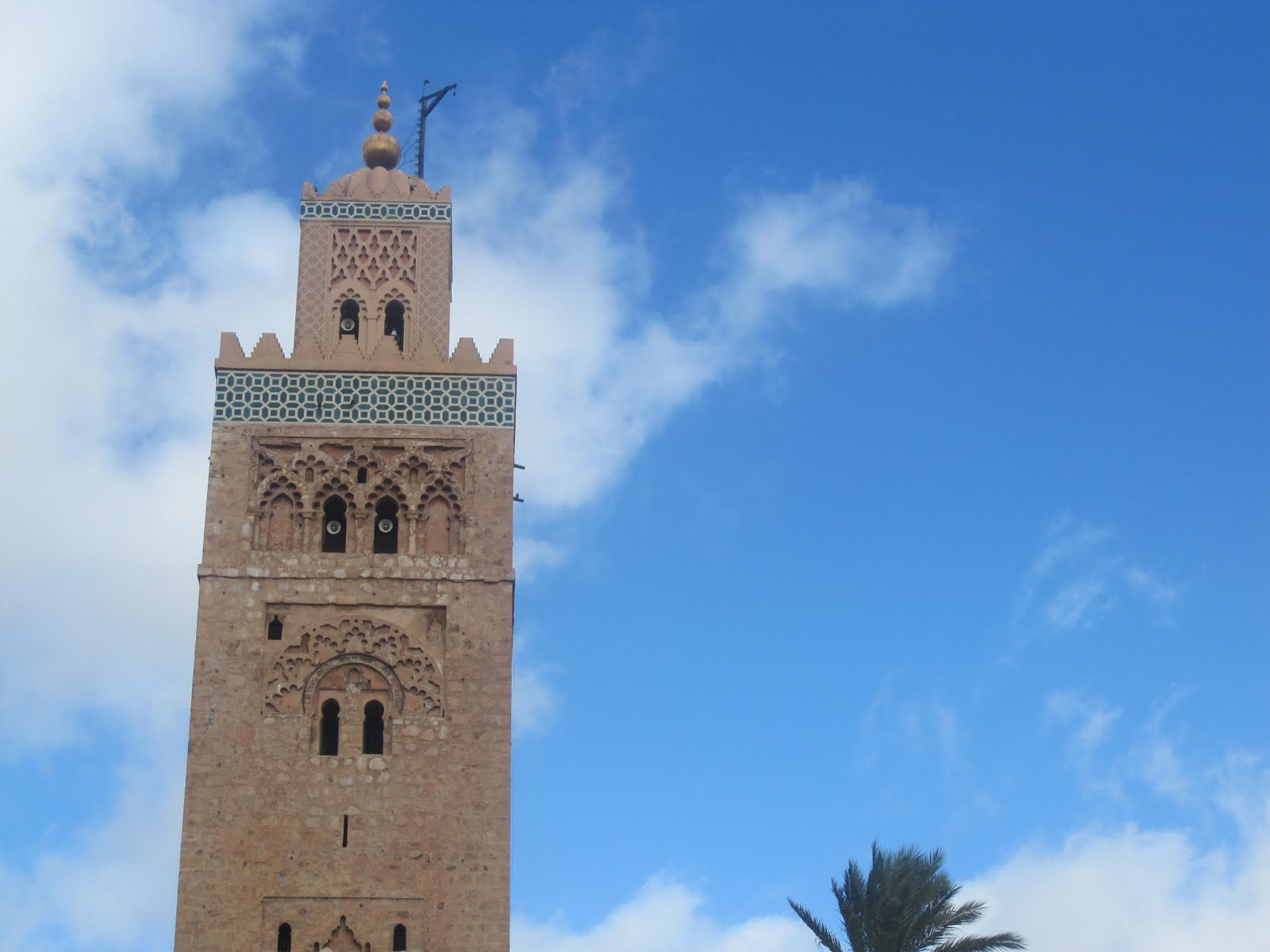
Once across the road we entered the Koutoubia Gardens, a big green open space with rows of palm trees, and followed a main route through where rough sleepers were getting out of their cardboard beds and preparing themselves for a long day begging on the street corners. Ahead of us was the twelfth century Koutoubia Mosque, the highest in the city, soaring into the perfect blue sky above and we could see clearly now why the early morning call to prayers had been so loud because on each of its four sides were two enormous speakers that looked more appropriate for an open air rock band concert than a church.

The Mosque wasn’t open for business at this time but we wouldn’t have been allowed in even if it had because non-believers are forbidden from entering a Muslim Mosque at any time so we had to make do with admiring the structure from the outside and sneaking a look inside through any open doors whenever we could.

There was no going any further now because we had to return to the Riad for breakfast so we retraced our steps and back at the Nafis found Mike and Margaret already waiting for us at our table that was laid out on the sunny terrace. From the terrace we could see (past the satellite dishes) all over the city and away in the distance to the south the Atlas Mountains that this morning were obscured by a hanging heat haze which made weather prospects look promising for the day ahead.

Hotel breakfasts are always a bit of a lottery I find and they can range from thoroughly disappointing to exceptionally good and I am glad to say that this one was right at the upper end of the scale. There were pancakes and cakes, fresh juice and plenty of tea and coffee and some absolutely delicious fresh baked bread and a range of fruity preserves all served with an excellent and satisfying attention to detail. Over breakfast we filled in another official form which seemed to serve no purpose other than to confirm what we had said on the entry form but the owner insisted that it was important because she had to register us at the police station today. We all ate far too much and when we had finished we left the terrace and prepared ourselves for a day in the vibrant streets of Marrakech.

Tuesday, 23 November 2010

Marrakech, The Riad Nafis


Another turn and then a dead end with a wooden door in the wall but nothing to indicate that this might be our destination. He knocked and someone inside approached and let us in. Here was a complete contrast to the medley of noise and confusion outside with an atmosphere of peace and tranquillity in a tiny five room guest house with an inner courtyard and a swimming pool with floating candles. This was the Riad Nafis and it was immediately charming and delightful. We had chosen well and Laurent, the owner, introduced us to the staff, allocated us our rooms and showed us around, which didn’t take long because it was only a small place after all.

We had selected a Riad for our accommodation because we wanted to stay inside the walls of the old towns rather than in the modern corporate hotels of the new city on the other side of the walls. The Nafis looked perfect and had good guest reviews and we were not disappointed. We had excellent rooms on the first floor with internal balconies overlooking the pool, nicely furnished bedrooms and big bathrooms.

As it was our first night we had chosen to eat at the Riad this evening and on the open air terrace a table had been prepared for us so after we had settled in and Laurent had given us all the advice that we could possibly need for a four day stay we made our way to the top and settled down for evening meal. Being in an Arab Muslim country we had been concerned about the availability of alcohol and had brought some with us just in case but, and I don’t want to sound like an alcoholic here, we were relieved to find that the Nafis had a licence to serve beer and wine so we ordered the local varieties and then had an excellent first meal of Moroccan salad, chicken tagine and a fruit pastry desert.


It had been a long day and there was a lot to do tomorrow so we didn’t stay up late but went to bed looking forward to a good night’s sleep. Unfortunately no one told us about the adhan which is the Islamic call to prayer, recited by a man called the Muezzin at various times of the day and starting it seems in the middle of the night. In total the adhan is called out in every mosque five times a day, traditionally from a minaret, summoning Muslims for mandatory prayers and the main purpose behind the multiple loud pronouncements of every mosque is to make available to everyone an easily understood summary of Islamic belief. In the old days this would have been done by shouting from the highest window but now it is done with the help of loudspeakers and there was no way of sleeping through this. From the top of the highest Mosque, the Koutoubia, it went on for about ten minutes and there was a lot of activity in the Riad as the young staff woke up and scampered to the roof with their prayer mats to join in.

It was about five o’clock and it was difficult to sleep soundly again after that and anyway Kim was excited about getting out onto the streets with her camera so after an hour or so I gave in and agreed to join her.

Sunday, 21 November 2010

Marrakech, An African Adventure


With the low cost airlines suddenly opening up exciting new routes beyond Europe and with reasonable, if not absolutely bargain prices, the time was right to travel a little further beyond our normal boundaries and we choose Marrakech in Morocco in North Africa. Neither of us had been to the continent of Africa before so this was going to be a whole new experience.

We travelled with Easyjet on a three and a half hour flight and close to our destination flew through a magnificent sunset which exaggerated the colours of the brown arid land and bathed Marrakech below us with a warm orange glow. The plane landed at the Menara airport, close to the city, at half past six where it was already dark but the temperature was close to 30º centigrade and a warm breeze greeted us as we stepped out of the aircraft and onto the tarmac.

There was a lot of congestion at passport control and an entry form to fill in which was probably the worst designed official form that I have ever encountered. Despite dealing with three incoming flights and all this bureaucratic nonsense the queues actually went down very quickly and when it was out turn to be processed we were given our unique identity number which was theatrically stamped into our passports and waved through to where a supervisor checked them for a second time presumably to make sure it had been done properly by the first official.

Before travelling I had read some advice that said watch out for taxi drivers who will gladly overcharge unsuspecting tourists. That is no different from anywhere else in the world of course but I was mindful of that so took the second piece of advice which said when arriving for the first time it was advisable to take a pre-booked shuttle service because finding places can be difficult at the first attempt and especially in the dark. At €32 it was a bit expensive but our driver was waiting for us as promised in the arrivals hall and he quickly loaded our bags and set off for the city just four or five kilometres away.

The traffic was mad and so was the driver as he carved his way through the rush hour traffic coping brilliantly with the ludicrous French driving rule of priorité à droite where vehicles from the right always have priority at junctions and roundabouts and which was evidently still the norm here even though the French themselves have seen the sense of virtually abandoning it in their own country. There was no lane discipline that I could make out and the ten minute journey was one extended game of ‘chance’ where drivers simply waited to see whose nerve would fold and who would yield first. We flashed past motorbikes and donkeys pulling wooden carts, pushbikes and pedestrians and at one point even encountered a camel train.

The route into the city took us past the famous Hôtel Mamounia where amongst others Winston Churchill and Mick Jagger used to like to stay. Churchill came for the painting and Jagger for the drugs! Then through the bus station which was heaving with early evening activity before stopping abruptly in an unpromising looking place on the Rue Sidi Mamoun where the driver unloaded the bags and invited us to follow him.

He took us through a gate into a busy road with small shops on one side and a high wall on the other that turned out to be Royal Palace of King Mohammed VI which is where he stays when he visits Marrakech. Suddenly he darted into a side road, no more than an alley really with an uneven surface with houses and shops along one side, then through a dog-leg turn and into a narrower lane and by now we were glad that we had taken the shuttle bus option because we would never have found this place by ourselves that’s for sure.