Showing posts with label Montenegro. Show all posts

Friday, 1 October 2010

Montenegro, Hercig Novi and return to Croatia


After the inconvenience of not being able to check out and pay the bill without first going to a cash machine we were glad to finally leave Kamaria and head back towards the border and Croatia.

After a short while we arrived on the outskirts of the fortified town of Hercig Novi and although the main road was dusty and scruffy it seemed bad manners not to pull off into the side streets and visit the old town. This was easier said than done because this is another town with a parking problem and we crawled in a queue of traffic as everyone was searching for a space. Finally we found one as close to the old town as we were likely to get so we accepted that this was the best we would be able to do. It said that it was a pay car park but there was no ticket machine or attendant so we were thoroughly confused. I made enquiries in a couple of shops and finally established that tickets were on sale at the newsagents so I bought two hours and nervously left the car. There were some conscientious parking wardens scrutinising windscreens and tickets and a yellow mini being towed away on a car transporter and I began to worry that I hadn’t understood the procedure and might come back to find the car removed and a long walk back to Mlini.

It was quite a long walk along the busy road and getting hotter under the late morning sun so were glad to reach the entrance to the Stari Grad old town and find some respite from the impatient traffic and the increasing heat. Inside the old gate and within the confines of the walls there were a succession of basking squares with an unhurried pace of life and we walked from one to the other to take in the sights. We were immediately glad that we had stopped off because this was really very nice and most probably a place easily missed by tourists heading for Kotor and Budva going one way and Dubrovnik going the other.

After the squares we climbed a stairway of worn shiny steps to get to the entrance of the fortress which stands at the top of the town overlooking the harbour below. Inside there were walls to walk and views to admire, nothing like Dubrovnik of course, but pleasant all the same and worth the small admission fee. It didn’t take long to complete the visit to the fortress so we walked back down and had a welcome cold drink in a bar in the main square next to the town’s old drinking fountain and the Serbian Orthodox Church in the centre.

After a short rest we walked the other way through twisting lanes and down steep steps towards the harbour but it was a long way, very hot and time was running out on our two hour parking ticket so we abandoned the walk at the half way stage and climbed back to the squares with their balconied buildings and tall shady trees and then retraced our steps back to the car which was exactly where we left it and no parking ticket tucked under the windscreen wipers either.

Getting out of Hercig Novi was no easier than getting in and we sat in a snarling traffic jam and followed the line of cars through the narrow one-way system and finding the right road included quite a lot of guesswork because although there was a sign for every hotel and grill bar the road signs had a curious absence of helpful information if you are looking for directions to the next town but eventually we threaded our way to the main road and prepared to leave Montenegro.

There was a wait again at the border as the immigration police thoroughly checked the documents of a convoy of camper vans from the Netherlands and as we waited we reflected on the Montenegro experience. We had liked it but not as much as we expected to, there was a clear sense of being somewhere different, even more so than Bosnia-Herzegovina in 2008 and to be honest we were glad to be going back to Croatia and we took a leisurely drive back to Mlini and the Villa Carmen.

We had a different room this time, not as good as the first but with a nice secluded balcony, which was cool and surrounded by greenery but required the precaution of plenty of insect repellent. After we had settled in we walked to Mlini for lunch at our favourite restaurant and then just let the rest of the day slide away as we swam in the soft blue water of the Adriatic and then sat at the edge of the water getting a swim suit full of tiny pebbles that we later transferred to the hotel room when we got changed.

Sitting on the terrace in the early evening we watched the colours of the sea and the sky go through their daily transformation and I was struck with how different it is here to Greece. In the Cyclades the sky is a consistent blue that explodes into a vivid sunset but here I have always found it more subtle with a greater variation and range of colour as the sky goes through several stages as it progresses through to the end of the day.

And the end of the day meant a final stroll into Mlini and another meal at the favourite restaurant which may not have been very adventurous or imaginative but we liked it there and we enjoyed an excellent final meal.

Thursday, 30 September 2010

Montenegro, Hotel Casa del Mare


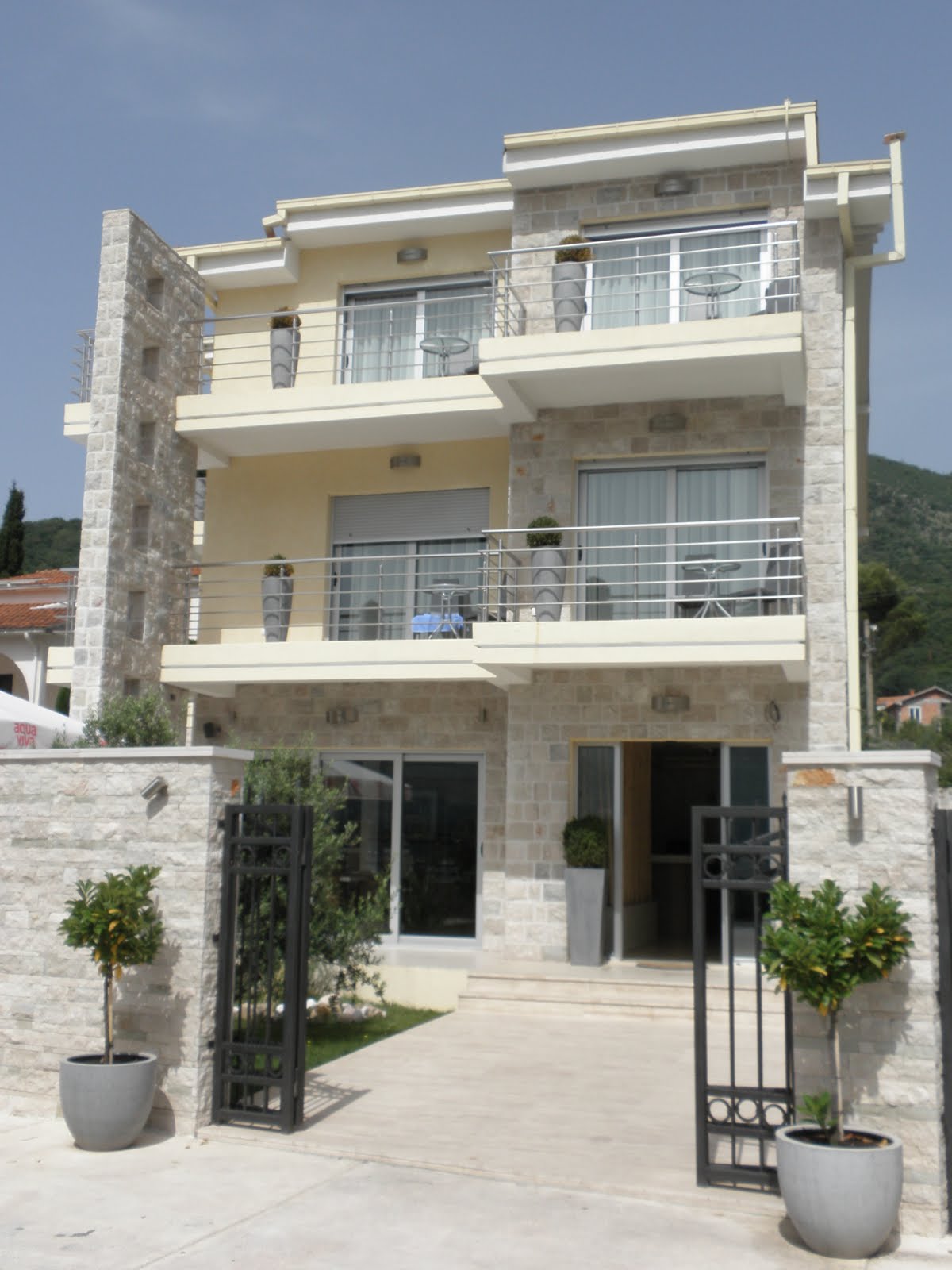
The Casa del Mare it has to be said was a curious hotel; a bizarre mix of excellence, comic and incompetence. This had started the moment that we arrived when a paperwork mix-up (their description) had led to confusion about room allocation, which turned out well for us because we had to be upgraded to one of the best rooms in the small eight bedroom hotel which we didn’t mind at all.

The owners were friendly, in fact I would have to say too friendly because it was impossible to get past reception without being intercepted and bombarded with far too much advice to be taken in all in one go but this was something we had to get used to even though generally speaking I prefer to go straight to my room or the bar or the restaurant without unnecessary conversation.

The room was first class with deliciously cool air-conditioning, modern furniture and bright cheerful decoration and there was nothing there to fault at all except the safe wasn’t bolted down and if anyone was minded to steal our valuables they could simply have walked out with the whole thing under their arm! Still, we were confident that wasn’t going to happen so we just found it amusing.

The al fresco restaurant was good, set in manicured gardens with modern furniture and immaculately clean and on account of this we decided to eat there on the first night and selected a table on the terrace. The waiter brought the menus and we made our selections from a huge choice while children with a family on the next table ran around and made a nuisance of themselves. This wasn’t a problem in itself except it looked dangerous to me when they kept getting under the waiters feet as he delivered food from the kitchens.

Now, the menu was fine but there was far too much on it and this didn’t assist decision making but this wasn’t a real problem either because the poor waiter was so busy that he didn’t return to take our order for almost fifteen minutes. When he finally turned up we ordered a bottle of white wine, a starter to share and a main course each.

The white wine selection put him in a spin because he didn’t have any pre chilled so he farcically tried to cool a bottle down in an ice bucket and resisted our attempts to drink it before he had dropped the temperature a degree or two. I think I would have just stuck it in the freezer for a minute ten minutes or so. Anyway, we insisted on drinking it as it was and he had to concede.

Then we had to wait another fifteen minutes for the first course to arrive, which turned out to be an excellent plate of food that we polished off quickly but then had to wait another thirty minutes for the main course which was sadly disappointing. When we had finished he apologised for the delays and advised us that he could speed things up tomorrow if we could choose our meals some time in advance.

This seemed sensible but I did expect this to mean first thing in the morning and the next day when we sat down for breakfast he immediately started to pester us about tonight’s evening meal and quite honestly this was a bit too soon for me to think about tonight’s main course let alone select it!

Breakfast was excellent, certainly one of the best hotel buffet breakfasts that we have had but he would keep banging on about fish and lobster and mussels for later on and we weren’t ready to make this choice just yet. He had another weird quirk of making us sign for the tea and coffee, which I thought was odd because breakfast was included in the rate. I asked him why and he said not to worry it was just for his records! I cannot even begin to imagine what this was all about.

After we had been out for the day we returned to the hotel at about six o’clock and he immediately pounced – did we know what we wanted to eat yet? We didn’t really but indulged him and asked for mussels. ‘Black or white?’ he enquired and when I looked puzzled he took us to the kitchen to show us the white variety. They were scallops, so we said ok but we would like some ordinary (black) mussels as well and for main course we would choose from the menu and went to the room confident that this would speed things up.

We choose red wine tonight so we didn’t have the cooling down routine and although service should have been quicker we had drunk three quarters of it before the starter arrived – just four scallops and no mussels and they weren’t even cooked very well! I asked for the mussels and it was his turn to look puzzled and he explained that we hadn’t ordered them. I didn’t want to argue with him but I thought that was the whole point of ordering early! When he returned to clear the plates I told him that we hadn’t enjoyed the scallops that much and he went into shock and demanded an explanation. And then the receptionist came to make the same enquiry and then the owner and I was beginning to wish I had just done the decent British thing and kept my dissatisfaction to myself.

I knew it was going to take a long time again because thirty minutes after ordering the main course he came back and asked us to remind him what we had chosen. I asked for some beer and he asked why and I explained as best I could that it taken so long for the food to arrive that we had drunk all the wine! The kids ran about again until one of them crashed into a plate glass window which slowed him down a lot and we sat and waited. And we waited for another thirty minutes until the main course arrived by which time it had taken so long that we no longer had an appetite for it so we ate about half of it and left.

At breakfast the next morning he aplogised several times but was careful to point out that it really was our own fault because we clearly didn’t know the difference between black and white mussels and we should have ordered earlier. And here was the real problem with the menu – there was just too much on it, the chef was providing too many selections when he should have been concentrating on a manageable number and I gave this advice on my feedback form later. The waiter did seem genuinely concerned that we hadn’t enjoyed our meal and brought us something special to compensate – a bowl of luke-warm chocolate mousse! We were dumbfounded and speechless and I still am.

Overall we did like the hotel and mostly we were amused more than irritated but we were glad to be leaving and going back to Croatia. But even this wasn’t as straight forward as it should have been because when we checked out the credit card payment machine was broken down and so they wanted payment in cash. I didn’t have enough Euros in my wallet so had to drive to a cash point three kilometres away in nearby Bijela and then return with the money where everyone else who wanted to check out this morning was having exactly the same problem.

An interesting place the Casa del Mare hotel. I won’t be going back!

Thursday, 23 September 2010

Montenegro, Sveti Stefan and Budva


The next stage of the drive took us through and out of the National Park and on to the city of Cetinje, which, for a big city, had a curious absence of helpful road signs and we drove around the same streets several times looking for the main coast road. Cetinje didn’t look especially exciting on a lazy Sunday afternoon, a old-fashioned sort of place with wide, tree-lined boulevards and grand public buildings, many of them fallen into disuse. Apparently the Government is currently moving some administrative buildings back into Cetinje, but for now it a backwater ghost town, with a sleepy sun-baked air and once we had received reliable instructions from a taxi driver on how to get out we drove straight through.

We were back on a main road now where the drivers were able to demonstrate their full repertoire of recklessness and we were glad when we reached the coast and our first destination, the picturesque island hotel complex of Sveti Stefan just south of Budva. This former fishing village perches on an outcrop of rock, connected to the mainland by a causeway. In the 1960s the entire village was converted to a luxury hotel, with a hundred-odd guest rooms in the original stone cottages.

Inside, apparently, there are sculpted gardens and narrow alleyways overhung with flowers, two small chapels and wonderful views out to sea. The hotel was once the preserve of the rich and famous, the likes of Princess Margaret and Sophia Loren feature in the guestbook. I say apparently though because after we had parked the car and walked to the entrance we were turned back by a security guard who informed us that the whole place was closed for renovations. We had planned to spend an hour or so here so we would have had time to stop in Cetinje after all but now we had to move on to Budva slightly ahead of schedule.

Budva is Montenegro’s busiest holiday resort and as soon as we drove in I was glad we weren’t staying there. There was a lot of construction and road works because Montenegro is impatient to rebuild its tourist industry that disintegrated after the war and I think they plan for this place to be their Benidorm or Lido de Jesilo because the place was full of noisy cafés and tacky bars and the holidaymakers there wore bright colours, rude tee shirts and had tattoos. In my opinion this is probably the last thing that Montenegro needs, I didn’t like it but we stopped anyway to take a look.

Actually it was much nicer around the harbour area but it was still a mixture of traditional, elegant modern and horrible holiday grunge as though the city hasn’t yet fully made up its mind what it wants to be. The old town however was delightful and although I say old town it technically isn’t because Budva is well known for the earthquake it suffered in 1979, after which the whole town had to be rebuilt and it took eight years for it to be completely finished. There were some nice shady streets and a fortress wall (€3 admission) but it was small and that was about all so we left, sat down for an afternoon drink in a bar where the waiters were more interested in the World Cup match on the television than the customers (Montenegro’s close neighbour Serbia were playing Ghana) and after a beer we paid and left for the return journey.

Once again, due to the shortage of road signs, I had a bit of trouble finding the right road out of the city but eventually we groped and guessed our way out and found the road back to Kotor where we stopped at a supermarket for evening alcohol supplies and then returned along the coast road that we had used earlier this morning. In a little village called Prčan overlooking the town of Dobrota on the other side of the bay we stopped for a drink in a bar and commiserated with the local Serbian football supporters when Ghana scored in the last minute and stole the game 1-0. After that we dawdled along the coast road, annoying anyone else who happened to be on the road at the same time and then caught the ferry back to Kamaria for a second evening at the Casa del Mare where we started with a game of two of cards where I continued a dazzling winning streak that had started on the outward flight and a couple of Niksickos on the balcony.

Sunday, 19 September 2010

Montenegro, Lovcen National Park


We had another busy day planned today and quite a long drive so we woke early and after breakfast set off in the car towards the National Park of Lovcen with a plan to go from there to the coast and visit Sveti Stefan and Budva.

This time, to reduce the journey time we took the short ten-minute ferry ride from Kamaria across the narrowest part of the Bay, the Verige strait and once back on dry land we choose the slower but more scenic coast road to Kotor. This was very picturesque but as the driver I couldn’t fully appreciate it because the road was so awful and the drivers so bad that I had to keep my wits about me at all times. The best description I can find for Montenegrin drivers is frightening, terrifying even, because they are completely reckless and crazy. Seat belts are rarely worn and speed limits are almost always ignored, thirty means fifty, forty means sixty and so on. ‘No Overtaking’ signs mean leave it until the last moment and take a risk, ‘Give Way’ means keep going and ‘Stop’ means ‘It’s up to you!’

Eventually we reached the southern outskirts of Kotor and drove through the blighted parts of the city well away from the main tourist centre and then took a sharp turn to the right to leave the main highway and join the mountain road to the country’s old capital of Cetinje. At first the road climbed slowly and swayed through the trees at the first stages of the climb and it wasn’t especially attractive either, as we drove through a succession of gypsy camps, rubbish tips and abandoned clutter in the lay-bys. As we climbed it began to improve however and the road became more exciting and hazardous as it lunged like a roller-coaster through hair-pin bends that became more frequent and progressively tighter as we went up. Luckily there wasn’t a lot of traffic to deal with because this road was not wide enough for two cars and it was certain that a Montenegrin motorist would not have given way.

Along the way we stopped as often as we could to admire the great views which although it was hazy and the sunshine was gently diffused were still stunning. From this height we could see that the bay is composed of several smaller broad bays, linked together by narrower channels, which forms one of the finest natural deep water harbours in Europe. Spread out below us was the Bay of Tivat and a small naval port, currently being transformed into a state of the art Super Yacht Marina called Porto Montenegro and beyond that the Bay of Herceg Novi, which guards the main entrance to the Bay of Kotor. The inner bays that we had driven around yesterday are the Bay of Risan to the northwest and the Bay of Kotor to the southeast. Directly below us, on the landward side, the long walls running from the fortified old town of Kotor to the castle of Saint John were now as far below our feet as they were above our heads the day before.

Once again there were a number of road signs that had been used for target practice and in places the drive seemed remote and edgy and I had visions of being held up at gunpoint by bandits but I didn’t share this scaremongering piece of information. I did regret not bringing a mobile phone out between us however.
When we reached the top we were at nearly one thousand seven hundred metres (three hundred metres higher than Ben Nevis) and the road flattened out as we entered the Lovcen National Park and drove across a green plateau criss-crossed with limestone fissures and craggy rocks and wild meadows full of flowers and butterflies. It didn’t occur to me that the roads could get any worse but sure enough they did as they became narrower and more pot holed and sometimes with great areas of the tarmac missing altogether. This didn’t slow the Montenegrins down at all and they still continued to speed around and I became convinced that some of them simply pointed their cars at us, closed their eyes and accelerated.

At a confusing cross roads there were local people selling the local delicacies of smoked ham and sir cheese and I had to stop for directions. We were close to our destination now, Njeguši, the origins of the Montenegrin royal family of Petrović and as we climbed the final stretch we passed winter snow now in its final rapid thaw. Thousands of people make a National pilgrimage here to the Mausoleum of Njegoš and most of them were here today because parking was a nightmare. We eventually found a spot and then climbed the four hundred and forty steps to the top for more stunning views. We didn’t pay the €3 to go in however because we suspected that there might not be an awful lot to see and the guidebook confirmed later that this was a good decision.

On the way back down the mountain the roads were filling up with local people driving out for a picnic and at one blind bend a death wish driver in a white Volvo almost took us out but somehow managed to avoid us at the very last second so this necessitated a short stop for a drink to steady the nerves and an underpants check!

Saturday, 18 September 2010

Montenegro, Kotor


At 35º centigrade it was extremely hot and Kim was full of complaints about the heat and the humidity and after we had walked through a slightly smelly street vegetable market that was sweltering in the sun we were pleased to go through the main gate of the old town and into the shaded cooler streets inside, Kim because she was out of the sun and me because she had stopped complaining.

It was busy inside because Kotor old town is quite small with a population of about five and a half thousand and it was playing host to the holidaymakers from the cruise liner and hundreds of others as well which temporarily more than doubled the population. Once again there was a distinct Italianate feel because the old Mediterranean port of Kotor is surrounded by an impressive city wall that was built by Republic of Venice and the Venetian influence remains dominant among the architectural styles around the main squares and up and down the tight twisting streets.

Kotor is a UNESCO World Heritage site and inside the walls the narrow sinuous streets took us past little picturesque shops, cafés, bars, antique monuments and cream stone buildings, balconies overflowing with flowers, washing lines full of immaculate laundry and the overwhelming smell of washing powder and fabric conditioner.

The old town of Kotor is wedged in between the rugged Bay and at the foot of the Lovćen massif mountain range directly under overhanging limestone cliffs of the mountains Orjen and Lovćen. At the back of the town there was an entrance to a demanding walk up the vertical mountain to visit the city walls but today it was too hot for us to even think about tackling it especially in flimsy sandals on slippy stones and paths with warnings of danger clearly signposted so we made do with admiring it all from sea level and then slipped back into the maze of streets and looked for a bar away from the blistering heat of the unrelenting sun which was reflecting off the buildings and bouncing about the paved squares and open spaces.

Kotor wasn’t quite what we were expecting it has to be said and Kim found it dirty and scruffy but I would describe it as no worse than untidy, the cruise ship spoilt it in a way because the old town was overcrowded and the hulking mass of the ship destroyed the charm of the seafront and the harbour. The cafés and bars were more expensive than I imagined they would be, certainly pricier than Croatia, but I thought the old town was nice enough and we sat in the shade in a corner of one of the small squares and had a beer before leaving.

We drove back the way that we had come around the Bay of Kotor, which is one of the most indented parts of the Adriatic Sea and, although technically it is actually a submerged river canyon, is sometimes called the southern-most fjord in Europe. By now it was late afternoon and the high cloud that was trapping in the heat and raising the humidity levels was beginning to clear and the water sparkled like parchment as the sky turned to a vibrant blue so we thought we might stop again in Perast and if all the coach tours had gone take the boat ride across to the islands.

One is called St. George island, and the other called Gospa od Škrpjela (Our Lady of the Rock), and each of them has a picturesque chapel. Gospa od Škrpjela is the only artificially built island in the Adriatic, with an area of three thousand square metres it was built upon a rock after two venetian sailors from Perast allegedly found a picture of the Virgin Mary on it in 1452.

A young man, who turned out to be from Sarajevo in Bosnia but studying in London and at home for the summer to make some money, offered us a ride across so we ignored the official tourist boats and accepted. He fired up the outboard engine and then we began the short crossing. About half way across the engine spluttered and cut out and for a few moments were completely becalmed as he fiddled with the fuel supply and grumbled about poor quality petrol (I made a mental note not to fill the car up in Montenegro) and it looked as though we would have to row the final part of the journey but he told us not to worry and after a few seconds he fired the engine back into life and we completed the journey.

We stayed on the island for half an hour but that was plenty long enough to see everything there was to see and when our transport returned he took us back to the mainland this time without incident. As we hopped off the boat he asked for €3 each and I thought this was fair and on the basis that the official boats charged 5 I gave him 4 and that made him smile,

It was still hot so while Kim cooled her feet off in the sea I went looking for a shop for alcohol supplies and when we had both finished our tasks at the end of a long day we agreed with each other that we liked Perast more than Kotor and then returned to the car and drove back around the Bay and returned to Kamaria and the hotel. The balcony which had been too hot earlier in the day when we had first arrived was comfortable now so we sat and watched the boats on the water and drank the Montenegrin beer called Niksicko, which despite its unpromising name was really rather nice.

Thursday, 16 September 2010

Montenegro, The Bay of Kotor


Once past the border, in front of us we could see mountains again and after we passed through the busy and rather untidy city of Herceg Novi the road reached the sea and started to follow the winding coast line of the picturesque Bay of Kotor and in front of us now was one of the country’s biggest tourist attractions.

After a short while we arrived at the town of Kamaria and identified our hotel, the Casa del Mare, which was a brand new boutique hotel where we had one of the best rooms with an expansive view over the Bay, the main road and the recycling bins. After we had checked out the mini-bar prices and settled in we took some advice from the hotel owner on where to go and what to see we then set off to circumnavigate the Bay and drive to Kotor on the other side.

There was a ferry boat across the narrowest point of the Bay but we had decided to drive the forty kilometres or so and stop now and again along the way. The first stop came quite soon at a lay-by with a good view both east and west and looking across to the Italianate town of Perast, once an important independent Venetian ship building town but now a modern tourist trap. There was a jewellery stall in one corner of the lay-by and while Kim looked at sparkly things on chains I examined an information board about the Bay. In the middle were about twenty clear holes about the thickness of a pencil and on closer examination I realised that they were bullet holes. The hairs on the back of my neck stood on end because whoever had been using it for target practice was clearly a very good shot and it occurred to me that I could be in someone’s rifle sights even as I stood there.

I was beginning to become aware that Montenegro might be a bit different to anywhere else that I had been before and I wasn’t inclined to hang around the lay-by any longer than necessary so I encouraged Kim to hurry up and leave and we carried on around the Bay of Risan passing yet more radar speed traps on the way to Perast.

Here was a place with a parking problem with a single road not wide enough for two cars to pass and no parking spaces. At the far end of the town I found one but before I had switched off the engine a waiter from a restaurant came out, explained that it was only for customers and shooed us off. The odd thing was that he didn’t take the trouble to ask if we wanted to use the restaurant and we might have done because it was just about lunchtime but not now after that unfriendly welcome.

So we drove back to the other end of the town and parked right on the edge and walked along the seafront and back to the centre. It was very quiet with very little activity and this was probably because now it was very hot indeed. We walked around the pretty centre with its church and a few shops, up and down some steps that didn’t go anywhere in particular and then found a place for a beer and a spot of lunch right on the water’s edge.

After a debate about whether or not to take a boat across the Bay to two islands with churches on them we decided against the €5 charge and as the time was getting on and lots of tourist coaches were turning up and overwhelming the town with visitors returned to the car and continued our journey. This took us through a string of attractive villages all around the seashore and towards the eastern end of the Bay where the backdrop was a wall of limestone mountain soaring over a thousand metres high and squeezing the towns and villages in between the rock and the sea.

My driving was continuing to irritate people and several times I was tooted and invited to pull over by motorists using hand signals that you won’t find in the Highway Code but I didn’t let this intimidate me and I continued sedately on, pulling over whenever I could to let agitated motorists pass me by.

Eventually we arrived in Kotor without incident and it was much bigger than I imagined it would be from the descriptions in the travel guides and there was a two thousand passenger cruise liner tied up at the dock which was so huge it dwarfed the town and looked sadly at out of place. We needed a car park and found one around the side of the town where a grumpy attendant gave us a ticket and explained the tariff and then we set off into the old town to explore.

Wednesday, 15 September 2010

Croatia to Montenegro


There was an unexpected early start today when Kim got up and threw back the shutters announcing that it was half past seven. Even though I was still asleep it was clear to me that it wasn’t anything like half past seven and sure enough it was only half past five and Kim has read her watch backwards!

Although we went back to sleep we needed an early start anyway because today we were driving to Montenegro. Over a second excellent breakfast we had to keep this to ourselves however because our Croatian hosts were not especially impressed that we were visiting the neighbours who caused so much damage in this part of Croatia only fifteen years or so before and certainly weren’t keen to encourage us to go there.

We wanted to go to Montenegro because we were aware of it up and coming status as a holiday destination and with the Montenegrin Tourist Board making big claims like,

‘Montenegro is the pearl of the Mediterranean situated in the south of the Adriatic, there is nowhere else that you can find, in such a small place, so much natural wealth, beauty, beaches, clear lakes, fast rivers, gorgeous mountains, history, culture, tradition, good weather, clean air, beautiful nature, blue Adriatic Sea, everyone should visit Montenegro sometime’

we felt obliged to go there before it gets too busy so when we left we drove out of Mlini and took the main coast road south, back past Cavtat and the airport and then towards the border.

Driving is not straight forward in Croatia for a number of reasons. First of all there are the unfamiliar rules like driving with headlamps on even during the day, which seems a bit pointless when the sun is permanently shining. And then there is the issue of speed limits: Because the main road runs through every town and village along the coast these change frequently and you have to keep your wits about you to make sure you are not speeding. These speed limits however to not apply to the Croatian drivers who quickly become impatient when held up by an inconvenient tourist and I frequently found myself at the front of an increasing queue of traffic who didn’t share my resolve for dutiful compliance with the limits. Whenever I could therefore I had to practice my impression of a Lincolnshire tractor driver and pull over at a convenient spot and let everyone pass.

South of the airport there were two more hazards, first of all the potholes that had to be carefully negotiated and secondly, caterpillars. Yes, caterpillars! I saw some things wriggling across the road but it took a while and a few casualties to realise what they were. There were hundreds of the little things making a dangerous crossing from one side to the other and the smears on the road was proof that a lot of them didn’t make it. I have no idea why they were doing but I have been doing some calculations to try and fully appreciate the risk. Each caterpillar was about five centimetres long and the road about eight metres wide so this would be the equivalent of an average man attempting to cross a busy motorway the length of three football pitches without getting run down and was therefore fairly hazardous.

As we approached the border the scenery stared to change, the mountains retreated further inland and we drove along the edge of a large lush green valley flanked by gentle hills with an abundance of trees and then the valley disappeared and the road was squeezed into a narrow pass that brought us to the border controls.

First of all we had to get out of Croatia and this involved a fifteen minute wait while the only man on duty was dealing with traffic coming in the opposite direction before a second man finally arrived to deal with traffic going into Montenegro. And then after a couple of kilometres we had to stop again and be processed by the Montenegrin border guards. These guys were really thorough and although there were only two vehicles in front of us this took another fifteen minutes of passport and hire car details scrutiny before we were allowed to proceed.

While we waited the environment police checked the sticker in the windscreen to make sure our environment tax was up to date, which luckily for us some previous hirer had paid for and which saved us the €10 tourist tax scam. The Robin Hood style tax is explained by the Montenegrin Government “as being in response to the increase in the number of vehicles which have additional negative influence on the air quality and the general degradation of the environment as such. The increased number of vehicles effects the emission of pollutants and dangerous substances and endangers the environment, especially during the summer season, due to the increased numbers of foreign tourists”. What a load of bullshit!

Now we were somewhere different but the first sign we saw was the familiar blue EU sign that announces the funding of an improvement project and this surprised us because they are not even in the EU: is it any wonder that we have an economic crisis I wondered? Montenegro is classified as a highly developed country by the Human Development Index but one of two former Yugoslav republics which are marked as ‘Moderate’ on the Failed States Index. As it turns out Montenegro has been receiving more European Union funding per capita than any other country for the last few years and €131.3 million has been earmarked by the European Commission for Montenegro to assist it achieve what is called European integration. Montenegro became a recipient of the EU funding through a new mechanism, the Instrument for Pre-Accession Assistance, or IPA, and most of the funds have gone towards ‘strengthening the infrastructure and management of the transportation sector’.

Well, we didn’t see much evidence of that and just as in Croatia I was being careful with speed limit compliance and once again I was irritating the local drivers. I wasn’t deliberately trying to make a nuisance of myself it was just that I was being mindful of the Foreign Office advice to take care when driving in Montenegro because the traffic cops can be rigorous in enforcing the law especially with foreign motorists and I was very conscious of having a Croatian number plate. It was a good job that I was being careful because in the thirty kilometre drive to our accommodation we passed four speed trap patrols that were waiting to pounce.

Wednesday, 25 August 2010

Croatia, Dubrovnik


The water taxi took about thirty minutes to make the short journey from Mlini to Dubrovnik and even though large cruisers anchored up outside the harbour spoiled the approach the old town fortifications looked spectacular as we sailed into the harbour and once off the boat we transported into an alternative world of narrow medieval streets, magnificent buildings constructed of white Dalmatian stone and a riot of red tiled roofs. We knew that we had all day to explore the city but we were impatient so purchased our tickets and climbed to the top of the walls for the two-kilometre walk around the magnificent tenth century guard’s walkway.

It was extremely hot and It took a couple of hours to complete the walk around the city stopping frequently to admire the breathtaking views of the cathedrals and churches, the battlement and towers and the busy streets bustling with activity at the base of the walls and through the city to the other side. The route took us first alongside the Adriatic and then at the Fort of St John into the old city port past fishing boats, yachts, pleasure craft and water taxis all floating gently on the placid sea within the protective walls of the harbour’s medieval defences. Then we were on the land side where there were there were the best views of the tiled roofs and on to the highest point at the Minceta Tower where there was a steep climb rewarded with an expansive panorama of the city and the vivid blue sea behind it.


The medieval city of Dubrovnik was founded in late antiquity and grew first under Byzantine and then later under Venetian rule before becoming an independent republic in 1358. It developed into a maritime and trading power that rivaled the Venetian Republic and reached its zenith in the fifteenth and sixteenth centuries. It even managed to keep its political independence under Ottoman rule, which began in 1526 but it was sacked in 1806 during the Napoleonic wars, and lost its status as a city-state two years later. It came under French rule and was ceded to Austria in 1815. A century later, it became part of Yugoslavia.

When we had completed the circumnavigation of the walls we returned to street level and walked first along the polished white paving stones of the main street occasionally taking detours into intriguing little side streets and alleys. We admired the reconstructed Rector’s House and the Cathedral, wandered through a street market and then to some of the quieter little streets underneath the walls for a different perspective. The old city dates from the thirteenth century, when the imposing fortifications began to be built and the elegance and charm of the historic centre is a perfect blend of Gothic, Renaissance and Baroque architecture. Not surprisingly the place had an Italianate feel with pizzerias and waiters pestering for business in that unique Italian sort of way but we didn’t mind this and just politely said no thank you in an English sort of way and walked on.


By the time we had walked underneath the walls of St John’s Tower and into the old harbour I was beginning to understand why in 1929 George Bernard Shaw described Dubrovnik as ‘Paradise on Earth’ and thankfully the post war reconstruction has restored the old town to its former splendour.

At the beginning of the bombardment, the city was placed on the List of World Heritage in Danger and quickly after it was over UNESCO launched an action plan to save Dubrovnik and the reconstruction work began. To rebuild the roofs the original sixteenth century rafters had to be strengthened and almost half a million tiles had to be replaced. The original tiles had been made in the village of Kupari, about fifteen kilometres from the city, and dated from the time of the Dubrovnik republic but the workshops had closed at the beginning of the nineteenth century, and specialists faced the task of finding a kind of tile which could as far as possible be made using the original materials and methods of construction. Eventually French and Croatian specialists managed to recreate the original technique and the famous roofline was perfectly restored.

The cost of the restoration was estimated at $20 for the old city within the walls and $30 million for the urban area as a whole. Much of the funding came from the new Croatian government and the Dubrovnik Reconstruction Office but also with aid from private Croatian sources and from UNESCO itself. Croatian and international teams of architects, sculptors, restorers and other experts managed to complete the bulk of the work within seven years and in December 1998 Dubrovnik was taken off of the danger list.

It was midday and hot so we returned to a waterside bar that we had used the previous year and thought about lunch. Last year we seriously over ordered here and ended up sending food back so this year we were mindful of that and ordered accordingly – just one plate of small fish and a salad. We were in a perfect spot next to the girls trying to sell thirty minute tours on glass bottomed boats and watching the guided tour parties trying to make decisions about who was going on and who wasn’t. Eventually we tired of watching the people parading back and forth, left the harbour and went back into the city.

It was now almost unbearably hot and Kim had acquired a headache but we had seen mostly everything we wanted to see in Dubrovnik so we walked to the bus stop, I bought the wrong tickets in a shop, and then waited in the shade for the Mlini bus for the fifteen minute ride back along an elevated road with great views over the city, the harbour and the sea.

Monday, 23 August 2010

Croatia, The Siege of Dubrovnik


We had an excellent breakfast on the sunny terrace with local specialties, fresh bread and home made marmalade and jam and Doris sold us tickets for the water taxi to Dubrovnik, which I think was probably another part of the family business.

We had about an hour to wait between breakfast and the boat and we spent this in Mlini wandering about the back streets, through overgrown gardens, down mysterious passageways and along the seashore, it was a lovely place and we had made an excellent choice of holiday location.

The taxi left from the little harbour in the village and we waited in the already hot sunshine until it arrived at ten o’clock and then selected seats on the upper deck and sat and sweltered while we waited for it to leave. Eventually it left and followed the coast towards the city and then we saw something unexpected and nothing like we had seen before on previous visits to Croatia, a string of war damaged shelled out hotels at regular intervals all the way to Dubrovnik. This we learned later was the legacy of an invasion by Montenegro during the secessionist wars of the 1990s.

Montenegro played a disastrous part in the break-up of the former Yugoslavia because in 1991 its army, urged on by Slobodan Milosevic, advanced across the border into neighbouring Croatia, destroying villages, looting and stealing on the way and then shelling the ancient city of Dubrovnik. The city was attacked by the Serbian-Montenegrin army and besieged for six months during which time about two thousand shells rained down on the walled city, damaging seventy percent of its buildings and two-thirds of its famous red roofs. Dubrovnik’s ancient heritage was threatened with destruction and a plaque within the city now shows all of the major strikes on public buildings and churches, cobbled streets made of Dalmatian stone and irreplaceable statues and monuments.

Early in 1991 the political leaders of Montenegro and the Yugoslav Peoples’ Army, the, JNA, justified the attack and siege of Dubrovnik as a necessary move towards protecting the territorial integrity of Montenegro and Yugoslavia and preventing a potential conflict along ethnic lines, as well as stopping the so-called unconstitutional secession of Croatia. The Montenegrin Prime Minister rallied the country with the rabble rousing statement that the ‘Croatian authorities wanted to have a war and they will have it.’ He continued by saying that ‘if Croatia wants to secede then the internal borders must be revised,’ while interpreting the war in Croatia as an inevitable outcome of the totalitarian policies of Zagreb: ‘One million Serbs in Croatia are deprived of their rights and are forced to respond with arms.’ He assured the people of Montenegro that the time had come to ‘draw the demarcation lines vis-à-vis the Croats once and for all,’ and that ‘the new borders with Croatia would be more logical and just than those drawn by the old and poorly educated Bolshevik cartographers’

In the early hours of 1st October JNA soldiers and reservists began military operations in the southern Croatian region of Konavle. Just after five o’clock the people living in the village of Vitaljina and throughout the region of Konavle were woken up by heavy artillery fire coming from the JNA positions at Prevlaka Peninsula, Prijevor, Mojdez, and also from the JNA’s naval vessels anchored off the Croatian coast. The artillery fire was then followed by an infantry thrust into Croatian territory.


The invaders evicted people from their houses and engaged in massive looting, pillaging, and the destruction of private and historical property, actions which had no justification or any strategic military objective. The airport was attacked and equipment stolen and heavy looting occurred in Kupari, where the hotel complex Vrtovi Sunca was virtually cleaned out of all its furniture and equipment, pieces of which were later either sold on the black market in Montenegro or given as ‘gifts’ to various state-run institutions and organizations in Podgorica, the capital of Montenegro. After the looting of the hotels they were then destroyed by heavy shelling, an action designed to destroy the economy of the region and to prevent them being used for refugees and people bombed out of their homes.

Europe and the World watched most of the dreadful events of the Yugoslavian wars on television screens but took no action but for the west at least, the destruction of Dubrovnik overstepped the mark and brought pressure on the warring factions to stop. It was almost as though the World was prepared to watch ethnic cleansing, death and destruction in cities with unfamiliar names that meant little to them but when a UNESCO World Heritage Site was attacked and a city that was seen to belong to the World and not a single place, collectively they said ‘enough is enough’.

The ‘War for Peace’ turned out to be one of the most disagreeable episodes in recent Montenegrin history because Montenegro disgraced itself by putting itself in the service of the Yugoslav army and Slobodan Milosevic. After the war Montenegro became a virtual pariah state, and the later bombing of nearby Kosovo reinforced this isolation.

After the end of the war in 1995 Montenegro remained closely allied to Serbia but declared independence on 3rd June 2006. In March 2007 the Montenegrin President apologized for involvement in attacks on Dubrovnik, which caused several hundred civilian deaths and destroyed countless homes, and agreed to pay damages. Some estimates place the value of the damage at around €35 million. So far, Montenegro has paid up only €375,000 as compensation for looting the area’s cattle. Reparation is going to take a long time and in the mean time the bombed out hotels which disfigure the coastline remain as a dreadful reminder of the war.

Really, I should have found out about this before the holiday and I suddenly began to feel a bit uneasy about visiting Montenegro the next day for fear of offending our Croatian hosts.

Wednesday, 18 August 2010

Croatia, Cavtat


As usual the Easyjet flight was late taking off and also arriving so added to its statistic on late or delayed flights that Michael O’Leary delights in gloating over when he provides benchmark statistics in the Ryanair in-flight magazine each month. Easyjet are frustratingly relaxed about flight times and I think on the whole I prefer the Ryanair approach.

There wasn’t a great deal to see for the first part of the flight because of cloud but we saw the snow capped peaks of the Alps poking through the mist and shortly after crossing Venice the vapours cleared and we had a clear view of the coast of Croatia and the string of islands separated from the main land by a vivid blue Adriatic Sea. As the plane flew south we picked out familiar places, Trogir, Primosten, Split and islands that we recognised, Hvar and Korcula, but this time from an unfamiliar perspective because for the last two years these were places that we had only seen from ground level as we had driven south from Zadar. This time we could appreciate the islands with their halos of golden sand, the blue sea and the salt and pepper grey mountains that rise dramatically behind the narrow coastal strip. As the plane descended we flew low over the old town of Dubrovnik and picked out the iconic red roofs, the city walls and the boats in the harbour.

Within seconds the plane was touching down and after a short wait we were in welcome sunshine as we walked to the terminal building to be processed at the passport control desk. It was a nice modern airport, clean and airy and after we passed through we found the car hire desk where we were upgraded from a small to a medium car for no additional cost. We were planning to drive to Montenegro and the Government Foreign Office website warns that driving can be difficult there with poor roads and temperamental drivers so on this occasion I agreed to pay the additional €6 a day for the fully comprehensive insurance.

After we had completed the paperwork and signed up we maneuvered out of the impossibly tight parking space in the parking lot and drove the short distance to the resort of Cavtat. I paid careful attention to the road and Kim worked out the air conditioning controls and air flow combinations because it was very, very hot indeed. It only took a few minutes to arrive in the small town and find a car park and then, after a quick change of clothes into something more appropriate for 28º of sunshine rather than a chilly morning in Stansted we walked around the harbour and slipped immediately into holiday mode.


Cavtat was delightful and because Croatia insists on a compressed holiday season of two months in July and August, and except for being directly below the flight path of landing planes, it was quiet and peaceful. In the harbour there were a pot-pourri of working boats, pleasure cruisers and some very expensive sailing boats and yachts so we picked a restaurant with a good view and enjoyed a simple lunch and a first Croatian beer called Ožujsko. It was good.

After lunch we walked around the little town through narrow leafy lanes and cobbled streets flanked with traditional red-roofed brownstone houses climbing back from the blue of the waterfront up narrow stairways smothered in clouds of white, mauve and pink blossom and every now and then a private shaded courtyard to investigate. Along the front there were busy cafés and tourist shops and the waiters and the shopkeepers allowed us to browse slowly without pestering for custom as they do in other parts of Europe.

It was early afternoon and getting hotter so it was time to leave and continue our journey towards the nearby village of Mlini where we would be staying for a couple of nights. I got us tangled up in the one way system and took the long route out of town that twisted along the coast and then climbed through green hills with contrasting yellow broom and scarlet poppies back to the main road and headed north.