The rain showed no sign of easing off so we settled in to an afternoon of sport on the satellite television which was promising a full afternoon of English Premier League football. I sampled the first can of Frydenlund and was pleased to discover that it was very nice indeed and then sat down for the match. I suppose they have to show English, German and Spanish matches because Norway doesn’t have a much of a football team themselves and although they are big hitters in the economic and social world league indexes their football record in World and European cup competitions is nothing much to brag about. They compensate for this however by having possibly the most famous bit of football commentary ever.
The Norwegian broadcaster Bjørge Lillelien most famously reported on Norway’s unlikely 2-1 victory against England in a World Cup qualifier in Oslo on 9th September 1981. At the end of the match he was almost hysterical, no, he was completely hysterical and, alternating between English and Norwegian, he screamed into his microphone:
“We are best in the world! We have beaten England! England, birthplace of giants”,
And he followed this up by taunting a roll call of famous English people:
“Lord Nelson, Lord Beaverbrook, Sir Winston Churchill, Sir Anthony Eden, Clement Attlee, Henry Cooper, Lady Diana we have beaten them all, we have beaten them all! Maggie Thatcher, can you hear me? Maggie Thatcher your boys took a hell of a beating! Your boys took a hell of a beating!”

Away from football interestingly Norway has a national cricket team that are ranked a credible thirty-eighth in the World, out of one hundred and five and a rugby team that is not so successful being ranked eighty-sixth out of ninety-four.
I didn’t get to watch the football match however because as we sat in the lounge the sky brightened a couple of shades of grey and the rain stopped so not having travelled eight hundred miles to Haugesund to watch television we found our coats and returned to the streets. Taking the bridge across the water we walked to the island of Risøy where behind a couple of streets of timber clad houses there was a large ship building yard and dry dock and in the middle and dominating the skyline was a massive blue building which turned out to be the biggest indoor shipping repair facility in Norway.
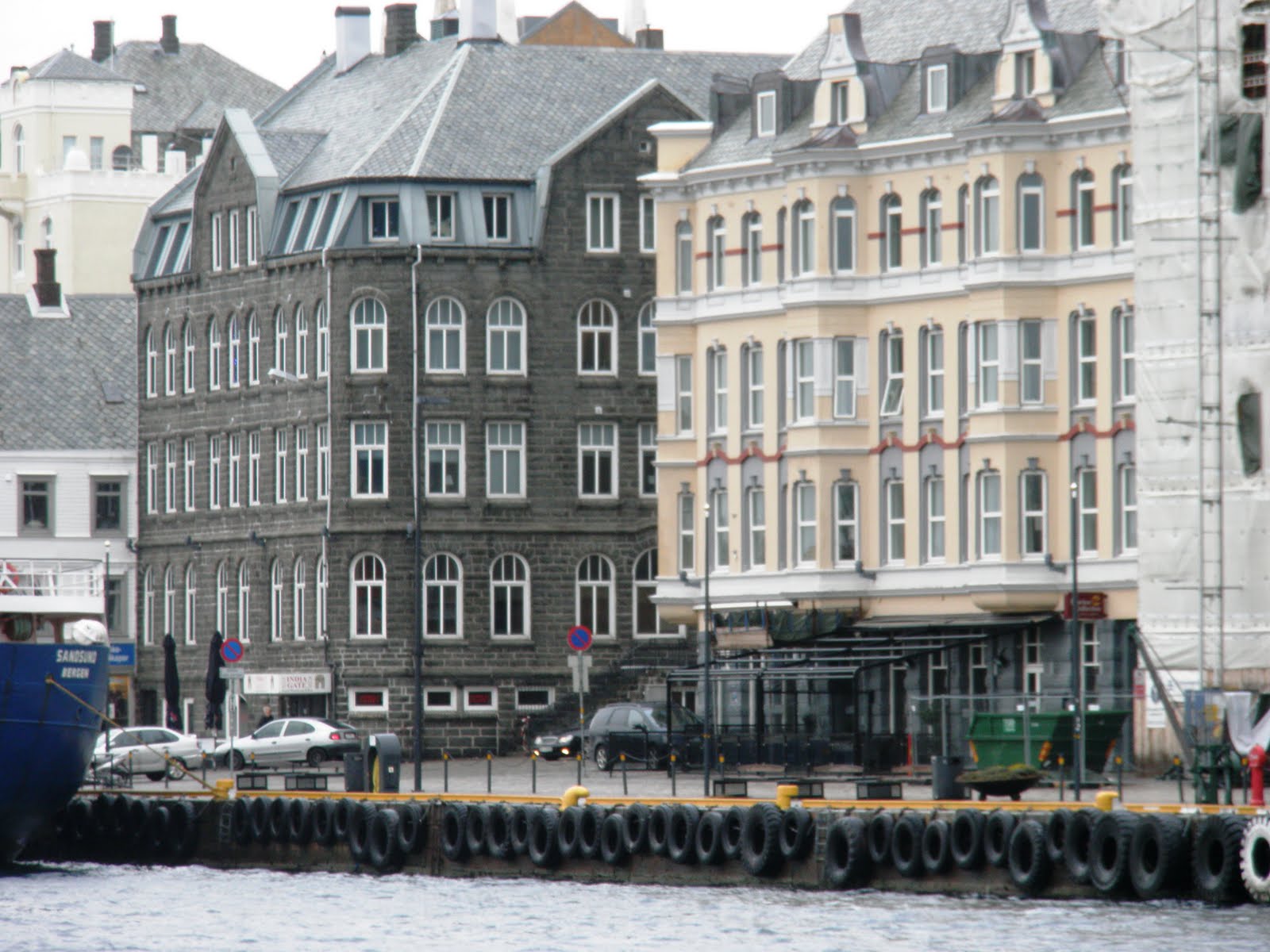
The wind buffeted us about and rearranged our clothing as we crossed back over the bridge and slipped into the shelter of the shopping streets again. Old photographs of Haugesund show Haraldsgate as a row of attractive timber buildings but over the years some of these have disappeared and have been sadly replaced with later inappropriate concrete and glass additions, a bit like any modern English town scarred forever by 1960s town planners. A lot of the wooden buildings looked in need of some urgent attention after the winter offensive had attacked the external finishes and the timbers. At home I like to paint the woodwork on the house every ten years or so whether it needs it or not but here I expect it is an annual chore.
It was still light and dry so we went on a rather pointless walk to a pretty church and then returned to the warmth of the hotel via the waterfront. We opened the wine and I had a second Norwegian beer, taking care to enjoy every expensive drop and when the waffle machine was wheeled into action at three o’clock we were first in the queue at the trough of batter mix and prepared ourselves a tasty snack.
On the top floor of the hotel there was a fitness centre and relaxation room so in the late afternoon we planned to sweat off the calories from the waffles in the sauna. We had the place to ourselves which was nice but overall it was a disappointing experience because even at maximum heat the temperature was only marginally warmer than I generally like my front room to be on a winter’s day. It certainly wasn’t making us sweat or casting off calories so we stayed for a short while, played on the fitness equipment for an even shorter while and then went back to our room where we sat and listened to the rain steadily falling. We finished the Norwegian beer and I instinctively knew that I should have bought more.
Our second evening buffet at the hotel Amanda was sadly not as good as the first, we had planned to make ourselves a prawn cocktail but without prawns this just wasn’t possible and there was no hot meat selection tonight either so we had to make do with something very similar to breakfast but without the eggs and bacon. Tonight the dining room was busy with Norwegian guests most of whom looked as though they were attending a tribute band retro rock concert, especially the men with their pony tails and platted beards. We were the only English people in the hotel and the Norwegians treated us with a sort of arms length curiosity because they were probably wondering what on earth we were doing there.
It was pouring with rain now so this ruled out any evening walk option so instead we made ourselves comfortable in the lounge, claimed possession of the television remote controller which put us in charge of channel selection and choose an English speaking film. Some Norwegian guests turned up but didn’t stay and this time unlike the Scott of the Antarctic arriving second at the south pole after the Norwegian Roald Amudsen, this time the English were there first and we were staying put.
By the end of the movie it had stopped raining but we were warm and comfortable and after a few glasses of wine we were had no real enthusiasm for stepping outside again today so we called it a day and went to bed worrying about tomorrow’s weather.