Showing posts with label Amorgos Chora. Show all posts

Sunday, 30 October 2011

Greece 2011, Katapola and the Monastery of Panagia Hozoviotissa


The plan today was to visit the Byzantine monastery of Panagia Hozoviotissa on the other side of the island which we had almost visited on our previous stay in Katapola. I say almost because although we made the bus ride and climbed a mountain of steps to get there we fell foul of the strict dress code and weren’t allowed in on account of the fact that we were wearing shorts. This time we were taking no chances so packed extra long sleeved shirts, shawls and trousers and after breakfast on the terrace set off for the bus stop.

As we walked we passed an old islander on a mule and it was obvious that he was going about his day and his work on his chosen form of transport. I got to thinking about how infrequently you see this now, much less even than when I first started to visit the Greek islands over twenty-five years ago and I realised that soon this will be a thing of the past. When this generation has gone it is likely that no one will continue to use donkeys for anything other than equine amusement. I felt glad that I had been there in time to see this and felt disappointed for those who will come after me and won’t.

We arrived at the bus stop in time but we needn’t have bothered as there was no bus driver because he was working to his own version of GMT, that’s Greek Maybe Time, and we had to wait twenty minutes after the scheduled departure before he arrived for work and warmed up the engine and the hydraulics before easing out of the car park to begin the journey.

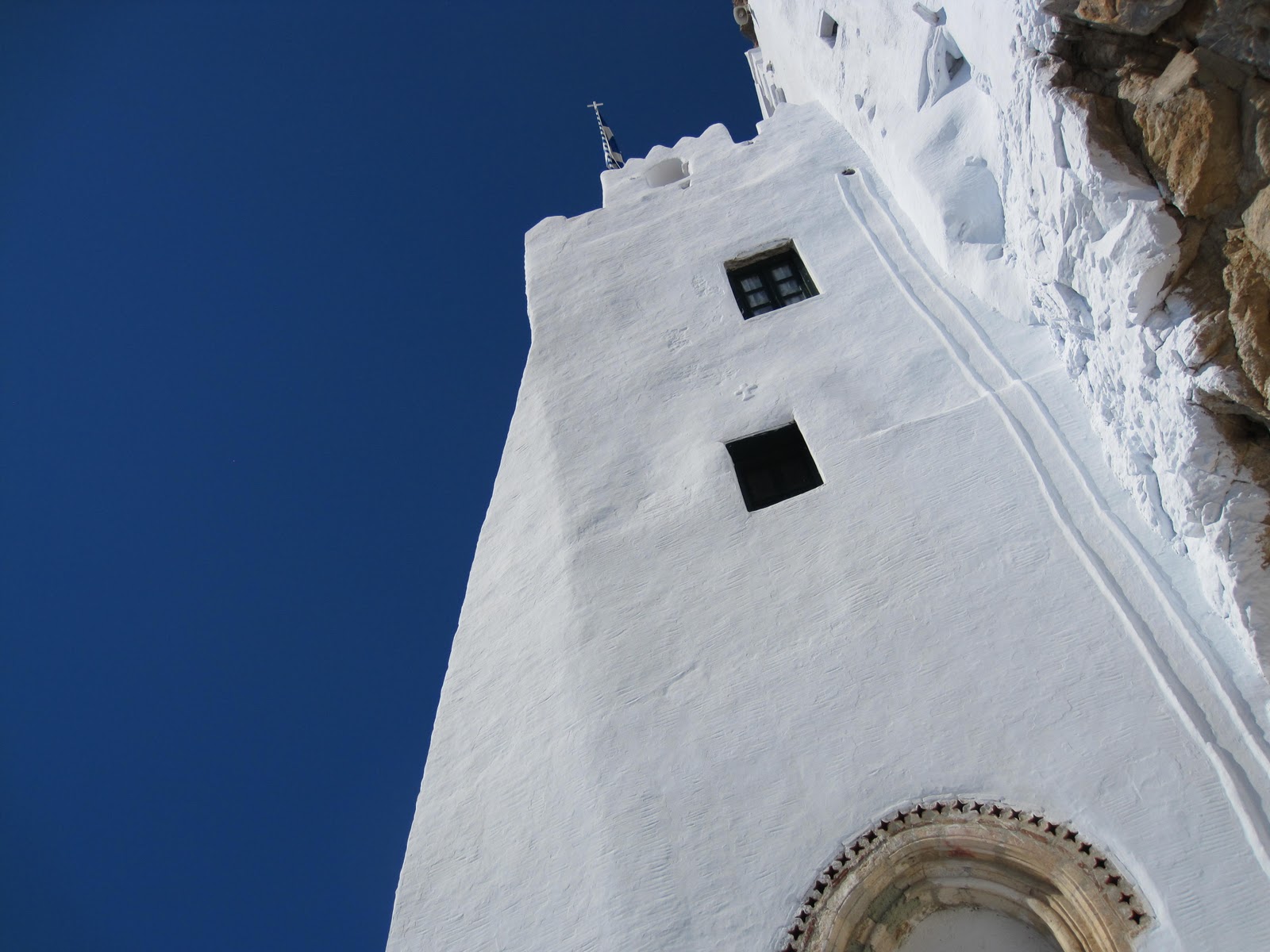
The bus dropped us off by the side of the road and there was a short walk to the car park of the monastery and then a gruelling climb up an uneven path which clung to the side of the mountain overlooking a stunning blue sea and which took us eventually to the entrance of the startling white building set against the contrast of the age streaked grey and tan rocks. The monastery is built in a most improbable location, on the side of and into an inhospitable mountain but it was a good choice if all they wanted was solitude and peace and quiet because there are no neighbours to worry about.

We were slightly irritated to see that this year there was a selection of clothing available to borrow for those who didn’t meet the dress code – it certainly wasn’t there two years ago. Anyway we changed into our appropriate clothes and climbed the final steps to the entrance where a young man assessed our appearance and, satisfied that we were presentable, allowed us in.

It had been a long walk just to visit a few tiny rooms and it didn’t take long to make our way through a couple of anti-chambers and then the main chapel smelling of incense and adorned with icons and pictures of old priests and decorated with cloth of vibrant green and blood red with gold brading. It was all over rather quickly and the longest part of the visit was a minute or two in room on the way out where a priest handed out loukoumi and a glass of special raki which was for sale in a small display case in the corner. Finally we visited a tiny museum displaying robes, manuscripts and religious artefacts and then we were shown back out into the sunlight and took the path back down to the bus stop.

On the way back we were ready for a second visit to the Chora where we ambled through the corkscrew streets returning several times to exactly the same place passing by several churches, the castle, blue doors, blue sky, shady vines and friendly cafés and I knew that this was my kind of town. The Chora is rather like a hippie time-warp, slow, lazy, faded and bleached, pot plants struggling in the midday sun and appropriately slow mood music in the tavernas and bars – it reminded me of a favourite pair of old denim jeans and my battered blue t-shirt that I am reluctant to throw away. In and around the tavernas there were lazy cats, which in between trying to look cute for diners with leftovers were concentrating on looking for a shady spot and simply snoozing the day away.


Saturday, 29 October 2011

Greece 2011, Katapola and the Chora (Amorgos)


Katapola was tranquil, peaceful and perfect and at this precise time might possibly have been the most wonderful place on earth and we looked forward to our three days of perfection because apart from concrete, mobile phones and air conditioning this place probably hasn’t changed a great deal in a thousand years.

We were surprised to see the Express Skopelitis ferry in the harbour because it was supposed to be sailing today and later someone told us that it had a problem with its certificate of seaworthiness and had lost its licence to operate. To make matters worse another ferry had failed to turn up and there was a lot of activity at the ferry booking office where the clerk was patiently trying to rearrange people’s disrupted travel itineraries. I mention this because in five day’s time we were due to sail on the Express Skopelitis ourselves and I began to wonder if we might have a problem but then Kim reminded me that five days is a long time in Greece so for the time being we thought no more about it.

First we walked around the rather untidy beach and collected more debris and Kim was by now so enthusiastic about the project I had to insist that she show some restraint because the she was collecting far more than we could ever realistically take back home in our luggage if we were to take our clothes back with us as well. The stroll took us around to the northern side of the bay and after we had walked through the streets and alleys we stopped for refreshment in the shade and agreed that for the remainder of the afternoon we would take a bus back to the Chora on the way back to the top of the mountain.

The Chora cannot be seen from the sea or from the harbour and this is where, in the past, Amorgans lived, safe from the sea and from hostile attack. From the outside it doesn’t look especially promising but once inside the walls of the town it is a different matter altogether. The town turns in on itself in an introspective sort of way and inside there were narrow shady streets and lots of traditional cafés and tavernas. It was a lazy place where time goes by slowly and no one is in a particular hurry about anything. If this was Naxos or Ios the Chora would have been teeming with shops and fast food places but this was a local town for local people and completely unspoilt by the retinue of tourist shops that can be found on more popular islands.

We explored the streets and in a very stiff breeze climbed to the very top to the redundant windmills that overlook the town and the Venetian castle that is built on top of a rocky outcrop that soars above it and its mass of dazzling white buildings.

Descending through the mazy streets and alleys there was time for a drink in the main square where old locals were beginning to gather for an end of day chat. I wondered where all the young people were and I think answered my own question – Athens probably.

There was a noticeable absence of English travellers but by contrast there were a lot of French people on Amorgos because this island was one of the locations for the Luc Besson film ‘Le Grande Bleu’ which the French rave about but which turns out to be one of those hard to understand surrealist French non-event movies that goes around in ever decreasing self indulgent circles until it finally disappears up its own aperture.

After we had taken the bus back and returned to the village we found a dusty mini-market because we wanted to buy some wine. It was surprisingly expensive and the information on the labels hard to interpret but at the back of the shop a French couple were passing judgement on a home-made red poured from a plastic bottle. They declared it to be acceptable so we agreed that if it was good enough for them then it would be perfect for us so we purchased a bottle and took it back to the room and sat on the balcony for a couple of hours and sorted through the driftwood in a sort of quality control process.

We waited now until nearly sunset time and then talk a walk along the southern shore of the harbour, past an inevitable white church and an unnamed statue where Kim captured more stunning sunset pictures and then we strolled back to the village stopping in again at the ferry booking office for information. The clerk had clearly had a stressful day and wasn’t inclined to be too helpful but we gathered that she didn’t like the Skopelitis very much on account of the fact that it is heavily subsidised by the Greek government and she seemed to resent that. We decided to leave and return tomorrow when hopefully a good night’s sleep might have improved her demeanour.

We had been looking forward to eating at a taverna called ‘The Corner’ (for no other reason it seems than it is indeed on a corner) but the danger with going back to somewhere that you have been before and enjoyed is that it may not live up to expectations and unfortunately this was one of those occasions.

It was a family run place and waiting on the tables were a couple of young children, clearly their parents were oblivious to presidential decree No. 62/1998, which sets the minimum age for admission to employment, including children in family businesses, at 15 years. After the meal we visited the bakery to buy some calorie packed baklava to end the day and there was a young boy working there as well who served us with expert precision and we took the sticky purchase back to the hotel where we ate it on the balcony and washed it down with a final glass of local red wine from the plastic bottle.